Until recently, locals say, this smallest and least populous province of the Philippines was a peaceful backwater. But geography dictates that it is now on the frontline of the great power competition between the United States and China for dominance in the Asia-Pacific region. The islands sit on the southern edge of the Bashi Channel, a major shipping lane between the Philippines and Taiwan that connects the South China Sea with the Western Pacific.
This year’s exercises revealed how the U.S. and its Philippine ally intend to use ground-based anti-ship missiles as part of efforts to deny the Chinese navy access to the Western Pacific by making this waterway impassable in a conflict, Reuters reporting shows. These missiles could also be used to attack a Chinese fleet attempting to invade Taiwan or mount a blockade against the democratically governed island.
…
Recent Chinese maneuvers show how access to the Bashi Channel is critical for Beijing’s plans in the Pacific. In June, a powerful Chinese navy aircraft carrier battle group used this passage to enter the Western Pacific before launching an extended series of exercises south of Japan, according to Japanese military tracking data.
The language of Hegseth’s press conference in Manila is indicative of the openly aggressive face of US imperialism under Trump. Gone was any reference to what had been the political shibboleth of Washington in the Asia Pacific region: the defense of “freedom of navigation.” Hegseth spoke rather of “preparing for war,” using the phrase more than once. Every time Hegseth mentioned China he termed it “Communist China,” and spoke of its “aggression.” Hegseth referred to US Seventh fleet commander Admiral Samuel Paparo “and his war plans. Real war plans.”
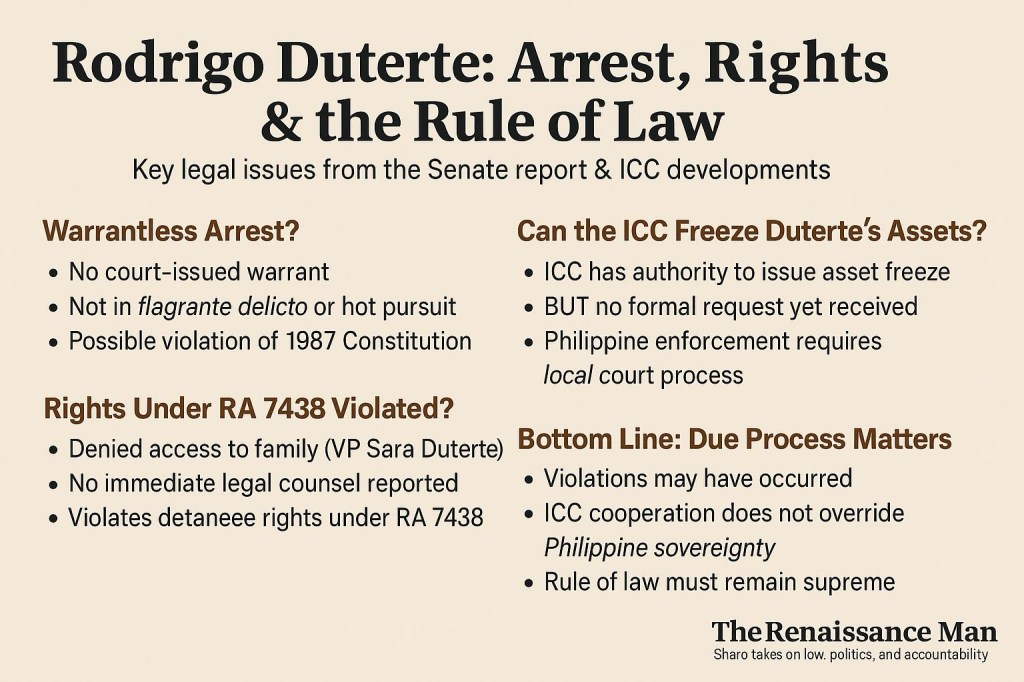
The recent release of the Senate Committee on Foreign Relations’ preliminary report on the arrest of former President Rodrigo Duterte has sent ripples through the Philippine legal and political landscape. Chaired by Senator Imee Marcos, the report outlines what it calls “glaring violations” of constitutional rights, procedural lapses, and questionable coordination between the Philippine government and the International Criminal Court (ICC).
As for President Marcos, he may have a solid plan to neutralize the Dutertes but it is the anguish of ordinary citizens reeling from high prices and low wages that he should be worried about. Even Vice President Sara Duterte is aware that the concern of the average voter is the economic crisis, which is why her arrival statement at The Hague when she visited her father focused on the need to address poverty, hunger, and joblessness in the Philippines. In other words, the most serious threat to the Marcos presidency is its own failure to fulfill the campaign promise of bringing down the price of rice and other goods, uplift the conditions of working families, and provide adequate and affordable services to the people.
Less than a month after Duterte took office, then- Secretary of State John Kerry announced a $32 million weapons and training package specifically to support the Philippine National Police. He made no mention of Duterte’s numerous threats to weaponize law enforcement on the campaign trail, or the fact that 239 suspected drug users had already been killed by police without due process at that point.
Three years ago, the most powerful political families in the Philippines joined hands to secure the nation’s biggest election victory in four decades. Now they are locked in a feud that threatens to derail one of Asia’s economic growth stars.
In dramatic events on Tuesday, Philippine President Ferdinand Marcos Jr.’s government arrested and deported his predecessor Rodrigo Duterte to face the International Criminal Court in The Hague. The move came just over a month after the impeachment of his daughter, Vice President Sara Duterte, by allies of Marcos. A Senate trial, which would determine whether she gets removed from office, is scheduled to begin in July.
Sara Duterte, left, with Ferdinand Marcos Jr. in 2022. Photographer: Ezra Acayan/Getty ImagesRead More »
The recent arrest of former Philippine President Rodrigo Duterte has sparked discussions about the legal processes involved, particularly concerning the roles of the International Criminal Court (ICC) and Interpol. Understanding these mechanisms is crucial in assessing the implications for Duterte’s case.
The Philippine STAR reported that presidential press officer Claire Castro brought up the idea at the tri-committee hearing on fake news, saying that forming another regulatory body for such could help fight the proliferation of fake news on the Internet.



 Ms. Cat’s Chronicles
You must be logged in to post a comment.