Philippines’ ‘assertive transparency’ strategy is causing them to miss out economically

The Philippines is going all in with the United States and bracing itself against lost Chinese largesse. President Ferdinand Marcos Jnr will fly to Washington next month to attend the US-Japan-Philippines trilateral leaders’ summit. It will be his fourth visit to the US since taking office as president less than two years ago.

South China Sea: Philippines must softly manage disputes or miss out economically

Previously:

PH: Compared To China, US Trade, Investment Offers Laughable + More

SCS: The Office of Naval Research funded Stanford’s GKC

PH: Compared To China, US Trade, Investment Offers Laughable + More

Compared To China, US Trade, Investment Offers Laughable

On the other hand, the BRI (Belt and Road Initiative) donations of China alone that are reality– Chico River Irrigation Pump, Davao Bucana Bridge, Estrella-Pantaleon and Binondo-Intramuros Bridge, the ongoing Kaliwa Dam Project that would provide 600/mld (million liters per day) to drying Metro-Manila and hundreds other projects– already count billions of dollars, not to mention private investments like DITO Telecoms’ $ 3.9 billion investment in our telecom sector.

Related:

Read More »

PH ignored China’s proposals on sea row

Original Source

The Philippine government has not acted upon several concept papers that China submitted almost a year ago that proposed ways to normalize the situation in disputed areas of the South China Sea, a ranking Chinese official said over the weekend.

PH ignored China’s proposals on sea row

Previously:

4 Philippine Sailors Injured, 2 Vessels Damaged in Chinese Attempt to Block Second Thomas Shoal Resupply

Is the Philippines becoming a US ‘proxy’ against Beijing in the South China Sea?

Is the Philippines becoming a US ‘proxy’ against Beijing in the South China Sea?

‘The ants that get trampled on’

Not everyone agrees with drawing closer to the US, however, and they warn about the Philippines turning into a “proxy” for American interests. The president’s own sister Imee, a senator, told ANC Digital earlier this month that “China will always be our neighbour, we have no fight with them, let’s not get dragged into a fight that’s not our own.”

Anna Rosario Malindog-Uy, director of the pro-China Asian Century Philippines Strategic Studies Institute, wrote in the Manila Times on February 10 that “agreements such as the EDCA, the VFA and the Mutual Defence Treaty have not only cemented the US military presence and influence in the Philippines but also, most importantly, exemplified the Philippines’ dependence on the US in the military and defence sector.”

Teresita Ang See, former president of the Philippine Association for Chinese Studies and currently part of its advisory council, told This Week in Asia: “Filipinos in general condemn China’s action. But many also understand that China’s assertiveness is in response to US, Japanese and Australian provocations and increasing military presence in the Philippines.”

She warned that “we are fighting a proxy war between the US and China and in the end we will be the ants that get trampled upon”.

H/T: Johnsonwkchoi

Related:

Responding to the Catholic Bishops

Philippines counts the cost of tough South China Sea stance against Beijing

Philippines counts the cost of tough South China Sea stance against Beijing

Philippines counts the cost of tough South China Sea stance against Beijing

The Philippines has become a laboratory in responding to Beijing on the South China Sea row, taking the most risk but showing inconsistency and underwhelming results thus far. Its predicament explains why other Southeast Asian claimant states remain unlikely to follow its lead. The tepid reaction to Manila’s pitch for an Asean claimants-only Code of Conduct is indicative.

As had happened in the past, lost economic opportunities and further erosion of Manila’s position in the flashpoint, relative to other disputants, may lead to a possible policy reversal in handling the maritime tiff come the 2028 presidential election.

Last year, the Philippines began to expose China’s illicit actions in the disputed waters. It inserted reporters in routine patrols and resupply sorties to document interference by the Chinese coastguard and maritime militia ships. The idea is to rally local and international support and impose reputational costs on Beijing. [Project Myoushu AKA Transparency Initiative]

This approach made strides in rousing public backing for Manila’s defence build-up, a stronger alliance with the United States, and a tougher stance against China. However, it also contributed to polarising domestic politics, affecting people-to-people ties and diminishing Chinese economic interest in the Philippines. Meanwhile, Beijing remains unmoved, weathering reputational costs and continuing to wield a capacity for escalation in the South China Sea.

During Xi’s visit to Hanoi last December, both sides vowed to upgrade the Kunming-Haiphong rail line. In contrast, Chinese funding for three rail projects discussed during the previous Duterte government is already dead in the water. China is unlikely to become a strong partner for President Ferdinand Marcos Jnr’s Build Better More infrastructure programme.

Losses in the tourism sector have also become evident. In 2019, before the pandemic, China was the Philippines’ fastest-growing tourist market, with more than 1.7 million arrivals, or a 21.1 per cent market share, just behind South Korea. Last year, as countries in Asia raced to benefit from the return of Chinese tourists, the Philippines only welcomed over 260,000 tourists from China, with the market share shrinking to just 4.84 per cent.

Ironically, for all the talk about Duterte’s China policy as appeasement, it was under his watch that the Philippines made the biggest upgrade in infrastructure in the Spratlys since the 1970s. He also invested in modernising the country’s military, procuring modern frigates from South Korea, multirole response vessels from Japan and cruise missiles from India. All these happened while relations with China remained stable.

Another irony is that while Manila celebrates every resupply mission to the Second Thomas Shoal that successfully eluded the Chinese blockade, Vietnam is busy doing substantial reclamation on its Spratly outposts and gearing for a potential second airfield, with reportedly little interference from Beijing. [Bueller?]

These should offer plenty of insights as the strategy of the Philippines over the maritime squabble evolves.

Indonesia’s feared ex-general Prabowo claims victory in presidential election + Notes

Indonesia’s feared ex-general Prabowo claims victory in presidential election

But the likely victory of Prabowo — an ex-general who was kicked out from the army and subjected to a two-decade ban from the U.S. over human rights violations — raises fears of the world’s third-largest democracy sliding backward into authoritarian rule.

Related:

3 things you should know about Indonesia’s presidential elections

Continuity and its risks


Prabowo is expected to largely continue the policies of President Widodo, or “Jokowi,” as Indonesians call him. President Widodo is not up for reelection as he’s serving his final term.

Through his two five-year terms, Indonesia’s economy — Southeast Asia’s largest — has grown at about 5% a year. His infrastructure building, cash and food assistance to the poor and health and education policies have been popular.

Indonesia is the world’s largest producer of nickel, used in making electric vehicle batteries, and Jokowi has barred the export of raw nickel, to help Indonesia move up the value chain from mining to manufacturing.

Prabowo is Suharto’s son-in-law. He received training in the 1980s from the U.S. military at Fort Benning, Ga. (now Fort Moore) and Fort Bragg, N.C. (now Fort Liberty).

Indonesia’s presidential election emerges as key battleground in US-China rivalry

Read More »

Prospects shaky for Philippines’ government and communist peace talks

CIA World Factbook

Prospects shaky for Philippines’ government and communist peace talks

Manila, Philippines – Fighting continues between the Philippine military and communist rebels despite an agreement to resume peace talks this month in an effort to end the world’s longest-running communist armed rebellion.

President Ferdinand Marcos Jr surprised many when, in November, his government announced an agreement with the National Democratic Front (NDF), the rebels’ political wing, to restart peace talks that his predecessor Rodrigo Duterte had ended shortly after taking office.

Considering that the Millennium Challenge Corporation just gave the Philippines a grant, I doubt that they’ll see any positive economic reforms. MCC’s support for “democratic reform” is akin to the “democracy promotion” advanced by the National Endowment for Democracy. My guess is that it’s to keep the Philippines in line with US foreign policy against China.

Philippines: US moving to protect their Puppet BBM, says China is trying to destabilize him thru Duterte + China Challenged

rhk111’s Channel

US moving to protect their Puppet BBM, says China is trying to destabilize him thru Duterte

The comparison between Zelensky and BBM is very appropriate, not only are they suspected to be both Cocaine Addicts, but they are also now Puppets of the US who are willing to sacrifice their Country in War for the sake of serving the Interests of the US.

I am currently in the process of proofreading my paper and making necessary corrections. I hope to have it completed by Monday. If and when it gets updated, I’ll upload it here with my other documents.

Related:

China Challenged

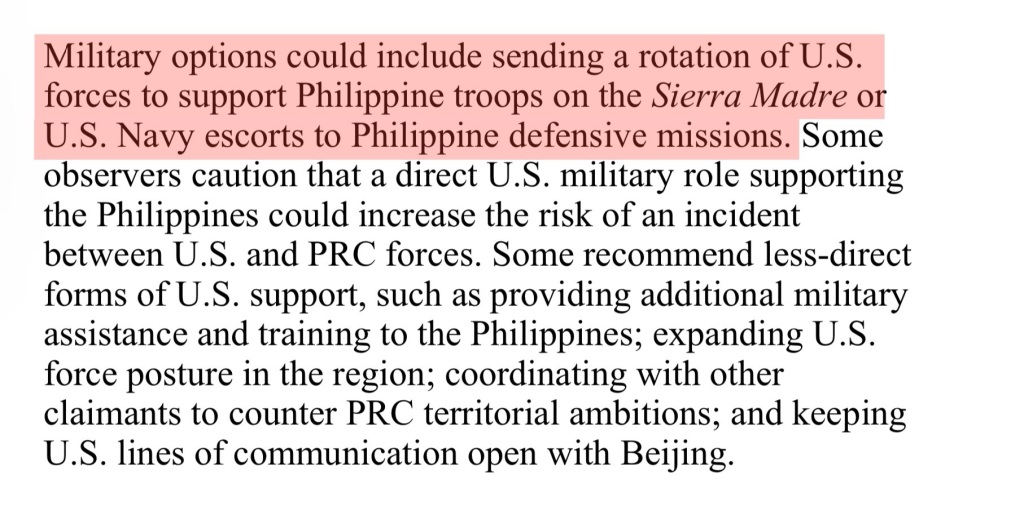
Report to Congress on China-Philippines Tensions in the South China Sea

The following is the Jan. 23, 2024, Congressional Research Service In Focus report, China-Philippines Tensions in the South China Sea.

Report to Congress on China-Philippines Tensions in the South China Sea

I’ll be updating this, soon: Philippines Game Changer – Project Myoushu – South China Sea Analysis. You can find it, here, as well. I just hope that they don’t end up stationing any US troops at the BRP Sierra Madre (see videos, below)!

Related:

Read More »

US Primes the Philippines for War on the People’s Republic of China

20-11-2023: In a short space of time, the Philippines has been transformed from a friendly neighbour of the People’s Republic of China (PRC), to one which is being pushed in the direction of a hostile adversary. The election of President Ferdinand “Bong Bong” Marcos Jr has been the catalyst for the tilt towards the US hegemon and away from an ally of the PRC and of the Russian Federation, which was cultivated by the former Filipino President Rodrigo Duterte. In fact, it is potentially much worse than just a shift in foreign policy. As The New Atlas points out, the Republic of the Philippines is being shaped into being South-East Asia’s “Ukraine” – a hapless Nazified proxy of US imperialism destroying itself in a failed war on Russia.[1] However, this rapid about turn is not being implemented in the Philippines without opposition, seemingly from such allies of the former President Duterte as current Vice President Sara Duterte (the daughter of Rodrigo Duterte) and former President Gloria Macapagal-Arroyo. While it is the case that Rodrigo Duterte and Sara Duterte have not always been side by side in politics, it does appear as though the Philippine elite are dividing on the pro-US course of Marcos Jr.

US Primes the Philippines for War on the People’s Republic of China