

Tag: Rome Statute
Former President Duterte and the farce of international justice
Due Process on Trial: The Duterte Arrest, the Rule of Law and Sovereignty + More
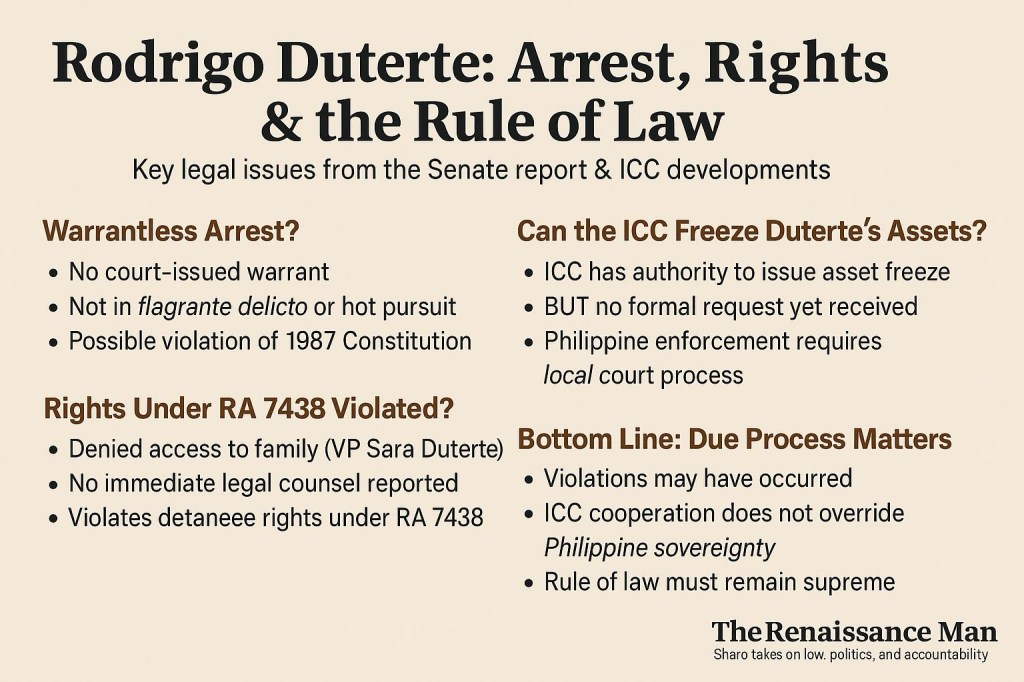
The recent release of the Senate Committee on Foreign Relations’ preliminary report on the arrest of former President Rodrigo Duterte has sent ripples through the Philippine legal and political landscape. Chaired by Senator Imee Marcos, the report outlines what it calls “glaring violations” of constitutional rights, procedural lapses, and questionable coordination between the Philippine government and the International Criminal Court (ICC).
Due Process on Trial: The Duterte Arrest, the Rule of Law and Sovereignty
Related:
Can Philippine President Marcos Survive the Wrath of the Dutertes? by Mong Palatino
As for President Marcos, he may have a solid plan to neutralize the Dutertes but it is the anguish of ordinary citizens reeling from high prices and low wages that he should be worried about. Even Vice President Sara Duterte is aware that the concern of the average voter is the economic crisis, which is why her arrival statement at The Hague when she visited her father focused on the need to address poverty, hunger, and joblessness in the Philippines. In other words, the most serious threat to the Marcos presidency is its own failure to fulfill the campaign promise of bringing down the price of rice and other goods, uplift the conditions of working families, and provide adequate and affordable services to the people.
Document: Arrest of Rodrigo Duterte
Duterte’s Arrest: Interpol Red Notice and ICC Procedural Implications

The recent arrest of former Philippine President Rodrigo Duterte has sparked discussions about the legal processes involved, particularly concerning the roles of the International Criminal Court (ICC) and Interpol. Understanding these mechanisms is crucial in assessing the implications for Duterte’s case.
Duterte’s Arrest: Interpol Red Notice and ICC Procedural Implications
“You Have Been Warned”: Republican Senators Threaten the ICC Prosecutor over Possible Israel Arrest Warrants
Read the full letter, obtained by Zeteo, which threatens sanctions in defense of Netanyahu.
Related:
ICC’s Putin arrest warrant based on State Dept-funded report that debunked itself
Israeli and US Leaders Must Be Held Accountable for the Genocide of Palestinians
Netanyahu and Gallant are committing genocide in Gaza. Biden and Blinken are aiding and abetting Israeli genocide.
Israeli and US Leaders Must Be Held Accountable for the Genocide of Palestinians
Wishful thinking…
Without the 2014 coup, Ukraine would be living in peace
This is the first of three parts of an interview that Oleg Nesterenko, President of the CCIE, gave to the publication “L’Éclaireur des Alpes”. This part discusses the responsibility of the 2014 Maidan coup for the tragic events that plunged Ukraine into war.
Without the 2014 coup, Ukraine would be living in peace
Ramaphosa arrives in Poland ahead of Russia-Ukraine Peace Mission
President Cyril Ramaphosa has arrived in Warsaw Airport in Poland ahead of the Peace Mission to Russia and Ukraine by seven African leaders.
Ramaphosa arrives in Poland ahead of Russia-Ukraine Peace Mission
Video via 2nacheki
Related:
African leaders to propose ‘confidence building measures’ to Russia, Ukraine
Those measures could include a Russian troop pull-back, removal of tactical nuclear weapons from Belarus, suspension of implementation of an International Criminal Court arrest warrant targeting Putin, and sanctions relief.
[2002] U.S. Announces Intent Not to Ratify International Criminal Court Treaty
U.S. Announces Intent Not to Ratify International Criminal Court Treaty
On May 6, 2002, the Bush Administration announced that the United States does not intend to become a party to the Rome Statute of the International Criminal Court. John Bolton, the Under Secretary of State for Arms Control and International Security, sent a letter to Kofi Annan, the Secretary-General of the United Nations, stating that “the United States does not intend to become a party to the treaty,” and that, “[a]ccordingly, the United States has no legal obligations arising from its signature on December 31, 2000.” [1]
…
While the policy merits of the Bush Administration’s announcement are of course open to debate, the announcement appears to be consistent with international law. There is nothing in international law that obligates a signatory to a treaty to become a party to the treaty, [6] and the Rome Statute itself (in Article 125) states that it is “subject to ratification, acceptance or approval by signatory States.” In addition, Article 18 of the Vienna Convention on the Law of Treaties provides that, upon signing a treaty, a nation is “obliged to refrain from acts which would defeat the object and purpose” of the treaty “until it shall have made its intention clear not to become a party to the treaty.” The Vienna Convention thus contemplates that nations may announce an intent not to ratify a treaty after signing it.
Related:
International Criminal Court: Letter to UN Secretary General Kofi Annan
Secretary Rumsfeld Statement On The ICC Treaty
American Foreign Policy and the International Criminal Court
President Clinton Statement on Signature of the International Criminal Court Treaty
US paranoid about Russia-China summit
The arrest warrant issued by the International Criminal Court against Vladimir Putin can only be seen as a publicity stunt by the Anglo-Saxon clique, with the US leading from the rear. Ironically, though, the ICC acted on the eve of the 20th anniversary of the Anglo-Saxon invasion of Iraq in 2003, which led to horrific war crimes but the “judges” at Hague slept over it. Both Washington and London admit today that the 2003 invasion was illegal — based on trumped up allegations against Saddam Hussein.
US paranoid about Russia-China summit
 Ms. Cat’s Chronicles
You must be logged in to post a comment.