
Philippines Could Receive $2.5 Billion in Security Aid from U.S. Defense Bill
Read More »Tag: Romeo Brawner Jr
A Narrow Pacific Waterway is at the Heart of U.S. Plans to Choke China’s Vast Navy +
Reuters reprint: A Narrow Pacific Waterway is at the Heart of U.S. Plans to Choke China’s Vast Navy
Until recently, locals say, this smallest and least populous province of the Philippines was a peaceful backwater. But geography dictates that it is now on the frontline of the great power competition between the United States and China for dominance in the Asia-Pacific region. The islands sit on the southern edge of the Bashi Channel, a major shipping lane between the Philippines and Taiwan that connects the South China Sea with the Western Pacific.
This year’s exercises revealed how the U.S. and its Philippine ally intend to use ground-based anti-ship missiles as part of efforts to deny the Chinese navy access to the Western Pacific by making this waterway impassable in a conflict, Reuters reporting shows. These missiles could also be used to attack a Chinese fleet attempting to invade Taiwan or mount a blockade against the democratically governed island.
…
Recent Chinese maneuvers show how access to the Bashi Channel is critical for Beijing’s plans in the Pacific. In June, a powerful Chinese navy aircraft carrier battle group used this passage to enter the Western Pacific before launching an extended series of exercises south of Japan, according to Japanese military tracking data.
Related:
Read More »Capes, Cameras, and the Cult of Visibility
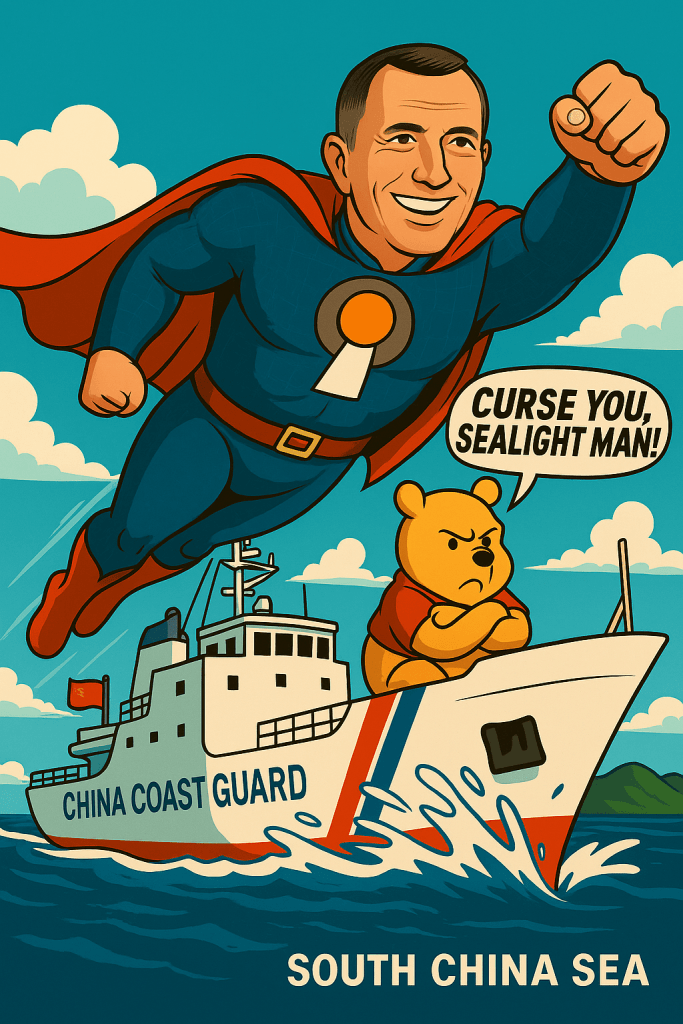
Capes, Cameras, and the Cult of Visibility: The SeaLight Crusade as White Savior Theater
By Tina Antonis
The South China Sea is more than a maritime dispute—it’s a theater of narrative warfare. While headlines focus on Chinese aggression and Philippine resistance, a quieter campaign unfolds in the background: one of satellite feeds, curated imagery, and Pentagon-backed storytelling. At the center of this effort is SeaLight, a project that claims to illuminate truth but often casts shadows of its own.
As explored in my article at Antiwar.com, SeaLight doesn’t just document—it performs. It reframes geopolitical tension through moral spectacle, positioning its creators as heroic arbiters of transparency. But when the messenger wears a cape and the funding flows from defense budgets, we must ask: is this clarity, or choreography?
Stage Left: The White Savior Enters
In the comic-strip cosmology of Ray Powell’s SeaLight project, transparency wears a cape. Clad in heroic postures and backed by satellite imagery, Powell casts himself as the guardian of maritime morality—unarmed, except with satellite feeds, theatrical flair, and strategic messaging.
Yet beneath the cartoon and Pentagon-funded optics lies a familiar archetype: the white savior, rebranded for the South China Sea.
China Is Imperialist? Says Who?
Calling China a “maritime occupier,” Powell positions himself as a bulwark against aggression. But that moral pose collapses under scrutiny. He speaks for a country with over 800 foreign military installations and a documented history of over 250 military interventions since 1991—wars in Iraq, Afghanistan, Libya, Syria, Somalia, and dozens more, all under the banner of peace, freedom, or preemption.
By comparison, China’s post–Cold War footprint includes no sustained foreign occupations and only scattered border conflicts and peacekeeping missions. The imbalance is staggering. And Powell’s framing doesn’t just ignore it—it performs around it.
As David Vine argues in The United States of War, this vast base empire is not a passive network—it’s an architecture of perpetual war. These outposts make military engagement not an exception but a structural habit, cloaked in strategic necessity and sold as global stewardship.
Powell’s cartoon rhetoric—calling China an occupier—obscures the scale of U.S. militarism. The term “occupation” is deployed not to analyze, but to project. When adversaries hold territory, it’s a crisis; when the U.S. spans the globe with armed installations, it’s policy.
Framing Conflict: The Optics of Consent
This isn’t irony. It’s performance. Powell’s language manufactures a moral frame for confrontation—costumed in transparency, but driven by escalation. The cape is literal. The conditioning is deliberate. And the stage is set for war.
SeaLight’s mission is not just visual documentation—it’s narrative warfare. As the Japan Times openly notes, its “chief weapon is photography, applied purposefully, generously and consistently over time.” These images—enhanced, curated, and distributed across media—are not neutral. They’re constructed to shape public perception, sway international opinion, and ultimately manufacture consent for confrontation.
Assertive transparency becomes a kind of ideological scaffolding—a stage on which geopolitical tension is dramatized, simplified, and morally polarized. The goal isn’t simply to reveal conflict; it’s to condition audiences for escalation.
And when the messenger dons a superhero’s cape, the spectacle transforms into something deeper: a story of rescue, of virtue, of intervention. This is not analysis—it’s soft propaganda dressed in heroic metaphor.
Consent for war doesn’t begin with missiles. It begins with mythmaking.
Philippines to receive 20 F-16 Block 70/72 fighter jets from the US as confrontations with China grow.
The timing of this approval is significant as the Philippines has been engaged in a series of escalating maritime confrontations with China over disputed territories in the South China Sea. U.S. officials, including Secretary of State Marco Rubio and Defense Secretary Pete Hegseth, have increasingly voiced support for Manila in countering Chinese maritime expansion. During his recent visit, Hegseth committed to “reestablish deterrence in the Indo-Pacific region,” calling attention to China’s growing assertiveness. Additionally, Philippine military leadership, including General Romeo Brawner, has publicly stated that a conflict in Taiwan would inevitably involve the Philippines, urging preparations for possible hostilities. Preparations for such scenarios have reportedly influenced the planning of joint U.S.-Philippine exercises, such as the annual “Balikatan” drills. These developments add urgency to the Philippine modernization program, of which the F-16 acquisition is a cornerstone.
Read More »
PH: SCS Reconnaissance, Typhon, CADC, Oil wars
West PH Sea: US Navy ship spotted near Scarborough amid China ‘patrol’
MANILA, Philippines — A United States Naval Ship (USNS) was spotted near the country’s landmass while China Coast Guard (CCG) was conducting what it considers as a patrol around Panatag (Scarborough) Shoal on Sunday morning, a West Philippine Sea monitor said.
Read More »
Philippine Army acquiring US missile system
Philippine Army acquiring US missile system
“It is planned to be acquired because we see its feasibility and its functionality in our concept of archipelagic defense implementation,” Philippine Army chief Lt. Gen. Roy Galido told a news conference.
“I’m happy to report to our fellow countrymen that your army is developing this capability for the interest of protecting our sovereignty,” he said, adding the total number to be acquired would depend on “economics.”
As a rule, it takes at least two or more years for the Philippine military to acquire a new weapons system from the planning stage, Galido said, adding it was not yet budgeted for 2025.
Brawner already announced that they wanted one, three months ago. Shortly afterward, the U.S. said that they were keeping the Typhon in the Philippines, at the Laoag International Airport. Will this be a second unit? The only new information that I’ve learned, is that it’ll take at least two years for them to officially acquire the Typhon. Why announce it, again? Except to provoke China?
Related:
What’s Really Going On In the South China Sea Between the Philippines and China
PH: The BongBong Rocket 🤭
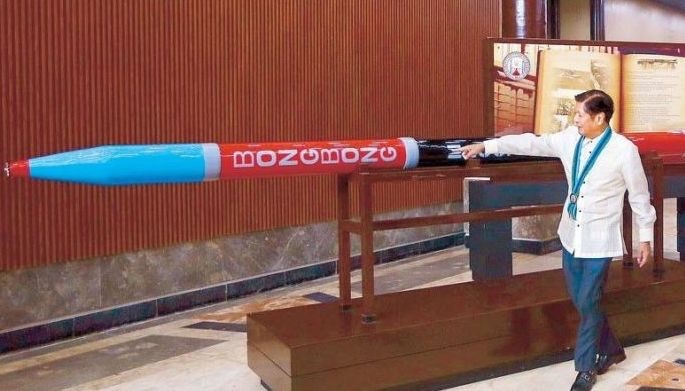
The Mystery of Marcos’ Rocket Program
Read More »’A Failed Project?’
The only VALID reason I could think of for all these “secrecy” or lack of transparency is that the program itself was NOT successful, and there are a number of ways that it could have failed. For one, the FAILURE or SUCCESS RATE of the launches were never published, and it’s possible that there were just too many launch failures, like the rockets exploding or veering off course at their launch pad or after launch, or even rockets not taking off at all. And even if the launches were successful, there is the issue of how accurate the rocket was in terms of hitting its target. If it ends up several hundreds or thousands of meters from its intended target, then it’s not very useful. And just like the Launch Rate, the Accuracy of the rockets were also never published.
What’s Really Going On In the South China Sea Between the Philippines and China
What’s Really Going On In the South China Sea Between the Philippines and China
by Tina Antonis
Maritime clashes between the Philippines and China had been mostly over the Philippines’ military outpost, BRP (BRP—Barko ng Republika ng Pilipinas, which translates to “Ship of the Republic of the Philippines”—the ship prefix for the Philippines) Sierra Madre, in the Spratly Islands, which is disputed by Brunei, China, Malaysia, the Philippines, Taiwan (a province of China, as recognized by the United Nations’ Resolution No. 2758), and Vietnam. The BRP Sierra Madre was intentionally run aground on a reef near the Second Thomas Shoal in the disputed Spratly Islands, in 1997, so that the Philippines could stake their territorial claim.
Read More »South China Sea: US troop aid may reassure Philippines but will prod China, analysts say
Has anyone realized that by disclosing the existence of “US Task Force Ayungin,” Biden admin implicitly recognized Philippines’ sovereignty over a disputed SCS feature?
Washington has never taken a position on SCS territories(but it has in ECS). This is a clear signal to China.*
South China Sea: US troop aid may reassure Philippines but will prod China, analysts say (archived)
The Philippines has said the US task force only offered support – in the form of intelligence and surveillance – and did not directly take part in its resupply missions to BRP Sierra Madre, the retired warship, but analysts suggested that China’s leadership could see it in a different light.
…
Zheng said the revelation about the American task force meant the US was likely to be more engaged in the drawn-out maritime conflicts in the region, even suggesting that Washington would “be the first to take part in the command and planning of Philippine maritime activities”.
…
Ding Duo, deputy director of the Centre for Oceans Law and Policy at the National Institute for South China Sea Studies in Hainan, said the presence of a special task force showed that Washington and Manila had long cooperated on resupply operations to Second Thomas Shoal.
…
“Such support emboldens the Philippines and is not conducive to China and the Philippines managing their differences,” Ding said. “The US involvement has also squeezed the political space for internal coordination and decision-making within the Philippines.”
…
He said it was also possible that American troops could be on Philippine ships and involved in front-line action “using a covert or concealed identity to participate in Philippine maritime operations” in future.
He said the US could “only intervene [in South China Sea disputes] in a covert manner and so it took the form of a task force”.
Related:
Read More »It’s officially published!

Read it at Antiwar.com or here with graphics. FYI, the “Ant” in Antonis is pronounced as 🐜.
 Ms. Cat’s Chronicles
You must be logged in to post a comment.