
Thitu Island is disputed by China, the Philippines, Taiwan, and Vietnam.
Read More »Tag: S. Rajaratnam School of International Studies
Philippines set to host second Typhon missile system, signalling Trump’s defence pledge + More
Philippines set to host second Typhon missile system, signalling Trump’s defence pledge
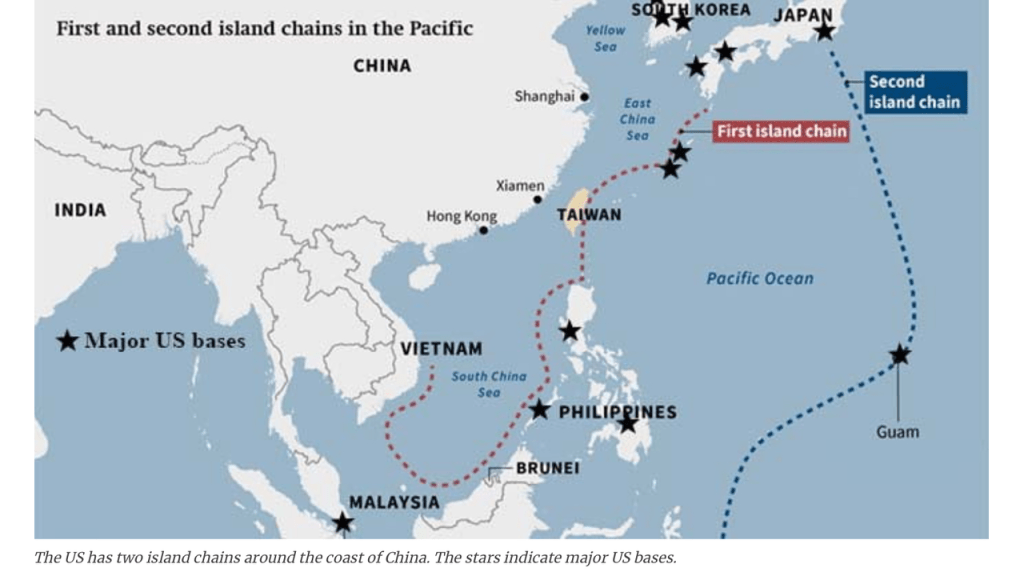
He added that the Typhon’s presence signalled renewed US commitment to the region, which would be further reinforced by separate visits to the Philippines by US Defence Secretary Pete Hegseth this week and Secretary of State Marco Rubio next month.
Read More »
US Keeps Missile System in Philippines as China Tensions Rise, Tests Wartime Deployment
MANILA (Reuters) – The United States has no immediate plans to withdraw a mid-range missile system deployed in the Philippines, despite Chinese demands, and is testing the feasibility of its use in a regional conflict, sources with knowledge of the matter said.
US Keeps Missile System in Philippines as China Tensions Rise, Tests Wartime Deployment
Previously:
Philippines aims to acquire Typhon missile launcher as regional arms race intensifies
Philippines aims to acquire Typhon missile launcher as regional arms race intensifies
China is against the deployment of the Typhon in the Philippines, which has been used in joint military exercises involving US troops
Philippines aims to acquire Typhon missile launcher as regional arms race intensifies
Related:
Foreign Ministry Spokesperson Lin Jian’s Regular Press Conference on August 30, 2024:
Bloomberg: The Philippines’ top military official said that the deployment of the US missile system in the country was mainly for training. China has been in the past said that the weapon system could be destabilizing. Does the Foreign Ministry have any comments on the recent comments by the Philippines’ military chief?
Lin Jian: On the US deployment of Mid-Range Capability missile system in the Philippines, China has made clear our opposition more than once. This move by the US and the Philippines incites geopolitical confrontation, escalates tensions in the region, and harms regional peace and stability. It has aroused high vigilance and concerns of countries in the region. The Philippines needs to have a clear understanding of the real intention of the US, respond to the common concerns of regional countries, avoid acting as the cat’s paw for the US at the expense of its own security interest, and quickly pull out the missile system as publicly pledged.
Why Are There Fears of War in the South China Sea?
South China Sea: Philippines’ anti-ship missile base puts Scarborough Shoal in cross hairs (more information)
What the article left out is; to shoot far, the Philippine military needs to see far. However, the Philippines don’t have any over-the-horizon (OTH) radar, military satellites, AWACS planes or other long-range ISR capabilities, to make use of the full range of the BrahMos missile. Without it the missile is limited to the range of its available ISR assets, which are measured in just dozens of kilometers.
However, if a BrahMos missile is ever launched against a long-range Chinese target, it will be easy to guess who would have supplied the essential Intelligence, Surveillance, and Reconnaissance (ISR) information and target identification to the Philippine military.
South China Sea: Philippines’ anti-ship missile base puts Scarborough Shoal in cross hairs
Even if the Philippines lacks the advanced communications, intelligence, and targeting systems needed to maximise the BrahMos’ capabilities, it could still leverage US support in these areas, Koh said, citing the sinking of Russia’s Moskva warship by Ukraine in 2022, which he said was achieved thanks to “targeting support provided by Kyiv’s allies, chiefly the Americans”.
The flagship of Russia’s Black Sea Fleet, the Moskva became the largest warship lost in combat since the second world war when it was hit by two Ukrainian Neptune anti-ship missiles in April 2022. US officials later told the media that the Pentagon had provided intelligence that led to the ship’s sinking.
For the Philippines, the BrahMos missiles are “significant game changers” [🙄], according to security strategist Chester Cabalza, president of the International Development and Security Cooperation think tank in Manila.
…
However, Don McLain Gill, an international-studies lecturer at De La Salle University in the Philippines, questioned whether the BrahMos purchase alone would deliver robust deterrence against China.
“It will be crucial for the BrahMos to be supplemented by efficient intelligence, surveillance, target-acquisition and reconnaissance, which is critical to track targets and ensure they can be used by command,” he said, warning Manila must invest further to maximise the missiles’ deterrent value.
Previously:
Philippines Builds First BrahMos Anti-Ship Missile Base Facing South China Sea
China’s top leaders adopt measured tone on Taiwan at Two Sessions meetings
China’s top leaders adopt measured tone on Taiwan at Two Sessions meetings
In his work report delivered on Tuesday (March 5), Premier Li Qiang only broadly restated China’s usual position on Taiwan, while Wang Huning – the Communist Party of China’s (CPC) fourth-ranked official – kept mention of cross-strait ties to a minimum in another report a day earlier.
Li said Beijing will “resolutely oppose separatist activities aimed at ‘Taiwan independence’ and external interference”, while promoting the “peaceful development of cross-strait relations” – language that has remained broadly similar to previous years’.
…
While it was unusual for “external interference” to feature in the work report, other Chinese leaders have used the term when addressing Taiwan policy in recent years, such as President Xi Jinping at the twice-a-decade party congress in October 2022.
…
Dr Li Nan, visiting senior research fellow at the East Asian Institute at the National University of Singapore, said the fact that the wording on Taiwan remained largely similar indicates that Beijing’s current Taiwan policy will continue, including with a heavier emphasis on deterrence.
…
Dr James Char, a research fellow at the S. Rajaratnam School of International Studies, said that, for now, the Chinese military will probably continue to stick to military operations below the threshold of war to achieve China’s national objectives.
4 Philippine Sailors Injured, 2 Vessels Damaged in Chinese Attempt to Block Second Thomas Shoal Resupply
As a result of the incident, Powell thinks that Manila “has the right to expect a more muscular response from its partners and allies.” After last year’s incidents, both the U.S. and Australia held joint maritime and aerial patrols with Philippine military forces in the South China Sea. The Philippines expects to hold more joint patrols with not only American and Australian forces, but also with countries such as France, Canada and Japan.
…
Yesterday, Philippine President BongBong Marcos vowed that the country would “push back” when its sovereignty was ignored in reference to China’s actions in the region during a speech in Australia. He further stressed that the Philippines’ stance on the South China Sea was guided by its interests, not at the “beck and call” of the United States.
BBM was at the Lowy Institute, a think tank funded by the Australian government, etc.
Related:
Philippines Budgets for a Permanent Base at Second Thomas Shoal
It’s Time to Build Combined Forward Operating Base Sierra Madre
Philippines Game Changer Analysis – Project Myoushu – South China Sea
Why China’s belt and road plan is facing threat of jihadist terrorism
Why China’s belt and road plan is facing threat of jihadist terrorism
Afghanistan and China share a 74km-long border along the mountainous Wakhan Corridor. At Beijing’s insistence, the Taliban relocated TIP militants from Badakhshan province, near the border, to other areas last year. However, some TIP elements are believed to have rebuilt their bases in Badakhshan.
Isis-K’s anti-China rhetoric may also be intended to attract Uygur militants to its fold. The more the Taliban regime curtail TIP activities, the greater the chances of Uygur militants gravitating towards Isis-K. According to a United Nations Security Council report, Isis-K has reached out to disgruntled fighters from other terrorist groups, and as many as 50 Uygur militants have joined it.
Notes for self:
- ISIS-K, likely supported by the US, is actively recruiting members from groups like TIP, ETIM, and Uygur extremists to target China’s Belt and Road Initiative.
- According to the Jamestown Foundation, a hawkish think tank, the Voice of Khorasan Magazine is produced by the al-Azaim Foundation for Media Production.
- It’s noteworthy that ISIS-K adopted a name reminiscent of Voice of America, a US-funded media outlet, which raises questions about potential symbolic connections.
China faces an increase in extremist threats in central Asia, US panel is told
China faces an increase in extremist threats in central Asia, US panel is told
Raffaello Pantucci, a senior fellow at Singapore’s S. Rajaratnam School of International Studies, said that the Islamic State Khorasan (Isis-K) had identified the perpetrator of the suicide bomb attack on worshippers in a mosque in the Afghan city of Kunduz in October as a Uygur.
…
US policymakers are paying more attention to the growth of China’s geopolitical influence through programmes like the Belt and Road Initiative (BRI) – which includes the China-Pakistan Economic Corridor (CPEC) – as Washington’s relationship with Beijing has frayed on multiple fronts.
…
“It used to be the Uygur militants that tended to be responsible for attacks on Chinese diplomats or Chinese businessmen in Kyrgyzstan,” Pantucci added. “Increasingly we see Kyrgyz in general being quite angry towards the Chinese … and we can see similar narratives in Kazakhstan.”
Still, anger against Chinese does not mean that Americans are welcome, Jennifer Brick Murtazashvili, founding director at the University of Pittsburgh’s Centre for Governance and Markets, said.
“The US lost so much credibility because of the way it left Afghanistan,” she said. “Regardless of how you may feel about the intervention, regardless of how you may feel about the withdrawal of decision to withdraw the way the US left, I think it left a very bitter taste in the mouth of many people in the region.”
After all that work, instigating terrorists, they’re still not welcome back! Wonder why?! 🙄
 Ms. Cat’s Chronicles
You must be logged in to post a comment.