
Discussion in the Meeting with the Creative Intellectuals (1946)
Read More »Tag: safeguards
YOU Are the Threat Now: How Governments are Criminalizing Critical Voices
COINTELPRO 2.0: Project Esther, EO 14243, and Palantir
The pattern is familiar, and the escalation is predictable. I warned about this recently, and now it’s unfolding exactly as anticipated.
From my May 22 post:
Just as I anticipated, the blame is being directed at China. Marco Rubio, currently serving in the Trump administration, has previously targeted various leftist organizations for their funding connections to Neville Roy Singham, who has been accused of having ties to the Communist Party of China. These allegations originated from front groups linked to Stratfor, often referred to as the “Shadow CIA,” as well as the State Department and U.S. Intelligence. Additionally, the Network Contagion Research Institute (NCRI) receives backing from the Israel lobby. Recall my previous post about Project Esther, which linked antisemitism to Marxism. Expect a crackdown on leftists and other antiwar activists who are protesting the Gaza war.
On May 28, the Heritage Foundation—architect of Project Esther—officially embraced the narrative linking pro-Palestinian activism to Chinese influence.
The Heritage Foundation’s Project Esther is more than a framework—it’s a blueprint for ideological suppression masquerading as national security policy. By tying anti-Zionism to antisemitism, then layering in foreign influence accusations, the initiative sets the stage for a sweeping crackdown on dissent. Under the guise of national security, any challenge to U.S. policy—whether in opposition to the Gaza war or broader leftist movements—can be framed as a foreign threat. This justification makes mass surveillance not just palatable but necessary.
Enter Palantir—the data engine that makes ideological suppression scalable. While Heritage Foundation shapes the narrative and justification for crackdowns, Palantir provides the technical apparatus to execute them. As I warned in my earlier post, EO 14243 and Trump’s Data Consolidation: The Hidden Agenda Behind Big Tech Surveillance, Palantir is embedding digital IDs across DHS, IRS, and Social Security, consolidating surveillance under the guise of fraud prevention. These tools, once presented as safeguards against fraud, now serve a far clearer purpose: streamlining the targeting and suppression of leftist dissent. Heritage Foundation supplies the blueprint—Palantir builds the machinery.
This isn’t new. The playbook remains the same—COINTELPRO weaponized bureaucratic surveillance to neutralize Black liberation and leftist movements under the guise of national security. Now, Project Esther will leverage EO 14243’s infrastructure to fuse ideological suppression with the mechanics of automated surveillance. Just as COINTELPRO framed activists as subversives to justify government crackdowns, Project Esther weaponizes accusations of extremism and foreign influence to achieve similar ends. The targets have shifted, but the machinery of repression remains intact.
Don’t say I didn’t warn you.
EO 14243 and Trump’s Data Consolidation: The Hidden Agenda Behind Big Tech Surveillance
As the implications of Executive Order 14243 (Stopping Waste, Fraud, and Abuse by Eliminating Information Silos) unfold, concerns about mass data aggregation and AI-driven surveillance are growing. This isn’t a distant possibility—it’s happening now, reshaping governance in ways that will only become clear when the consequences are irreversible. For those still questioning the scale of this transformation, consider this from Brian Berletic on Twitter:
Read More »Ukraine, Russia react to controversial US minerals sharing deal + Trump administration notifies Congress of proposal to sell Ukraine $50m or more of ‘defense articles’
Ukraine, Russia react to controversial US minerals sharing deal
The draft published by lawmakers does not include any explicit U.S. security guarantees — long one of Kyiv’s primary demands. However, the agreement “guarantees new deliveries of American weapons, including air defense systems — their cost will be credited to a joint fund,” according to Mykhailo Podolyak, an advisor to President Volodymyr Zelenskyy.
Related:
The U.S.-Ukraine Mineral Deal: What We Know
Read More »Due Process on Trial: The Duterte Arrest, the Rule of Law and Sovereignty + More
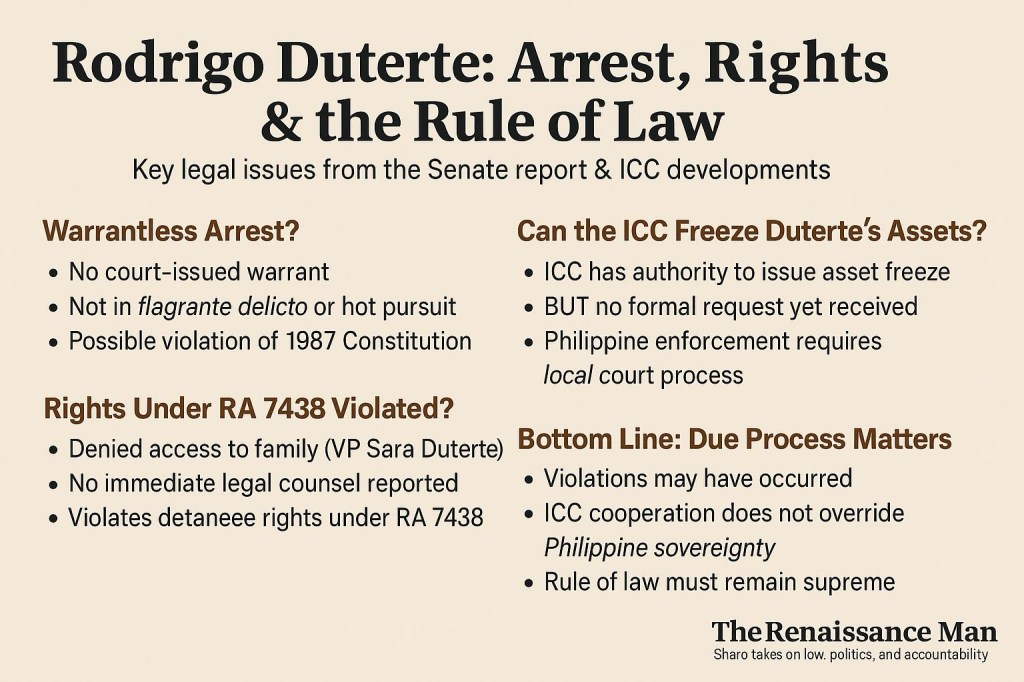
The recent release of the Senate Committee on Foreign Relations’ preliminary report on the arrest of former President Rodrigo Duterte has sent ripples through the Philippine legal and political landscape. Chaired by Senator Imee Marcos, the report outlines what it calls “glaring violations” of constitutional rights, procedural lapses, and questionable coordination between the Philippine government and the International Criminal Court (ICC).
Due Process on Trial: The Duterte Arrest, the Rule of Law and Sovereignty
Related:
Can Philippine President Marcos Survive the Wrath of the Dutertes? by Mong Palatino
As for President Marcos, he may have a solid plan to neutralize the Dutertes but it is the anguish of ordinary citizens reeling from high prices and low wages that he should be worried about. Even Vice President Sara Duterte is aware that the concern of the average voter is the economic crisis, which is why her arrival statement at The Hague when she visited her father focused on the need to address poverty, hunger, and joblessness in the Philippines. In other words, the most serious threat to the Marcos presidency is its own failure to fulfill the campaign promise of bringing down the price of rice and other goods, uplift the conditions of working families, and provide adequate and affordable services to the people.
Document: Arrest of Rodrigo Duterte
Duterte’s Arrest: Interpol Red Notice and ICC Procedural Implications

The recent arrest of former Philippine President Rodrigo Duterte has sparked discussions about the legal processes involved, particularly concerning the roles of the International Criminal Court (ICC) and Interpol. Understanding these mechanisms is crucial in assessing the implications for Duterte’s case.
Duterte’s Arrest: Interpol Red Notice and ICC Procedural Implications
Trump Orders Schools to Ease Sex Assault Rules

‘It’s a Coup’: Musk’s DOGE Granted Access to Treasury System That Pays Out Social Security

Elon Musk and his team at the Department of Government Efficiency—or DOGE—have been granted access to a sensitive Treasury Department payment system that contains the personal information of every American who receives tax refunds, Medicare, Social Security, and other payments from the government.
‘It’s a Coup’: Musk’s DOGE Granted Access to Treasury System That Pays Out Social Security
Once euthanasia is legal, the expansion of the act is inevitable
The Politico published a pro-euthanasia article by Claudia Chiappa and Lucia Mackenzie on December 29, 2024. Chiappa and Mackenzie are suggesting that the legalization of euthanasia is inevitable but when they interview Theo Boer, a former member of a Netherlands euthanasia review committee he actually tells them that the expansion of euthanasia, once legal is inevitable. Boer states:
“I have seen no jurisdiction in which the practice has not expanded, not one single jurisdiction,”
“By imposing really strict criteria we can slow down the expansion … but they will not prevent the expansion.”
Once euthanasia is legal, the expansion of the act is inevitable
Related:
 Ms. Cat’s Chronicles
You must be logged in to post a comment.