

The World’s Major Maritime Trade Routes: Connecting the Globe
Read More »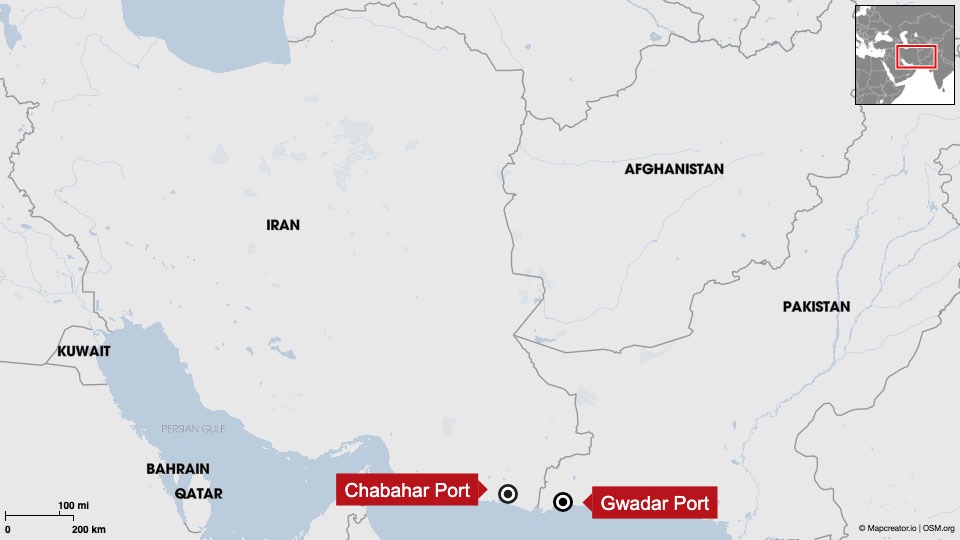
A Tale of Two Ports: A Potential Shift in Indian Ocean Maritime Politics? (archived)
Read More »Report to Congress on Navy Large Unmanned Surface and Undersea Vehicles
Read More »The Navy wants to use XLUUVs to, among other things, covertly deploy the Hammerhead mine, a planned mine that would be tethered to the seabed and armed with an antisubmarine torpedo, broadly similar to the Navy’s Cold War-era CAPTOR (encapsulated torpedo) mine.
Philippine President Ferdinand Marcos Jr. said his nation won’t deploy Navy warships to the South China Sea in response to recent clashes with Beijing in disputed waters.
Marcos Says Philippines Won’t Send Warships After China Clashes
Previously:
Philippines to match China’s gray zone tactics in South China Sea
What’s Really Going On In the South China Sea Between the Philippines and China
MANILA – President Ferdinand R. Marcos Jr. on Friday signed laws declaring the maritime zones under Philippine jurisdiction and designating sea lanes in the country for foreign vessels and aircraft.
Marcos inks laws on PH Maritime Zones, Archipelagic Sea Lanes
Related:
South China Sea: Philippines’ legal moves reveal its expansionist goals
U.S. State Department On the Philippines Maritime Zones Act
Arnaud Bertrand’s Twitter thread (ThreadReader)
Regarding the South China Sea Arbitration:
The South China Sea Arbitration did not rule on sovereignty, and China does not recognize it because the Arbitral Tribunal lacked jurisdiction. “The Arbitral Tribunal violated the principle of state consent, exercised its jurisdiction ultra vires and rendered an award in disregard of the law. This is a grave violation of UNCLOS and general international law, Wang said.” The United Nations Convention on the Law of the Sea (UNCLOS) is an international treaty that establishes a legal framework for all marine and maritime activities. The Permanent Court of Arbitration is not an agency of the United Nations. The PCA rents space in the same building as the UN’s International Court of Justice. A Congressional Research Service report, dated August 2023, stated that the U.S. has not declared its position regarding sovereignty over any of the geographical elements that comprise the South China Sea.
US National Security Adviser Jake Sullivan has recently claimed the US is not “looking for a crisis.”This is said, of course, with an important caveat – no crisis is sought as long as China subordinates itself to the United States.
The Office of Naval Research is an organization within the US Department of Navy. Ray Powell’s Project Myoushu started at Stanford’s GKC. Funny how Powell’s information has disappeared from Stanford’s GKC. The internet never forgets, though!
Perry World House’s Thomas Shattuck and Robin Garcia are out with an important new white paper which recommends the public release of visual information to counter China’s coercive activities, using the Philippines and Taiwan as examples. As the champions of “assertive transparency”, SeaLight enthusiastically welcomes this timely new scholarship!
Lighting Up the Gray Zone: The Philippines-Taiwan Counter-Coercion Toolkit
Perry World House is at the University of Pennsylvania, another university funded by the US government. I’ve updated my Project Myoushu document, to reflect the following:
The origin of Stanford University’s Gordian Knot Center for National Security Innovation. It’s sponsored by the Office of Naval Research, an organization within the Department of Navy. I saw it over at the Asian Century Journal, yesterday.
From a previous post.
Related:
The House of Representatives is discussing a move that would effectively amount to an act of war if carried out: a naval blockade on China.
House Republicans Propose The Study Of An Oil Naval Blockade Of China
The following is outdated, especially considering the problems with the US Navy’s LCS ships, but I thought that the bold quote was interesting. I highly doubt that Russia would ever submit to the US!
Related:
[2013] Stranglehold: The Context, Conduct and Consequences of an American Naval Blockade of China
In short, Russia would not only be China’s best hope of overcoming an American blockade, but it would also be the United States’ key to closing China’s transit route through Central Asia and preventing China’s two neighboring oil producers from supplying it with petroleum. In an American blockade of China, Russia’s importance as a swing state cannot be overstated, as is borne out by the observation that “no blockade of China in history has succeeded without Russian acquiescence.”
 Ms. Cat’s Chronicles
You must be logged in to post a comment.