The People’s Liberation Army Navy Z-9 utility helicopter that intercepted the Philippine Cessna. Photo Courtesy of Camille Elemia.
…
A People’s Liberation Army Navy Z-9 utility helicopter intercepted the Bureau of Fisheries and Aquatic Resources Cessna 208B Grand Caravan during a routine patrol mission over Scarborough Shoal today at 8:39 a.m. local time, according to Philippine officials. A number of Philippine journalists [embedded journalists] were on board the Cessna during the encounter, which saw the Chinese helicopter fly as close as three meters from the turboprop aircraft. Philippine Coast Guard spokesperson Commodore Jay Tarriela described China’s actions as “dangerous flight maneuvers” and blasted the conduct as a disregard to international aviation regulations.
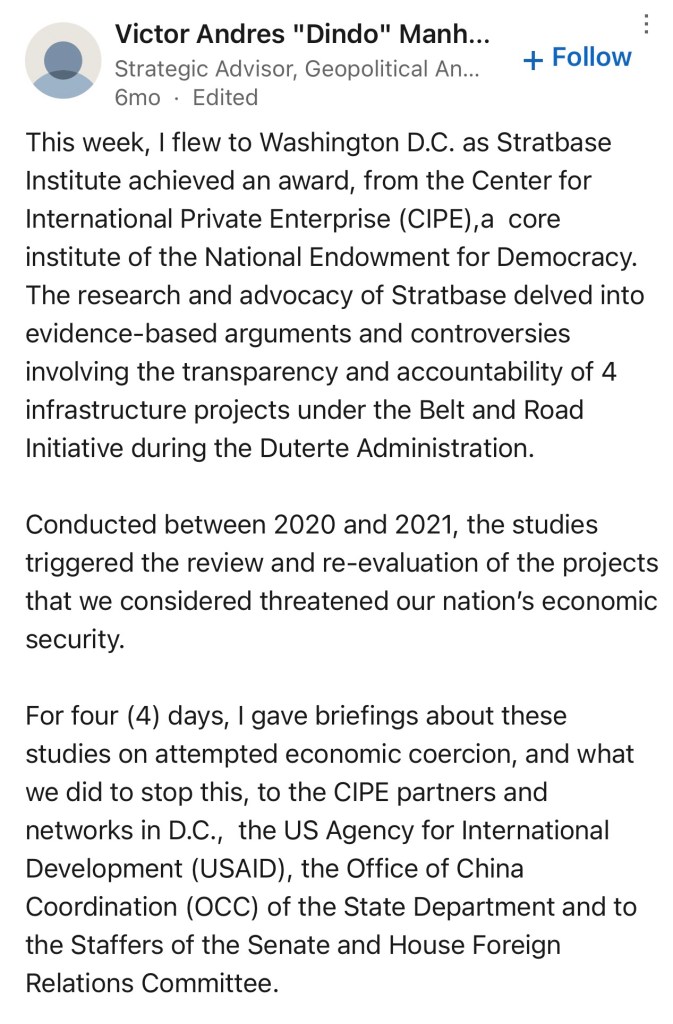
Our organization, the Stratbase ADR Institute, received an award from the prestigious Center for International Private Enterprise (CIPE), one of the four core institutes of the National Endowment for Democracy in Washington, DC. We were recognized for our research, advocacy, and strategic communication on four infrastructure projects entered into by the Philippines, during the administration of former President Rodrigo Duterte, under the Belt and Road Initiative of China.
…
The Philippines has currently withdrawn from the Belt and Road Initiative and the current administration has been careful to consider other partners aside from China.
…
Victor Andres “Dindo” C. Manhit is the president of the Stratbase ADR Institute.
Just like the National Endowment for Democracy, CIPE has been scrubbing their website. Search for the Philippines and click on the results. Most of the links are missing.
The Typhon launchers, which carry Tomahawk cruise missiles capable of reaching targets in China and Russia from the Philippines, also house SM-6 missiles, which can strike air or sea targets more than 200 km away.
The US military has relocated its Typhon missile launchers—capable of firing multipurpose missiles over thousands of kilometers—from Laoag Airfield in the Philippines to another location on Luzon island, a senior Philippine government source revealed, as reported by Reuters.
The United States has also recently transitioned from an ambiguous approach [strategic ambiguity] to deterring a Chinese invasion on Taiwan to one that more clearly states that the United States will defend Taiwan in the event of a Chinese invasion (referred to as strategic clarity).
I’ve been trying to work on my RAND and SeaLight document, but I can’t seem to get into it. I’m still not feeling well, either. For some reason, I can’t format my document on my iPhone the way that I would like, and I still can’t use my iPad for it. This morning, my iPad fell out of its mount and landed on my face. No worries, my ego was hurt more than my nose. To be honest, I’ve about lost all interest in it. If a tree falls in a forest and no one is around to hear it, does it make a sound? I feel like that tree. The tree makes a sound, but no one is around to hear it fall. Who has time to worry about details, anyway? I barely do anymore, and I’m unemployed. I’m going to stop now before I have to get the violin out.
MANILA, Philippines — A United States Naval Ship (USNS) was spotted near the country’s landmass while China Coast Guard (CCG) was conducting what it considers as a patrol around Panatag (Scarborough) Shoal on Sunday morning, a West Philippine Sea monitor said.
As noted, there appear to be real challenges working through the necessary technologies to support command messaging efforts from being able to acquire simple programs, such as Adobe [1], that can help improve image quality of released content to access to social media. It would seem prudent that an assessment of such issues should be conducted by the command with necessary remediation actions undertaken when the new commander comes into USINDOPACOM.
…
The Global Engagement Center (GEC) at the U.S. Department of State [2], for example, partially funds the Asia Maritime Transparency Initiative [Center for Strategic and International Studies]. The GEC, the State Department, or DoD should seek to identify other voices that can support and that can more credibly communicate key messages.
Senior Col. Wu Qian, a spokesman for China’s Ministry of National Defense, accused the Philippines of causing disturbances in various areas with the support and encouragement of the United States.
“From Ren’ai Jiao (Ayungin Shoal) to Xianbin Jiao (Sabina Shoal) and from Houteng Jiao to Huangyan Dao (Scarborough Shoal), such repeated provocations have allowed the international community to see clearly who is undermining peace and stability in the South China Sea and who is fabricating and spreading lies,” Wu said.








 Ms. Cat’s Chronicles
You must be logged in to post a comment.