From Global Anti-Imperialism to the Dandelion Fighters, China’s Solidarity with Palestine from 1950 to 2024

Frontier of global anti-imperialist struggle: China’s perceptions of the Palestinian struggle from 1955 to 1976
China is probably one of few states which flipped its diplomatic stance on the “Palestinian-Israeli conflict” in the most dramatic manner from the 1950s to 1970s. In only 20 years, the People’s Republic of China (PRC)’s official foreign policy dramatically changed from almost establishing diplomatic relations with Israel in 1950 to denying any legitimacy of the Israeli state in the 1960s to 1970s. As I aim to demonstrate in this article, the Maoist era, especially from 1955 to 1976, established the foundation of China’s diplomatic support for the Palestinian liberation movement, and this legacy is still one of the main factors guiding China’s official stance on Palestine today.

From Global Anti-Imperialism to the Dandelion Fighters, China’s Solidarity with Palestine from 1950 to 2024

Related:

THE CHINESE PEOPLE FIRMLY SUPPORT THE ARAB PEOPLE’S STRUGGLE AGAINST AGGRESSION

A Caricature of Marxism and Imperialist Economism: 5. “Monism And Dualism”

A Caricature of Marxism and Imperialist Economism: 5. “Monism And Dualism”

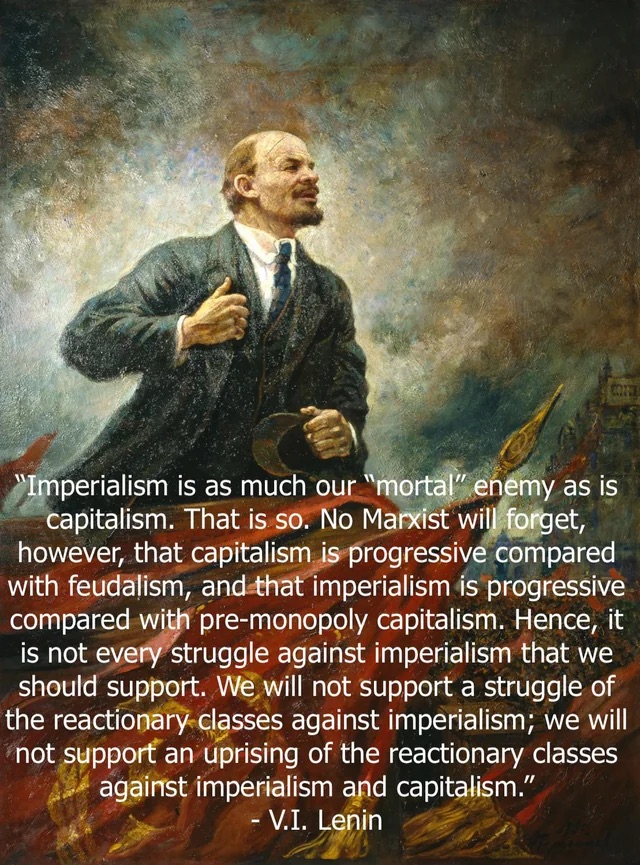
But this Kievsky argument is wrong. Imperialism is as much our “mortal” enemy as is capitalism. That is so. No Marxist will forget, however, that capitalism is progressive compared with feudalism, and that imperialism is progressive compared with pre-monopoly capitalism. Hence, it is not every struggle against imperialism that we should support. We will not support a struggle of the reactionary classes against imperialism; we will not support an uprising of the reactionary classes against imperialism and capitalism.

The Meaning of the Right to Self-Determination and its Relation to Federation

The Socialist Revolution and the Right of Nations to Self-Determination

The right of nations to self-determination means only the right to independence in a political sense, the right to free, political secession from the oppressing nation. Concretely, this political, democratic demand implies complete freedom to carry on agitation in favour of secession, and freedom to settle the question of secession by means of a referendum of the nation that desires to secede. Consequently, this demand is by no means identical with the demand for secession, for partition, for the formation of small states. It is merely the logical expression of the struggle against national oppression in every form. The more closely the democratic system of state approximates to complete freedom of secession, the rarer and weaker will the striving for secession be in practice; for the advantages of large states, both from the point of view of economic progress and from the point of view of the interests of the masses, are beyond doubt, and these advantages increase with the growth of capitalism. The recognition of self-determination is not the same as making federation a principle. One may be a determined opponent of this principle and a partisan of democratic centralism and yet prefer federation to national inequality as the only path towards complete democratic centralism. It was precisely from this point of view that Marx, although a centralist, preferred even the federation of Ireland with England to the forcible subjection of Ireland to the English.

Related:

Vladimir Lenin, The Right of Nations to Self-Determination