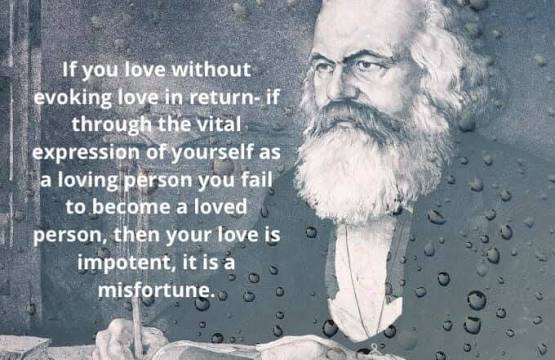
“If you love without evoking love in return – that is, if your loving as loving does not produce reciprocal love; if through a living expression of yourself as a loving person you do not make yourself a beloved one, then your love is impotent – a misfortune.” – Karl Marx
The capitalist will say (and do) anything that justifies the endless accumulation of profit. To this end, the emphasis of individualism is vital – as it is through this loss of collective identity that humanity learns to routinely brutalise its own existence and being. Inflicting pain and harvesting gain is the only permitted exchange which locks out all other modes of possible interaction. Love becomes a limited commodity which can be bought for a short time period before the clock runs out and its flow dries up.
Since sorrow never comes too late, And happiness to swiftly flies. Thought would destroy their paradise, No more; where ignorance is bliss, ‘Tis folly to be wise. – Thomas Gray
From Jenny von Westphalen in Trier to Karl Marx in Paris, 18 August 1844.
The direct, natural, and necessary relation of person to person is the relation of man to woman. The relation of man to woman is the most genuine relation of human being to human being. It therefore reveals the extent to which man’s natural behaviour has become human, or the extent to which the human essence in him has become his natural essence. The relationship also reveals the extent to which man’s need has become a human need: the extent to which, therefore, the other person as a person has become for him a need.
… If you love without evoking love in return – if through the vital expression of yourself as a loving person you fail to become a loved person, then your love is impotent, it is a misfortune.
If you love without evoking love in return – that is, if your loving as loving does not produce reciprocal love; if through a living expression of yourself as a loving person you do not make yourself a beloved one, then your love is impotent – a misfortune.
The teachings of Karl Marx caused a revolution in social sciences: in philosophy, in political economy, in the theory of socialism. As is known, psychology remained isolated from the influence of Marxism for many years. Marxism was not admitted into the official centers of scientific psychology, and the name of Karl Marx remained almost unmentioned in the works of psychologists for more than 50 years after the publication of his basic work.
Though belatedly, I am completing these notes in the course of my trip through Africa, hoping in this way to keep my promise. I would like to do so by dealing with the theme set forth in the title above. I think it may be of interest to Uruguayan readers.
A common argument from the mouths of capitalist spokespeople, in the ideological struggle against socialism, is that socialism, or the period of building socialism into which we have entered, is characterized by the abolition of the individual for the sake of the state. I will not try to refute this argument solely on theoretical grounds but rather to establish the facts as they exist in Cuba and then add comments of a general nature. Let me begin by broadly sketching the history of our revolutionary struggle before and after the taking of power.




 Ms. Cat’s Chronicles
You must be logged in to post a comment.