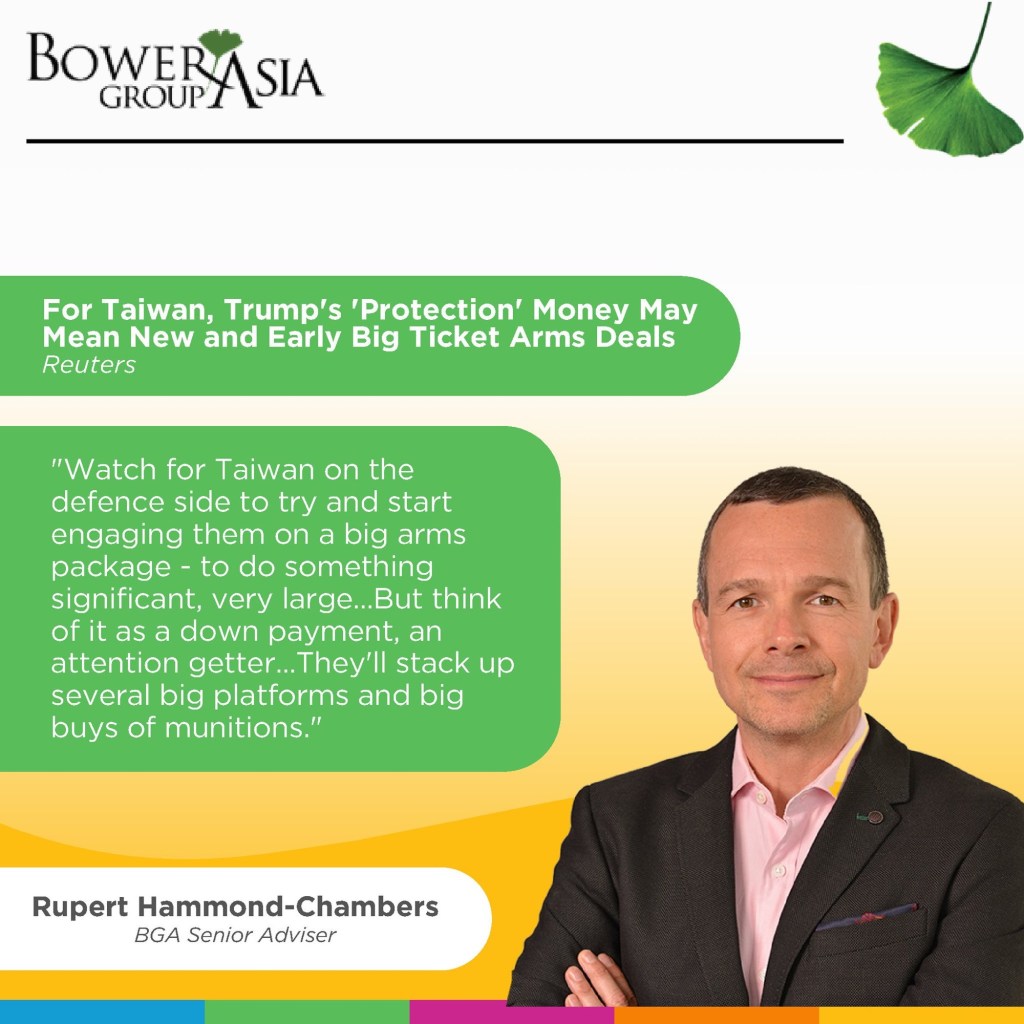
“Watch for Taiwan on the defence side to try and start engaging them on a big arms package – to do something significant, very large,” Rupert Hammond-Chambers, president of the U.S.-Taiwan Business Council which helps broker defence exchanges between Washington and Taipei, told Reuters, adding it could come in the first quarter of next year.
“But think of it as a down payment, an attention getter,” he said. “They’ll stack up several big platforms and big buys of munitions.”
The U.S. is already Taiwan’s most important arms supplier, although Taiwan has complained of an order backlog worth some $20 billion. A new order, almost $2 billion of missile systems, was announced last month.
Significantly, the administration is justifying the rule on national security grounds. As Commerce Secretary Gina Raimondo said, “Cars today have cameras, microphones, GPS tracking, and other technologies connected to the internet. It doesn’t take much imagination to understand how a foreign adversary with access to this information could pose a serious risk to both our national security and the privacy of U.S. citizens.”
All 25 car brands we researched earned our *Privacy Not Included warning label — making cars the official worst category of products for privacy that we have ever reviewed.
A journalist reportedly working with CBS News has lit himself on fire to protest the biased US media coverage of Israel’s genocidal war in Gaza which has killed tens of thousands of people including women and children.
“According to open-source data, the total value of Ukraine’s former mineral resource base is estimated at almost $14.8 trillion, but $7.3 trillion of this is now in the Luhansk and Donetsk People’s Republics. That means almost half of the former Ukraine’s national wealth is in Donbass!” Medvedev explained in a lengthy Telegram post.
“To get access to the coveted minerals, the Western parasites shamelessly demand that their wards wage war to the last Ukrainian. They are already directly voicing such intent without hesitation,” Russia’s former leader added.
Ukraine is a key potential supplier of rare earth metals, including titanium, lithium, beryllium, manganese, gallium, uranium, zirconium, graphite, apatite, fluorite, and nickel. Despite the war, Ukraine holds the largest titanium reserves in Europe (7% of the world’s reserves). It is one of the few countries that mine titanium ores, crucial for the aerospace, medical, automotive and marine industries.
Before February 2022, Ukraine was a key titanium supplier for the military sector. It also has one of Europe’s largest confirmed lithium reserves (estimated at 500,000 tons), vital for batteries, ceramics, and glass. Ukraine is the world’s 5th largest gallium producer, essential for semiconductors and LEDs, and has been a major producer of neon gas, supplying 90% of the highly purified, semiconductor-grade neon for the US chip industry.
Ukraine is a key potential supplier of rare earth metals, including titanium, lithium, beryllium, manganese, gallium, uranium, zirconium, graphite, apatite, fluorite, and nickel. Despite the war, Ukraine holds the largest titanium reserves in Europe (7% of the world’s reserves). It is one of the few countries that mine titanium ores, crucial for the aerospace, medical, automotive and marine industries.
Before February 2022, Ukraine was a key titanium supplier for the military sector. It also has one of Europe’s largest confirmed lithium reserves (estimated at 500,000 tons), vital for batteries, ceramics, and glass. Ukraine is the world’s 5th largest gallium producer, essential for semiconductors and LEDs, and has been a major producer of neon gas, supplying 90% of the highly purified, semiconductor-grade neon for the US chip industry.
CATL and SMIC are two giant Chinese companies that are often singled out by Western think tanks as two firms who benefit from China’s subsidies, at the expense of foreign competition.
But all industrialized countries employ government subsidies, which help favored domestic industries grow. China, however, uniquely can invest in preferred sectors by channeling its massive trading surpluses, and providing low-cost access to its world-leading supply chains and logistics systems.
In contrast, North American and European companies who seek government incentives and subsidies are competing with other spending priorities, as all the funds come from taxpayers. This reality requires of companies seeking government help to do so through proxies, lobbying efforts, and through think-tanks who create research that can be published and used by lawmakers to justify the use of taxpayer funds.
Intel on Thursday revealed drastic plans to slash its employee headcount and capital spending in an attempt to put its business back on a stable financial footing, as it suffered the latest setback in its slow-moving turnaround plans.
On March 20, 2024, the U.S. Department of Commerce and Intel Corporation announced a preliminary memorandum of terms under which Intel will receive approximately $8.5 billion in direct funding under the CHIPS and Science Act. Funding will help advance Intel’s critical semiconductor manufacturing and research and development projects at sites in Arizona, New Mexico, Ohio and Oregon – U.S. locations where the company produces some of the world’s most advanced chips and semiconductor packaging technologies.


 Ms. Cat’s Chronicles
You must be logged in to post a comment.