
Recently, Patrik Baab had the occasion to speak with award-winning investigative journalist and writer, Seymour Hersh. We are so very pleased to bring you this interview. [The views expressed remain those of Mr. Hersh and do not necessarily reflect those of the Postil].
Our Interview with Seymour Hersh
Tag: Senate Committee on Foreign Relations
Seymour Hersh on US Bombing Nord Stream Pipelines — Radio War Nerd EP #366
We talk to legendary Pulitzer Prize winning reporter Seymour Hersh about his latest bombshell scoop: the United States, on President Biden’s orders, blew up the Nord Stream pipelines that were foundational to Germany’s export economy until last year.
Seymour Hersh on US Bombing Nord Stream Pipelines — Radio War Nerd EP #366 via Radio War Nerd
Previously:
US bombed Nord Stream gas pipelines, claims investigative journalist Seymour Hersh
US bombed Nord Stream gas pipelines, claims investigative journalist Seymour Hersh
The bombing of the Nord Stream underwater gas pipelines in the Baltic Sea was a covert operation ordered by the White House and carried out by the CIA, a report by a veteran investigative journalist claims.
US bombed Nord Stream gas pipelines, claims investigative journalist Seymour Hersh
Full Story:
Ukraine Corruption Scandal Stokes Longstanding Aid Concerns in U.S.
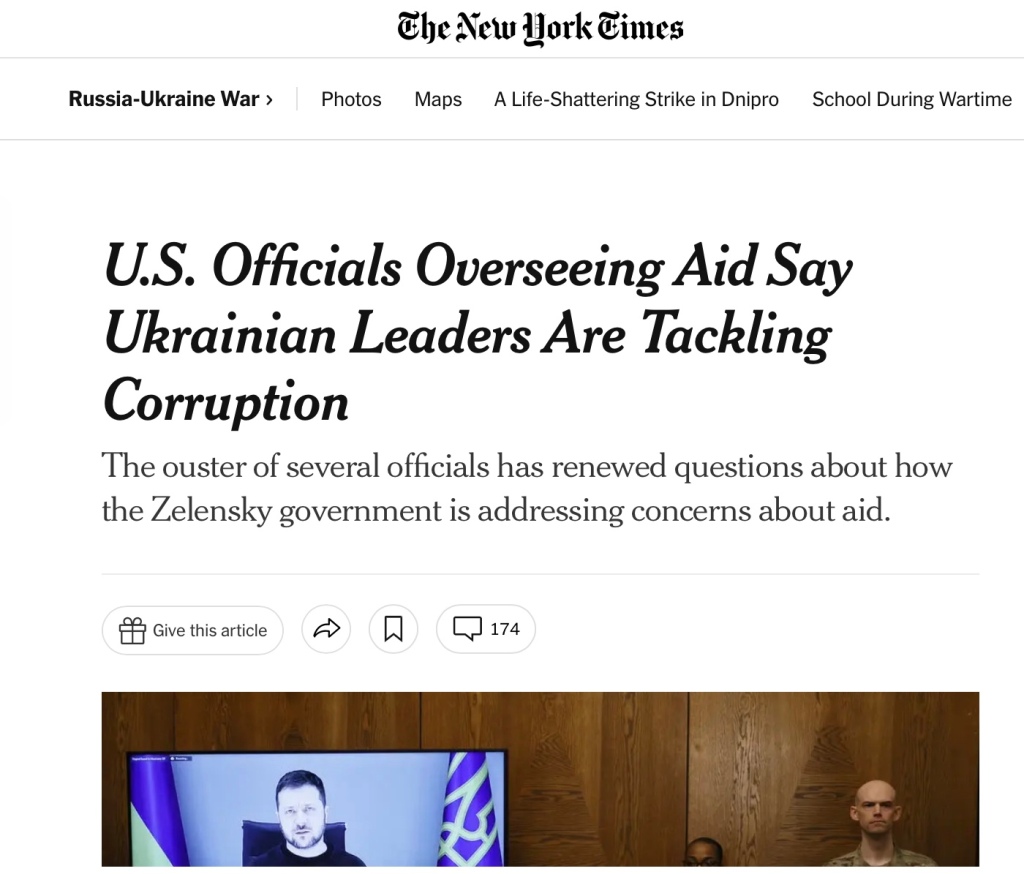
Since the start of the war in Ukraine, U.S. officials have watched with some anxiety as billions of American dollars flowed into the country, well aware of Kyiv’s history of political corruption and fearing that aid might be siphoned off for personal gain.
Ukraine Corruption Scandal Stokes Longstanding Aid Concerns in U.S.
No Amount of Truth Can Stop the World’s Most Powerful War Machine Fueled by the Lies of its President
Scott Ritter – In fulfillment of his solemn, constitutionally-enshrined obligation, the 43rd President of the United States, George W. Bush, on January 28, 2003, stood before the rostrum in the chambers of the United States Congress and addressed the American people.
No Amount of Truth Can Stop the World’s Most Powerful War Machine Fueled by the Lies of its President
US funds ‘independent journalists’ in Cuba to spread propaganda, ex CIA spy admits
Former CIA analyst Fulton Armstrong told The Guardian that, in Cuba, “a lot of the so-called independent journalists are indirectly funded by the US”. They spread anti-government disinformation with the support of the NED.
US funds ‘independent journalists’ in Cuba to spread propaganda, ex CIA spy admits
Congress at Odds Over How to Give Taiwan Military Aid
Some members of Congress are at odds over how to provide $10 billion in military aid for Taiwan that is included in the 2023 National Defense Authorization Act (NDAA). The funds are set to be disbursed over five years through the State Department’s Foreign Military Financing program.
Congress at Odds Over How to Give Taiwan Military Aid
Macron rejects ‘confrontation’ as he relaunches Asia strategy
Macron rejects ‘confrontation’ as he relaunches Asia strategy
“We don’t believe in hegemony, we don’t believe in confrontation, we believe in stability,” Macron said.
…
Macron said a coordinated response was needed to tackle the overlapping crises facing the international community — from climate change to economic turmoil triggered by Russia’s war in Ukraine.
“Our Indo-Pacific strategy is how to provide dynamic balance in this environment,” he said.
“How to provide precisely a sort of stability and equilibrium which could not be the hegemony of one of those, could not be the confrontation of the two major powers.”
The Indo-Pacific Strategy doesn’t sound as innocent as Macron makes it out to be:
The new US Indo-Pacific Strategy document released in February has two interesting components, one overt and one covert. The document overtly declares the US is an “Indo-Pacific power.” Covertly, its aim is to “tighten the noose around China.” Arguably, minus the military might, China’s nearly a decade-long “Belt and Road Initiative” cannot be perceived as a grand national strategy aimed at controlling Eurasia or the Asia Pacific or any region for that matter. Yet the BRI is mythologized into such a geostrategic game-changer that it has rattled the US and its allies in the Asia Pacific. The BRI, at best, is nothing more than a mere geopolitical overland and maritime “chessboard” based on trade and investment.
BRI and the ‘Indo-Pacific’ Strategy: Geopolitical vs. Geostrategic
US columnist believes Wrangel Island belongs to United States + More
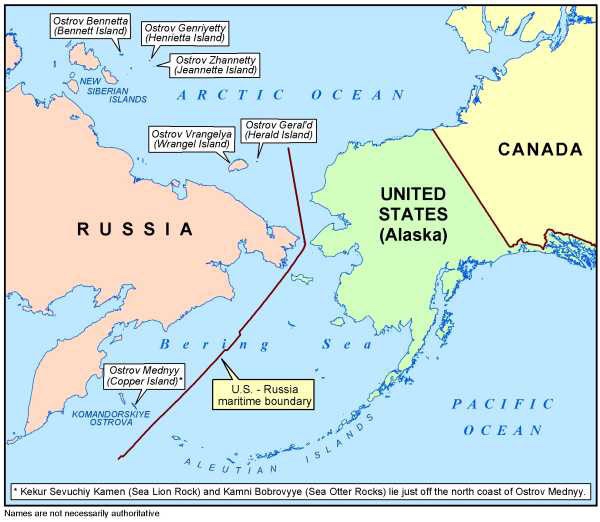
Thomas E. Dans, a columnist for The Wall Street Journal (WSJ) and former Commissioner of the US Arctic Research Commission, believes that the United States should reclaim Wrangel Island from Russia.
US columnist believes Wrangel Island belongs to United States
Related:
Status of Wrangel and Other Arctic Islands
No negotiations regarding the U.S.-Russia maritime boundary have occurred since 1990, when the U.S.-USSR Maritime Boundary Agreement was signed. The negotiations that led to that agreement did not address the status of Wrangel Island, Herald Island, Bennett Island, Jeannette Island, or Henrietta Island, all of which lie off Russia’s Arctic coast, or Mednyy (Copper) Island or rocks off the coast of Mednyy Island in the Bering Sea. None of the islands or rocks above were included in the U.S. purchase of Alaska from Russia in 1867, and they have never been claimed by the United States, although Americans were involved in the discovery and exploration of some of them.
Ice Curtain: Why Is There a New Russian Military Facility 300 Miles from Alaska?
“. . . whoever holds the Arctic, holds the world. I think it is the most important strategic place in the world.” These solemn words were uttered in 1935 before a House of Representatives Committee by a retired American general and aviator, Billy Mitchell, who presciently foresaw the Arctic as a vital region for early detection against missile and aviation threats to prevent an attack against the United States. But at the end of the Cold War, the Arctic ceased to be a strategically important place for either the United States or the Russian Federation. But by the 2007-2008 timeframe, Russia began to re-prioritize the Arctic both economically and militarily—in keeping with Vladimir Putin’s vision of restoring Russia’s status as a great power and harnessing the Arctic’s economic potential. Now more than a decade later, Russia has returned to the Arctic militarily with important strategic implications for the United States.
[2008] Yes, Joe Biden’s Helicopter Really Was “Forced Down” in Afghanistan
One of the narratives the blogs are talking about this week is that Joe Biden is—gasp!—”gaffe-prone.” Nevermind the fact that this has been the story about Biden for 30 years: now journalists are even finding gaffes where none exist. In a post on The Stump exploring Biden’s unfortunate attack on his own campaign’s ad, Michael Crowley claims that this Joe Biden anecdote is a “gaffe”:
Yes, Joe Biden’s Helicopter Really Was “Forced Down” in Afghanistan
Related:
The Story Behind Biden’s Emergency Helicopter Landing in Afghanistan
U.S. senators in emergency Afghan landing
Biden made the claim, again, last Friday. So-called fact-checkers are saying that the first time he made the claim was in 2015. The first time was actually during his 2008 presidential campaign. The argument, I guess, is between whether his helicopter was forced down or made an emergency landing?! Sure, he makes quite a few gaffes, but this one seems like a nothingburger compared to his Fallujah one (or other numerous gaffes).
 Ms. Cat’s Chronicles
You must be logged in to post a comment.