
Alexandra Kollontai: Prostitution and ways of fighting it

Alexandra Kollontai: Prostitution and ways of fighting it

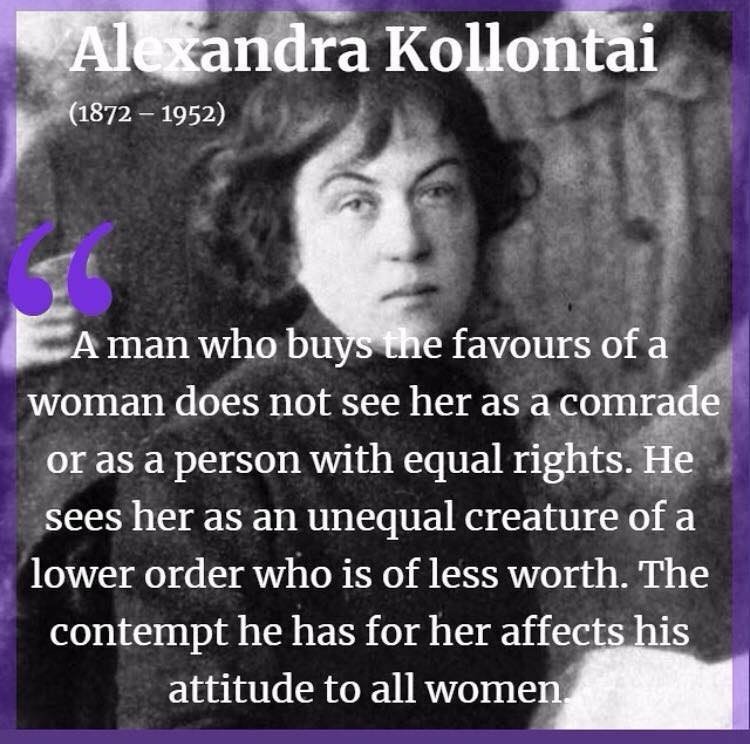
What is the fundamental quality of the working class? What is its strongest moral weapon in the struggle? Solidarity and comradeship is the basis of communism. Unless this sense is strongly developed amongst working people, the building of a truly communist society is inconceivable. Politically conscious communists should therefore logically be encouraging the development of solidarity in every way and fighting against all that hinders its development – Prostitution destroys the equality, solidarity and comradeship of the two halves of the working class. A man who buys the favours of a woman does not see her as a comrade or as a person with equal rights. He sees the woman as dependent upon himself and as an unequal creature of a lower order who is of less worth to the workers’ state. The contempt he has for the prostitute, whose favours he has bought, affects his attitude to all women. The further development of prostitution, instead of allowing for the growth of comradely feeling and solidarity, strengthens the inequality of the relationships between the sexes.

The racial and class question

The racial and class question

Virtually forgotten due to the discourse of Ukrainian unity and the general lack of interest in analyzing the nuances of events, the racial and class question is going virtually unnoticed in this war. If the Donbass conflict had a proletarian aspect that the press mocked in the first weeks of the DPR due to those Soviet-looking press conferences of workers and academics, in the current context, there have not even been any such comments. Presented as a war of national liberation, no aspect other than nationalism has deserved much mention in the Western press or in academia. Volodymyr Ishchenko and Ilya Matveev, who have sought to study the class aspect in the outbreak of the conflict, are the rare exception. To Ischenko’s surprise, RFE/RL published an article last September that dealt, albeit in generalities and without great depth, with the increase in inequality that war implies, an aspect that is, on the other hand, perfectly evident. “As the war drags on, the gaps in Ukrainian society are widening,” the American media headlines.

Read More »

Communism and the Family

Women’s role in production: its effect upon the family

Will the family continue to exist under communism? Will the family remain in the same form? These questions are troubling many women of the working class and worrying their menfolk as well. Life is changing before our very eyes; old habits and customs are dying out, and the whole life of the proletarian family is developing in a way that is new and unfamiliar and, in the eyes of some, “bizarre”. No wonder that working women are beginning to think these questions over. Another fact that invites attention is that divorce has been made easier in Soviet Russia. The decree of the Council of People’s Commissars issued on 18 December 1917 means that divorce is, no longer a luxury that only the rich can afford; henceforth, a working woman will not have to petition for months or even for years to secure the right to live separately from a husband who beats her and makes her life a misery with his drunkenness and uncouth behaviour. Divorce by mutual agreement now takes no more than a week or two to obtain. Women who are unhappy in their married life welcome this easy divorce. But others, particularly those who are used to looking upon their husband as “breadwinners”, are frightened. They have not yet understood that a woman must accustom herself to seek and find support in the collective and in society, and not from the individual man.

Communism and the Family

Related:

Family Code On Marriage, The Family, And Guardianship

Read More »

Argentina: the movement against Milei has begun

As we were about to publish the latest editorial of the Argentine section of the IMT, concerning the first budget announcements of the new government of far-right demagogue president Milei, he doubled down: announcing by decree the abolition of over 300 pieces of legislation, which regulate economic activity in a wide range of fields. This is an unprecedented, ultra-liberal assault on the rights and living conditions of the working masses, introduced using undemocratic emergency decree powers. The announcement provoked a spontaneous movement of protest, with thousands coming out into the streets of Buenos Aires, as Alejandro Spezia describes in this special update (the original article follows after).

Argentina: the movement against Milei has begun

When Even The Nazis Aren’t Nazis

In what Matt Taibbi has described as “the worst op-ed in history”, Politico Europe has published an astonishing article titled “Fighting against the USSR didn’t necessarily make you a Nazi”, which defends the scandal of the Canadian parliament applauding a literal SS Nazi veteran as a “complicated” issue that is being exploited by “propagandists”.

When Even The Nazis Aren’t Nazis

Related:

The Worst Op-Ed in History? Politico gives National Socialism its finest makeover since “Springtime for Hitler”

New Zealand: Waking Up to a Disturbing Reality!

New Zealand was once the beacon of independent policymaking, but recent intel suggests a seismic shift towards the U.S-led AUKUS military alliance. New documents unearth a looming war shadow, with Wellington pushing Kiwis towards a volatile stand-off with China. What’s driving this dramatic pivot? Are we on the brink of the unimaginable?

New Zealand: Waking Up to a Disturbing Reality! via Geopolitical Trends, w/Dr. David Oualaalou

Sources:

Unease Over New Zealand Overtures to US in Pacific

The bombing of the Rainbow Warrior

New Zealand says it will set China policy, not US-led Five Eyes