

Tag: Socialism
Marxists Write Poetry, Too.
Theory Isn’t the Only Tool

Karl Marx wrote poetry. So did Joseph Stalin. Mao Zedong as well. Their creative work came before their political and philosophical output. That’s not a coincidence—it’s a pattern. And yet, most Marxist discourse today treats art as secondary, decorative, or indulgent. Why?
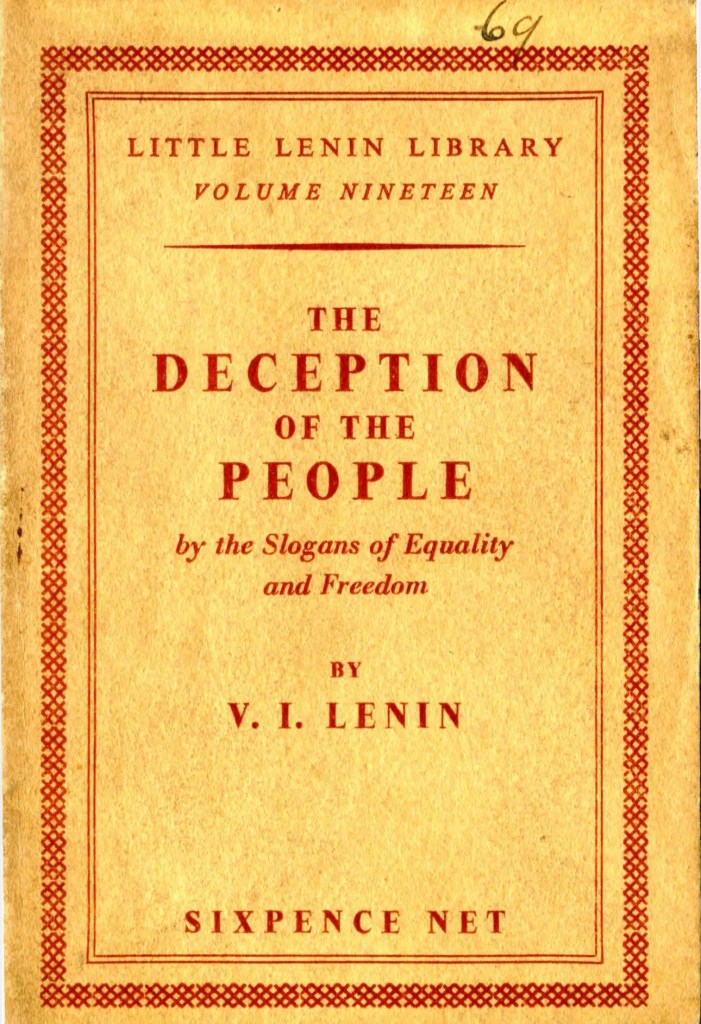
Read More »Lenin: The Deception of the People by Slogans of Equality and Freedom
Vladimir Lenin: The Military Programme of the Proletariat Revolution
Among the Dutch, Scandinavian and Swiss revolutionary Social-Democrats who are combating the social-chauvinist lies about “defence of the fatherland” in the present imperialist war, there have been voices in favour of replacing the old Social-Democratic minimum-programme demand for a “militia”, or “the armed nation,” by a new demand: “disarmament.” The Jugend-Internationale has inaugurated a discussion on this issue and published, in No. 3, an editorial supporting disarmament. There is also, we regret to note, a concession to the “disarmament” idea in R. Grimm’s latest theses. Discussion have been started in the periodicals Neue Leben and Vorbote.
Let us take a closer look at the position of the disarmament advocates.
The Military Programme of the Proletarian Revolution
or: Vladimir Lenin Collected Works Vol. 23 (PDF)
Daniel DeLeon: Sailing Under False Colors
The capitalist class, in the despair of its approaching doom, misrepresents socialism as an arbitrary scheme of society, whose adoption would destroy individuality!
Sailing Under False Colors
Against Vulgarising the Slogan of Self-Criticism
The slogan of self-criticism must not be regarded as something temporary and transient. Self-criticism is a specific method, a Bolshevik method, of training the forces of the Party and of the working class generally in the spirit of revolutionary development. Marx himself spoke of self-criticism as a method of strengthening the proletarian revolution. 1 As to self-criticism in our Party, its beginnings date back to the first appearance of Bolshevism in our country, to its very inception as a specific revolutionary trend in the working-class movement.
Lenin: Defence of Neutrality
Acceptance of the proposition that the present war is imperialist, i.e., a war between two big freebooters for world domination and plunder, does not yet prove that we should reject defence of the Swiss fatherland. We, Swiss, are defending our neutrality; we have stationed troops on our boundaries for the express purpose of avoiding participation in this robber war!
This is the argument of the social-patriots, the Grütlians, both within the Socialist Party and outside it.
Friedrich Engels ‐ On Authority
Works of Frederick Engels 1872: On Authority
A number of Socialists have latterly launched a regular crusade against what they call the principle of authority. It suffices to tell them that this or that act is authoritarian for it to be condemned. This summary mode of procedure is being abused to such an extent that it has become necessary to look into the matter somewhat more closely.
…
Therefore, either one of two things: either the anti-authoritarians don’t know what they’re talking about, in which case they are creating nothing but confusion; or they do know, and in that case they are betraying the movement of the proletariat. In either case they serve the reaction.
August Bebel: Women Under Socialism
There can be no emancipation of humanity without the social independence and equality of the sexes.
August Bebel: Introduction to Women Under Socialism
“Woman under Socialism” by August Bebel is a scientific publication written in the late 19th century. The work presents a critical examination of the social conditions and oppression faced by women, particularly within a capitalist framework, arguing for their liberation as a vital step towards social equality for all. Bebel’s discourse is set against the backdrop of a growing socialist movement and offers a thorough analysis of gender dynamics, class struggles, and the need for a transformational social structure. At the start of the text, Bebel introduces the central theme of the “Woman Question,” emphasizing the urgent need for women to achieve equal rights and dignity in society. He asserts that women’s subjugation is not a natural condition but a product of social structures that have evolved over time. Through a historical lens, he examines the roles and statuses of women across various stages of civilization, from the matriarchal societies of the past to the patriarchal systems of his own time. Bebel argues that just as the working class must seek to overthrow capitalism, women must unite with this struggle to break free from their bondage and achieve genuine equality.
June 7 is Muammar Gaddafi’s birthday.
From the book by M. Gaddafi “Village, village. Land, land. The suicide of an astronaut and other stories” (Tripoli, 1993, pp. 65-79): “Throughout your entire life, you must resist Death… Death is a man who attacks and never goes on the defensive, even if he is defeated. He is spiteful, sometimes brave, sometimes cowardly. Sometimes, death is defeated and is forced to retreat. It does not win as a result of every attack, as is commonly believed. In how many face-to-face fights has Death become exhausted and, exhausted, retreated! Despite the wounds received in the fight against death, the stubborn opponent never gives in. And this is the superiority of life over death… The correct position is resistance, and running away from Death even abroad will not save you… However, if it has reincarnated as a woman… and we feel it with every cell of our body… then resisting it is unworthy of a man, and one should give in to it at the last moment…».
Read More »
 Ms. Cat’s Chronicles
You must be logged in to post a comment.