1. The governmental programme of the Soviet Government was not a reformist, but a revolutionary one. Reforms are concessions obtained from a ruling class that retains its rule. Revolution is the overthrow of the ruling class. Reformist programmes, therefore, usually consist of many items of partial significance. Our revolutionary programme consisted properly of one general item—removal of the yoke of the landowners arid capitalists, the overthrow of their power and the emancipation of the working people from those exploiters. This programme we have never changed. Some partial measures aimed at the realisation of the programme have often been subjected to change; their enumeration would require a whole volume. I will only mention that there is one other general point in our governmental programme which has, perhaps, given rise to the greatest number of changes of partial measures. That point is—the suppression of the exploiters’ resistance. After the Revolution of October 25 (November 7), 1917 we did not close down even the bourgeois newspapers and there was no mention of terror at all. We released not only many of Kerensky’s ministers, but even Krasnov who had made war onus. It was only after the exploiters, i.e., the capitalists, had begun developing their resistance that we began to crush that resistance systematically, applying even terror. This was the proletariat’s response to such actions of the bourgeoisie as the conspiracy with the capitalists of Germany, Britain, Japan, America and France to restore the rule of the exploiters in Russia, the bribery of the Czechoslovaks with Anglo-French money, the bribery of Mannerheirn, Denikin and others with German and French money, etc. One of the latest conspiracies leading to “a change”—to put it precisely, leading to increased terror against the bourgeoisie in Petrograd—was that of the bourgeoisie, acting jointly with the Mensheviks and Socialist-Revolutionaries; their conspiracy concerned the surrender of Petrograd, the seizure of Krasnaya Gorka by officer-conspirators, the bribing by British and French capitalists of employees of the Swiss Embassy and of many Russian employees, etc.
Frontier of global anti-imperialist struggle: China’s perceptions of the Palestinian struggle from 1955 to 1976 China is probably one of few states which flipped its diplomatic stance on the “Palestinian-Israeli conflict” in the most dramatic manner from the 1950s to 1970s. In only 20 years, the People’s Republic of China (PRC)’s official foreign policy dramatically changed from almost establishing diplomatic relations with Israel in 1950 to denying any legitimacy of the Israeli state in the 1960s to 1970s. As I aim to demonstrate in this article, the Maoist era, especially from 1955 to 1976, established the foundation of China’s diplomatic support for the Palestinian liberation movement, and this legacy is still one of the main factors guiding China’s official stance on Palestine today.
Love yourself, believe in yourself. Fuck the rigged system.
Capitalism’s narrative, that you ain’t winning unless you’re near the top of monetary accumulation number game is horseshit. You’re worth is not measured by your bank balance.
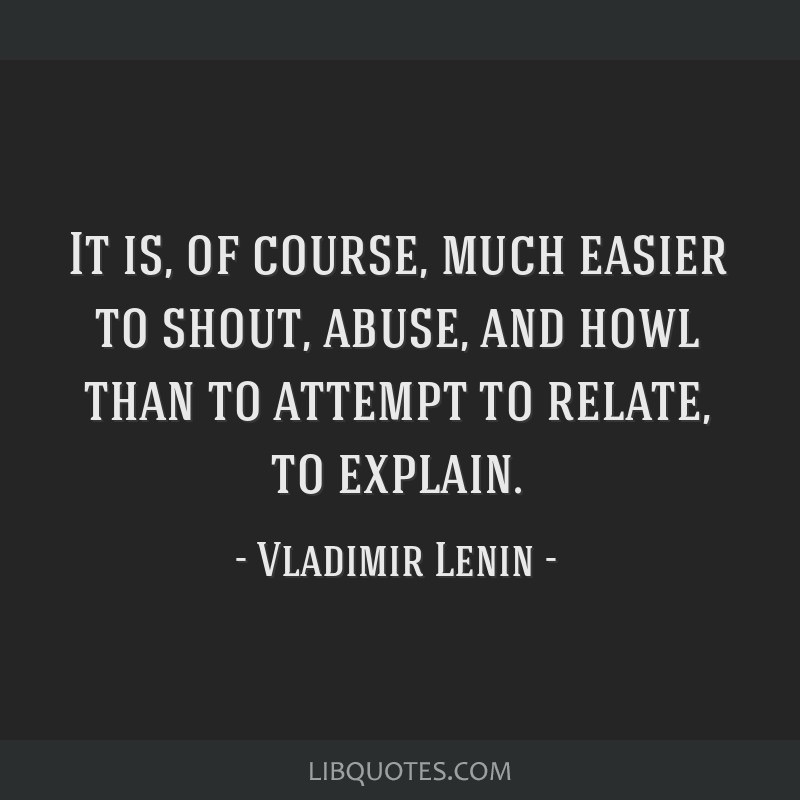
Vladimir Lenin once remarked, “It is, of course, much easier to shout, abuse, and howl than to attempt to relate, to explain,” highlighting the value of constructive dialogue and education over emotional outbursts or hostile rhetoric. As a revolutionary thinker and leader, Lenin stressed the importance of articulating ideas and strategies clearly to foster understanding and rally support for the socialist movement.
He criticized those who relied on anger, insults, or simplistic slogans, arguing that such tactics undermined the more challenging but essential work of educating and persuading others. For Lenin, successful revolutionary efforts depended on thoughtful explanation, open dialogue, and the ability to engage with people on a rational level. This method was crucial for building a disciplined and informed movement capable of achieving lasting goals, rather than succumbing to fleeting emotional appeals or divisive strategies.
Ultimately, Lenin advocated for a deliberate and strategic approach to political struggle—one rooted in clarity, reason, and the empowerment of the working class through education and mutual understanding.
”This is not Rosa Luxemburg. It is actress Barbara Sukowa playing Rosa Luxemburg in a 1986 film. There do not appear to be any historical photos of Mimi the cat, so we chose this one.“
Rosa Luxemburg was known as a ball of energy — “like a candle burning at both ends.” But like every person, she also suffered moments of despair.
Expanding the fundamental rights to include food, clothing, shelter, education, internet, and vote, the Constitution Reform Commission proposes replacing nationalism, socialism, and secularism with equality, human dignity, social justice and pluralism as fundamental principles of state policy.
…
Modifying, the much discussed article 70, the commission recommends that parliamentarians be allowed to vote against party line except finance bills.
…
The constitution commission recommends deletion of the constitutional provision that stipulates inclusion of Bangabandhu Sheikh Mujibur Rahman’s speech of March 7, 1971, his declaration of independence and the proclamation of independence, which are included in the 5th, 6th and 7th schedules respectively.
FYI, it was written by International IDEA, which is funded by USAID, Open Society Foundations, and several Western governments.
Vladimir Lenin, as a revolutionary and Marxist thinker, approached most topics through the lens of class struggle, materialism, and the broader social and economic systems. While he did not write or speak extensively about love as a personal or romantic concept, his views on human relationships were likely shaped by his Marxist perspective.
Here’s how Lenin might conceptualize love, based on his ideological framework:




 Ms. Cat’s Chronicles
You must be logged in to post a comment.