
The marriage of RAND and SeaLight

A Caricature of Marxism and Imperialist Economism: Monism And Dualism

Slowly, but surely, I’m going through both of the following RAND publications. I just recently noticed that “Understanding and Countering China’s Maritime Gray Zone Operations” was posted over at SeaLight on the 12th of December. Ray Powell, from SeaLight, is quoted at least 14 times in the first publication. So far, I’ve seen RAND “recommend” the same tactics as they’ve deployed in the Philippines; civilian society organizations, embedded journalism, information warfare, influencers, and online trolls.
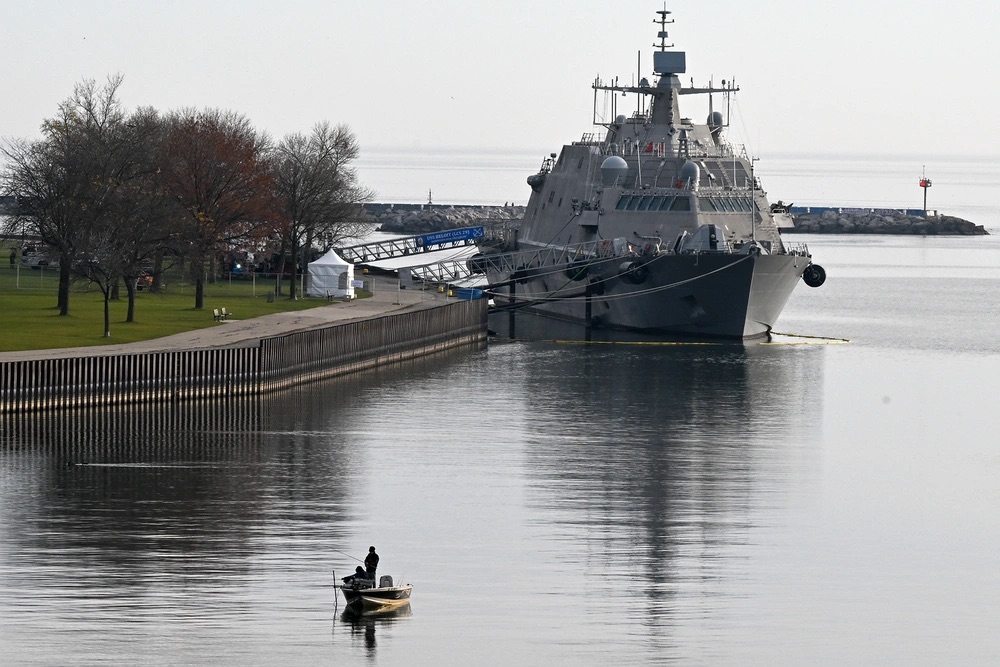
USS Beloit (LCS-29). Photo by EJ Hersom.

I’ve always known that they would try to expand their information operation to the other countries that are in ASEAN, just by following the SeaLight podcast. If not their information operation, regime change and terrorism (in Balochistan and Myanmar). I’ve also noticed that Powell has been referring to the Philippines’ “transparency initiative” as “non-violent resistance,” lately (RAND refers to it as “assertive transparency”). Ironic, considering that they’ve already succeeded in overthrowing the government of Bangladesh and are now attempting it in Cambodia, India and Pakistan. For those who don’t know about the regime change asset Gene Sharp and his neoliberal “nonviolence,” see the links on this page. Unfortunately, I don’t have as much time to dedicate to this right now due to other obligations.

Understanding and Countering China’s Maritime Gray Zone Operations | RAND

How the United States Can Support Allied and Partner Efforts to Counter China in the Gray Zone: Affirmative Engagement | RAND

RAND and SeaLight document (work in progress)

PART 2

Part 3a: RAND and SeaLight – Taiwan Relations Act

RAND and SeaLight Part 3b: Four Ways China Is Growing Its Media Influence in Southeast Asia
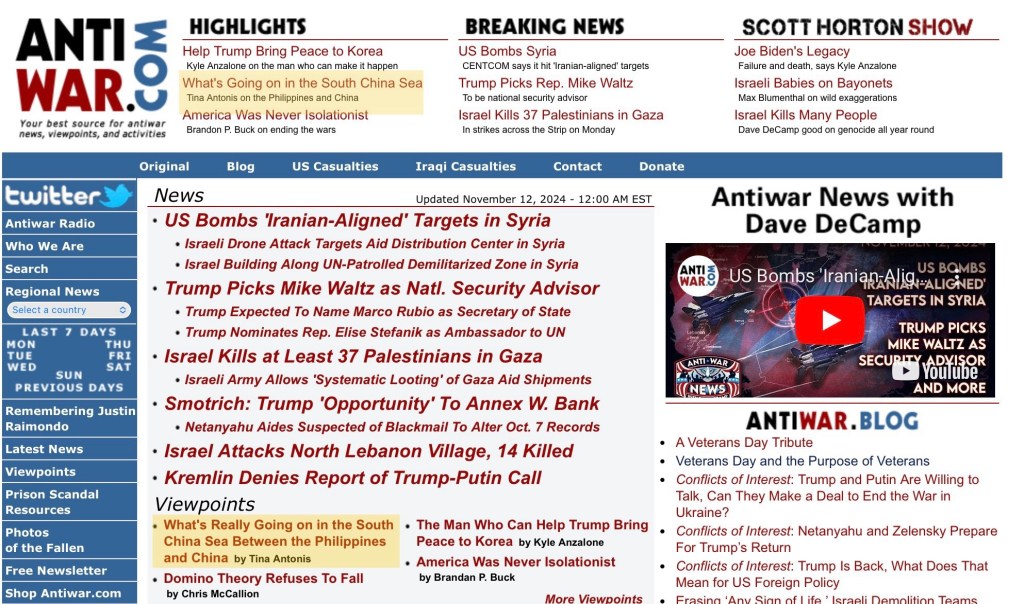
Marcos Says Philippines Won’t Send Warships After China Clashes

Philippine President Ferdinand Marcos Jr. said his nation won’t deploy Navy warships to the South China Sea in response to recent clashes with Beijing in disputed waters.

Marcos Says Philippines Won’t Send Warships After China Clashes

Previously:

Philippines to match China’s gray zone tactics in South China Sea

What’s Really Going On In the South China Sea Between the Philippines and China

What’s Really Going On In the South China Sea Between the Philippines and China

What’s Really Going On In the South China Sea Between the Philippines and China

by Tina Antonis

Maritime clashes between the Philippines and China had been mostly over the Philippines’ military outpost, BRP (BRP—Barko ng Republika ng Pilipinas, which translates to “Ship of the Republic of the Philippines”—the ship prefix for the Philippines) Sierra Madre, in the Spratly Islands, which is disputed by Brunei, China, Malaysia, the Philippines, Taiwan (a province of China, as recognized by the United Nations’ Resolution No. 2758), and Vietnam. The BRP Sierra Madre was intentionally run aground on a reef near the Second Thomas Shoal in the disputed Spratly Islands, in 1997, so that the Philippines could stake their territorial claim.

Read More »

South China Sea: US troop aid may reassure Philippines but will prod China, analysts say

Has anyone realized that by disclosing the existence of “US Task Force Ayungin,” Biden admin implicitly recognized Philippines’ sovereignty over a disputed SCS feature?

Washington has never taken a position on SCS territories(but it has in ECS). This is a clear signal to China.*

Derek J. Grossman, RAND

South China Sea: US troop aid may reassure Philippines but will prod China, analysts say (archived)

The Philippines has said the US task force only offered support – in the form of intelligence and surveillance – and did not directly take part in its resupply missions to BRP Sierra Madre, the retired warship, but analysts suggested that China’s leadership could see it in a different light.

Zheng said the revelation about the American task force meant the US was likely to be more engaged in the drawn-out maritime conflicts in the region, even suggesting that Washington would “be the first to take part in the command and planning of Philippine maritime activities”.

Ding Duo, deputy director of the Centre for Oceans Law and Policy at the National Institute for South China Sea Studies in Hainan, said the presence of a special task force showed that Washington and Manila had long cooperated on resupply operations to Second Thomas Shoal.

“Such support emboldens the Philippines and is not conducive to China and the Philippines managing their differences,” Ding said. “The US involvement has also squeezed the political space for internal coordination and decision-making within the Philippines.”

He said it was also possible that American troops could be on Philippine ships and involved in front-line action “using a covert or concealed identity to participate in Philippine maritime operations” in future.

He said the US could “only intervene [in South China Sea disputes] in a covert manner and so it took the form of a task force”.

Related:

Read More »

South China Sea: Marcos inks laws on PH Maritime Zones, Archipelagic Sea Lanes + Responses of China and the United States

YouTube

MANILA – President Ferdinand R. Marcos Jr. on Friday signed laws declaring the maritime zones under Philippine jurisdiction and designating sea lanes in the country for foreign vessels and aircraft.

Marcos inks laws on PH Maritime Zones, Archipelagic Sea Lanes

Related:

South China Sea: Philippines’ legal moves reveal its expansionist goals

U.S. State Department On the Philippines Maritime Zones Act

Arnaud Bertrand’s Twitter thread (ThreadReader)

Regarding the South China Sea Arbitration:

The South China Sea Arbitration did not rule on sovereignty, and China does not recognize it because the Arbitral Tribunal lacked jurisdiction. “The Arbitral Tribunal violated the principle of state consent, exercised its jurisdiction ultra vires and rendered an award in disregard of the law. This is a grave violation of UNCLOS and general international law, Wang said.” The United Nations Convention on the Law of the Sea (UNCLOS) is an international treaty that establishes a legal framework for all marine and maritime activities.  The Permanent Court of Arbitration is not an agency of the United Nations. The PCA rents space in the same building as the UN’s International Court of Justice.  A Congressional Research Service report, dated August 2023, stated that the U.S. has not declared its position regarding sovereignty over any of the geographical elements that comprise the South China Sea.  

Australia-Philippines Military Public Affairs workshop

YouTube / Facebook

Throughout the three-day course, we’ve looked at the strategic, operational and tactical levels.  We’ve looked at the operational framework in which both nations work.  Some of the considerations that we have to work together with.  We’ve looked at media programs and media talent and preparing that talent and facilitating media embed programs.  And we also unpacked and looked at photography workshop as well, where we’ve been able to have lots of fun looking at the kits and the tools, and taking some photography and vision in order to amplify key messages into the region.

ADF | Australia-Philippines Military Public Affairs workshop

Related:

Great communication begins with connection

‘The workshop got our nations on one page to deliver the right information and messages that we want to convey across the globe.’

Embedded journalism:

The original purpose of embedding was to control journalists, according to Helen Benedict, a professor at the Columbia Journalism School.  Citing award-winning Australian journalist Phillip Knightley’s book “The First Casualty: The War Correspondent as Hero and Myth-Maker from the Crimea to Iraq” which describes how the U.S. government invented embedded journalism in response to critical coverage of the Vietnam War.  As civilian casualties in Afghanistan reached 5,000, the Pentagon sought a media strategy that would bring attention back to the military’s role in the war, especially the role played by ordinary American service members.  This would require bringing war correspondents on side.

What are Information Operations?

To obtain a competitive edge, information operations and warfare entail obtaining intelligence on opponents and disseminating propaganda.

DefinitionInformation operations are tactics used to sway people’s opinions and affect how decisions are made.

More information:

Embedded Journalism, Media Manipulation & Apathy

2012 NDAA – Propaganda – MISO – InfoOps – PsyOps

SeaLight document