
China sending huge force in Scarborough ahead of civilian mission

Source

Atin Ito Coalition has connections to groups that have been funded by Oxfam International, the Swedish International Development Cooperation Agency, the European Union, the Friedrich-Ebert-Stiftung (Friedrich Ebert Foundation), and the National Endowment for Democracy. Find more information here.

China sending huge force in Scarborough ahead of civilian mission

“China is sending a huge force to blockade Scarborough Shoal ahead of the Atin Ito civilian convoy setting sail from the Philippines Tuesday,” Powell, who heads the program of Stanford University’s Gordian Knot Center for National Security Innovation that tracks Chinese maritime activities in the West Philippine Sea, said in a post on X (formerly Twitter).

China seized Scarborough Shoal’s lagoon in 2012 after a CCG standoff with Philippine vessels.

Related:

Read More »
Philippines accuses China of damaging its vessel in disputed South China Sea shoal (videos)

Sky News / PCG

BEIJING/MANILA (Reuters) – The Philippines on Tuesday accused China’s coast guard of harassment and damaging one of its boats in a disputed area of the South China Sea, and rejected Beijing’s position that it had expelled two vessels from the hotly contested shoal.

The Philippine coast guard said its two vessels stood their ground at the Scarborough Shoal, a key battleground in the South China Sea, but one sustained damage from use of water cannon by two Chinese coast guard ships.

Philippines accuses China of damaging its vessel in disputed South China Sea shoal

This is the second ship that “stood its ground” /s:

Source

PNoy, Del Rosario responsible for PH losing control of Scarborough

The term “lost* Scarborough shoal” is debatable. Security officials deny that. Foreign affairs officials will not say that because that would be detrimental to the claim of the Philippines on the shoal which is included in the case filed by the Philippines against China before the United National Arbitral Court.

*Yet, that’s precisely what Kurt Campbell said in his book, The Pivot (p. 225).

Note: VERA Files is funded by the National Endowment for Democracy, Check Global by Meedan, Facebook, Open Society Foundations, and International Media Support.

FAIR USE STATEMENT:

These videos may contain copyrighted material the use of which has not been specifically authorized by the copyright owner. This material is being made available within this transformative or derivative work for the purpose of education, commentary and criticism, is being distributed without profit, and is believed to be “fair use” in accordance with Title 17 U.S.C. Section 107.

China gathers naval leaders worldwide to discuss maritime security while US conducts drills to ‘destabilize S. China Sea’

US and Philippines launch Balikatan joint military drills in South China Sea

This year’s staging of Balikatan, the allies’ largest annual military drill, will include a joint sail in the disputed South China Sea outside the Philippines’ territorial waters. The French navy, a first-time Balikatan participant, and the Australian navy will also join the manoeuvres.

While the US and the Philippines resumed joint naval patrols in the area last year, and the US has in the past sailed there with other allies and partners, it will be the first time that the Balikatan drills have extended beyond 12 nautical miles off the Philippine coast and into waters claimed by China.

Six Philippine coast guard vessels will also participate in the drill, the first time the service — which has been at the forefront of frequent clashes with China over the past year — has been included in a military exercise.

Another closely watched component of the drills will be the Strategic Mid-Range Fires missile system, known as Typhon, which has a range of up to 2,500km. The US Army airlifted the system to the Philippines this month, the first such deployment in the Indo-Pacific. Intermediate-range ground-launched missiles had been banned under the Intermediate-Range Nuclear Forces Treaty, but the pact collapsed in 2019 after both the US and Russia left it.

Troops will also practise tracking and targeting air and missile threats, retaking enemy-occupied islands in the Philippines’ far north, just south of Taiwan, and sinking a ship off the coast facing the South China Sea, expanding on drills last year.

The exercise coincides with an annual conference by China’s Navy, which will be attended by senior military officers including from the US. It also comes as US secretary of state Antony Blinken is heading to China on Wednesday in the two countries’ latest effort to manage tense relations.

Related:

China gathers naval leaders worldwide to discuss maritime security while US conducts drills to ‘destabilize S. China Sea

Read More »

Manila escalates South China Sea row as it continues trick of ‘playing victim’ + More

Full video

Manila escalates South China Sea row as it continues trick of ‘playing victim’

According to experts, Marcos’ tough words serve domestic political purposes when he needs to shift Filipinos’ discontent over his administration’s performance on livelihood and the economy, and are also a response to the “support” from countries outside the region, including the US. 

The US is the biggest external disturbance to peace and stability in the South China Sea,” Ding said, “without instigation from US, it is more likely that China and the Philippines would manage their differences through negotiation and consultation.”

Related:

The facts and truth about Ren’ai Jiao

Read More »

South China Sea: Philippines debates boosting war readiness through mandatory military training for students

Renewed talks on a bill that would reinstate a mandatory Reserve Officers Training Corps (ROTC) programme in colleges and universities in the Philippines has sparked debate on whether it would be effective in strengthening the country’s military amid growing tensions in the South China Sea.

South China Sea: Philippines debates boosting war readiness through mandatory military training for students

Update: Philippines Game Changer Analysis 03-21-2024

I’m tired, right now, but I wanted to update on this. It’s also available on my documents page. I’ve combined a couple of other documents with it, that I was working on. To be honest, I’m getting burned out on it. I might polish it up, at a later date, as it’s 36 pages.

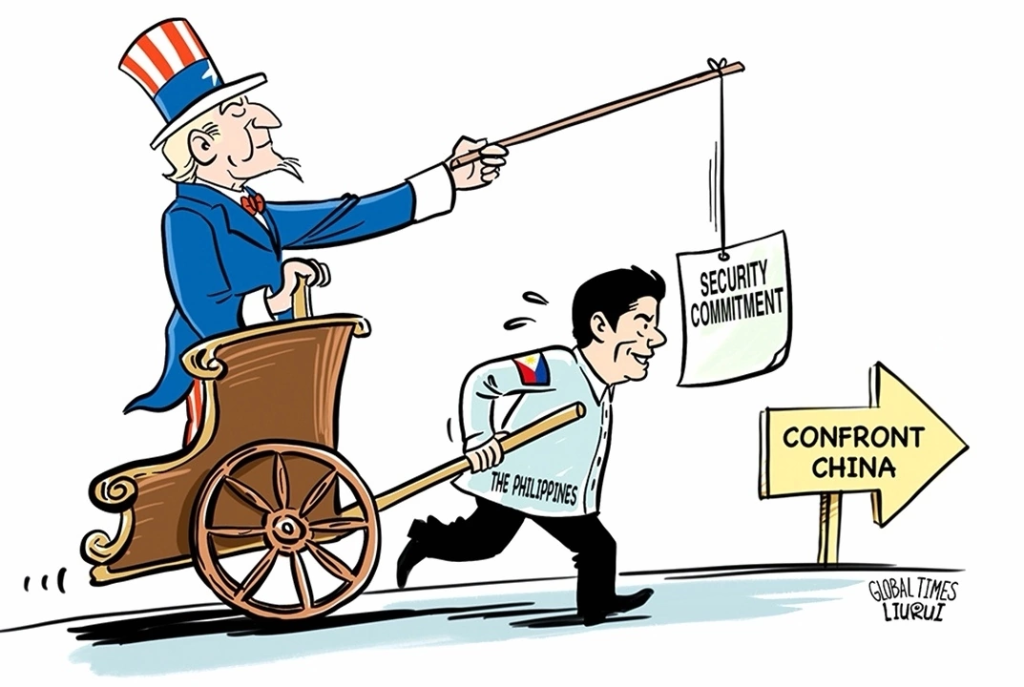
Is the Philippines becoming a US ‘proxy’ against Beijing in the South China Sea?

Is the Philippines becoming a US ‘proxy’ against Beijing in the South China Sea?

‘The ants that get trampled on’

Not everyone agrees with drawing closer to the US, however, and they warn about the Philippines turning into a “proxy” for American interests. The president’s own sister Imee, a senator, told ANC Digital earlier this month that “China will always be our neighbour, we have no fight with them, let’s not get dragged into a fight that’s not our own.”

Anna Rosario Malindog-Uy, director of the pro-China Asian Century Philippines Strategic Studies Institute, wrote in the Manila Times on February 10 that “agreements such as the EDCA, the VFA and the Mutual Defence Treaty have not only cemented the US military presence and influence in the Philippines but also, most importantly, exemplified the Philippines’ dependence on the US in the military and defence sector.”

Teresita Ang See, former president of the Philippine Association for Chinese Studies and currently part of its advisory council, told This Week in Asia: “Filipinos in general condemn China’s action. But many also understand that China’s assertiveness is in response to US, Japanese and Australian provocations and increasing military presence in the Philippines.”

She warned that “we are fighting a proxy war between the US and China and in the end we will be the ants that get trampled upon”.

H/T: Johnsonwkchoi

Related:

Responding to the Catholic Bishops

Philippines counts the cost of tough South China Sea stance against Beijing