Chinese Missile Boat Undertakes ‘Alarming’ Action

Chinese Missile Boat Undertakes ‘Alarming’ Action (archived)

A Chinese navy missile craft shadowed a Philippine civilian ship on Friday in an unprecedented encounter that one analyst described as “alarming.”

The Fisheries and Aquatic Resources (BFAR) vessel the BRP Datu Romapenet was en route to a South China Sea feature known as Half Moon Shoal to deliver supplies to fishermen.

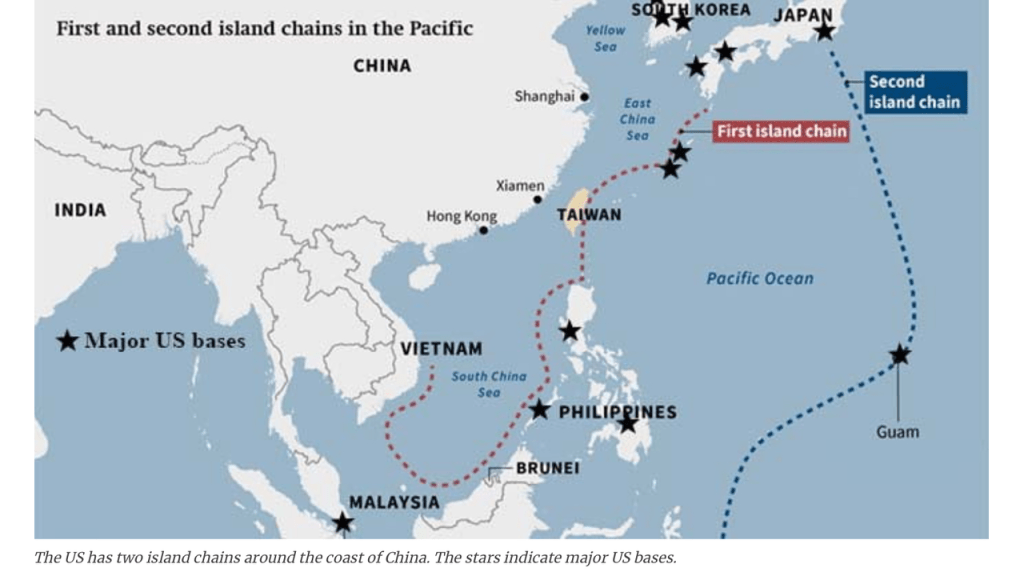
Half Moon Shoal is situated at the eastern edge of the Spratly Islands and about 60 miles from the Philippine province of Palawan, well within the Southeast Asian country’s recognized exclusive economic zone (EEZ).

According to the Philippines’ ABS-CBN News, which was onboard, the ship picked up a tail in the form of a Houbei-class (Type 22) guided-missile craft, easily identifiable by its wide camouflaged catamaran hull.

Chester Cabalza, founder of Manila-based think tank the International Development and Security Cooperation, told the news agency it was the first time a Type 22 had been spotted in the EEZ.

“This incident is alarming because a missile ship shadowed our BFAR ship,” Cabalza said, adding that it was a show of power intended to intimidate the Philippines.

Read More »

PH: America, Marcos and AFP can get us nuked

IF advocates of the United States’ access to bases of the Armed Forces of the Philippines (AFP) and US deployment of intermediate-range missiles prove the above headline unduly alarmist, this writer would be most thankful.

America, Marcos and AFP can get us nuked (archived)

Related:

Out-Competing China and Constraining Russia

Forget Hardened Bases, Pacific Conflict Requires Agile Combat Employment, Commander Says

The Plan to Defend Guam from Missile Threats Is Years from Completion: More Investment Is Needed Now

Ground-Based Intermediate-Range Missiles in the Indo-Pacific

The U.S. Alliance with the Philippines

US-South Korea drills ramp up amid North Korean nuclear threats

US-South Korea drills ramp up amid North Korean nuclear threats

Tensions are mounting on the Korean Peninsula as South Korea and the United States prepare for key annual joint military drills amid increasing nuclear threats from North Korea. The exercises, scheduled for Aug. 19-29, are designed to improve defenses against missile strikes, GPS jamming and cyber threats.

US-South Korea drills ramp up amid North Korean nuclear threats

MacArthur’s Last Stand Against a Winless War

If war breaks out in Asia, the U.S. won’t send ground troops. Take note, Philippines!

The Strategy of Denial, pp 117-118

MacArthur’s Last Stand Against a Winless War

Never get involved in a land war in Asia, MacArthur had told Kennedy, because if you do, you will be repeating the same mistake the Japanese made in World War II—deploying millions of soldiers in a futile attempt to win a conflict that cannot be won.

Kennedy appreciated MacArthur’s soothing judgment on Cuba (and would soon change the military’s top leadership—perhaps in keeping with MacArthur’s views), but then shifted the subject to Laos and Vietnam, where communist insurgencies were gaining strength. The Congress, he added, was pressuring him to deploy U.S. troops in response. MacArthur disagreed vehemently: “Anyone wanting to commit ground troops to Asia should have his head examined,” he said. That same day, Kennedy memorialized what MacArthur told him: “MacArthur believes it would be a mistake to fight in Laos,” he wrote in a memorandum of the meeting, adding, “He thinks our line should be Japan, Formosa, and the Philippines.” MacArthur’s warning about fighting in Asia impressed Kennedy, who repeated it in the months ahead and especially whenever military leaders urged him to take action. “Well now,” the young president would say in his lilting New England twang, “you gentlemen, you go back and convince General MacArthur, then I’ll be convinced.” So it is that MacArthur’s warning (which has come down to us as “never get involved in a land war in Asia”), entered American lore as a kind of Nicene Creed of military wisdom—unquestioned, repeated, fundamental.  

Full video

China unveils evidences showing Philippine grounded warship at Ren’ai Jiao destroys coral reefs, endangers marine organism

Source

While Manila mulls over filing a case against China with so-called “solid evidence of the damaged coral reefs caused by Chinese actions,” China, on Monday, released a report based on an unprecedentedly extensive and detailed on-site ecosystem survey around Ren’ai Jiao (also known as Ren’ai Reef), with solid evidence showing that the grounded warship has caused damage to the coral reefs and environmental pollution in the South China Sea.

China unveils evidences showing Philippine grounded warship at Ren’ai Jiao destroys coral reefs, endangers marine organism

Related:

(Full text in English) “Investigation Report on the Illegal “Beach” Warship Destroying the Coral Reef Ecosystem in Ren’ai Reef”

Experts warn of Philippines scheming for ‘new arbitration’ on South China Sea + More

Philippines rejects China’s accusation of environmental damage in South China Sea

China has in turn dredged sand and coral to build artificial islands in the South China Sea, which it says is normal construction activity on its territory, but which other nations say is aimed at enforcing its claim to the waterway.

A report by the Center for Strategic and International Studies last year found China’s construction activity buried more than 4,600 acres (1,861 acres) of reef.

China claims almost all of the vital waterway, where $3 trillion worth of trade passes annually, including parts claimed by the Philippines, Brunei, Malaysia, Taiwan and Vietnam.

Greg Poling, from the front CSIS, claims that Vietnam is also building artificial islands.