The implementation of yet another U.S. initiative may allow it to interfere in the information policy of ASEAN and control the cyberspace of all of Southeast Asia.
This reminds me of the tech camps that were held in Ukraine before the Euromaidan. Anyone who has been following me for a while knows where that led to.Except, replace China with Russia.
The Philippine military opened two weeks of combat drills Monday that would include seizing an island in the disputed South China Sea and likely be frowned upon by China.
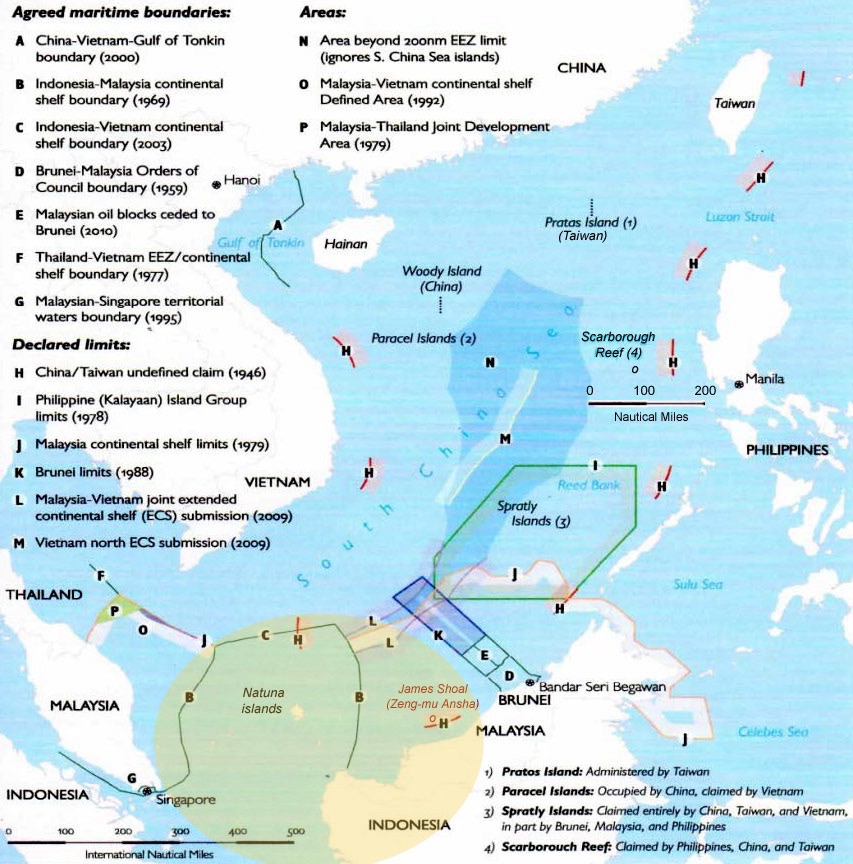
On Monday, Indonesia’s coast guard “drove out” a China Coast Guard cutter that was shadowing a survey vessel in Indonesian waters of the South China Sea. On Tuesday, the Chinese vessel was back again in the same spot, according to maritime security expert Ray Powell.
…
Geo Coral is a Norwegian-owned geophysical vessel flagged in Norway. She is operating under charter to PT Pertamina, Indonesia’s state-owned oil company, to conduct a 3D seismic survey off the Natuna Islands. “Pertamina East Natuna is focusing on oil and gas exploration activities in the East Natuna Working Area [East Natuna gas field], which has great potential to contribute to national energy security,” said a Pertamina spokesman on Tuesday.
Vladimir Putin answered questions from the heads of leading BRICS media agencies. The meeting was held ahead of the BRICS summit in Kazan.
The meeting was attended by the heads of media agencies from Brazil, China, Egypt, Ethiopia, India, Saudi Arabia, South Africa, and the UAE. It was moderated by Head of the Rossiya Segodnya Media Group Dmitry Kiselev.
US National Security Adviser Jake Sullivan has recently claimed the US is not “looking for a crisis.”This is said, of course, with an important caveat – no crisis is sought as long as China subordinates itself to the United States.
As China rises, Asia rises with it. The Southeast Asian state of the Philippines stood to rise alongside the rest of the region until relatively recently as the United States successfully convinces the Philippines to do otherwise.
The Philippine Fact-Checker Incubator was established with the financial backing of Facebook, in collaboration with VERA Files and Rappler. The incubated organizations include ABS-CBN News & Current Affairs, Manila Broadcasting Company, MindaNews, Philstar.com, PressONE.ph, and Probe Productions. They are accredited by the International Fact-Checking Network. – PFCI, Poytner.
Poynter Institute has been funded by the Gates Foundation, the Koch Network, the National Endowment for Democracy, the Omidyar Network, and Open Society Foundations. Other sponsors are CNN, the Scripps Howard Foundations, Craig Newmark Philanthropies, the Ethics and Excellence in Journalism Foundation, TEGNA Foundation, etc..
China’s hybrid “state capitalist” system, driven by centralized planning and fierce competition, has led to dominance in critical technological fields and emerging markets. Western multinational corporations are advised to adopt a pragmatic approach to capitalize on four key strengths of China’s economy: its innovation ecosystem, its investment in the Global South, its ultra-competitive markets, and its vast consumer base. Those who fail to engage risk losing global revenue and strategic opportunities.
Never get involved in a land war in Asia, MacArthur had told Kennedy, because if you do, you will be repeating the same mistake the Japanese made in World War II—deploying millions of soldiers in a futile attempt to win a conflict that cannot be won.
…
Kennedy appreciated MacArthur’s soothing judgment on Cuba (and would soon change the military’s top leadership—perhaps in keeping with MacArthur’s views), but then shifted the subject to Laos and Vietnam, where communist insurgencies were gaining strength. The Congress, he added, was pressuring him to deploy U.S. troops in response. MacArthur disagreed vehemently: “Anyone wanting to commit ground troops to Asia should have his head examined,” he said. That same day, Kennedy memorialized what MacArthur told him: “MacArthur believes it would be a mistake to fight in Laos,” he wrote in a memorandum of the meeting, adding, “He thinks our line should be Japan, Formosa, and the Philippines.” MacArthur’s warning about fighting in Asia impressed Kennedy, who repeated it in the months ahead and especially whenever military leaders urged him to take action. “Well now,” the young president would say in his lilting New England twang, “you gentlemen, you go back and convince General MacArthur, then I’ll be convinced.” So it is that MacArthur’s warning (which has come down to us as “never get involved in a land war in Asia”), entered American lore as a kind of Nicene Creed of military wisdom—unquestioned, repeated, fundamental.
DARWIN, July 26 (Reuters) – The U.S. military is building infrastructure in northern Australia to help it project power into the South China Sea if a crisis with China erupts, a Reuters review of documents and interviews with U.S. and Australian defence officials show.
SYDNEY – A remote Australian island close to an Indian Ocean chokepoint for Chinese oil shipments is on a list of possible locations for US military construction aimed at deterring China, with the US saying it “may or may not” support American forces.

 Ms. Cat’s Chronicles
You must be logged in to post a comment.