
Related:
Read More »Tag: Spratly Islands dispute
The Philippines’ Fishermen Front Line: the KBBM Program Exposed
A timely reminder for me to dig deeper into my research on the Philippines’ maritime militia, the PERA Act folded into the latest NDAA, and the SeaLight Foundation.
The Philippines’ Fishermen Front Line: the KBBM Program Exposed
Previously:
Read More »China accuses Philippines of ‘premeditated’ provocations near Sabina Shoal + more
Beijing has accused Manila of organising a “premeditated” provocation and dangerous manoeuvres near a disputed reef in the South China Sea, and Washington of making false statements that have escalated tensions in the region.
Manila said Philippine fishing boats near Sabina Shoal had been targeted with water cannons by Chinese coastguard ships in an incident on Friday, while Beijing said Philippine personnel had threatened Chinese officers with knives.
Chinese foreign ministry spokesman Guo Jiakun said on Monday that the Philippines had assembled a large number of vessels “in an organised and premeditated manner to provoke trouble” in waters near the shoal.
[SCMP] China accuses Philippines of ‘premeditated’ provocations near Sabina Shoal (archived)
Related:
Read More »Filipino fishermen injured in China Coast Guard encounter
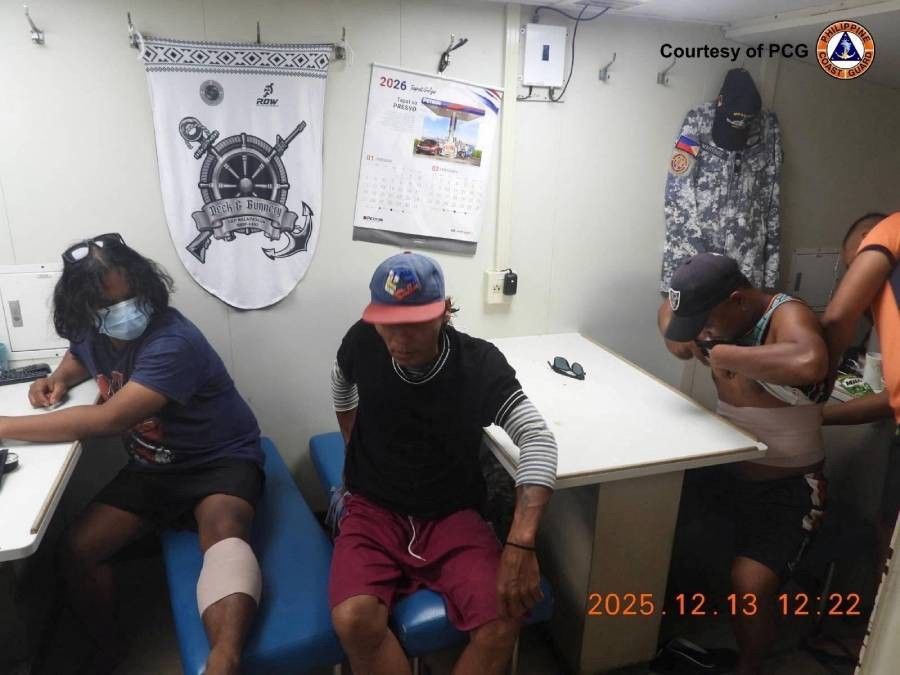
[Aaron-Matthew Lariosa] VIDEO: China Coast Guard Blasts Fishermen With Water Cannon Near Sabina Shoal, Philippines Dispatches Patrol Boats
Read More »The Great Filipino Fishermen Scandal
Updated: Philippines accuses China of ramming vessel near disputed island as tensions soar
WATCH: A China Coast Guard vessel (CCG 21559) fired a water cannon and rammed the BRP Datu Pagbuaya near Pag-asa Island this Sunday morning while the ship was assisting Filipino fishermen under the “Kadiwa para sa Bagong Bayaning Mangingisda” program, the PCG reports.
The incident occurred after CCG and Chinese militia vessels made dangerous maneuvers around anchored BFAR ships. CCG 21559 fired at 9:15 AM and rammed the BRP Datu Pagbuaya at 9:18 AM, causing minor damage but no injuries. (Video courtesy of PCG) | via Christine Boton
Related:
Update: I missed this one. Yesterday’s maritime incident happened near Sandy Cay, which is approximately 1.5 nautical miles from Thitu Island.
Read More »The August 11 SCS Incident & US-Backed Fisherfolk Collectives in the Philippines
Note that Scarborough Shoal is in disputed territory: What’s Really Going On In the South China Sea Between the Philippines and China.
Scarborough Shoal Incident 2.0: The PLAN Inches Closer to War (archived)
A Chinese People’s Liberation Army Navy (PLAN) destroyer and China Coast Guard (CCG) cutter collided 10.5 nautical miles east of Scarborough Shoal in the Philippines’ exclusive economic zone (EEZ) on the morning of 11 August. It marked the second time China has been embarrassed by the Philippines in these waters. This time, the results appear to have been deadly, as at least four members of the CCG were either severely injured or killed during the violent collision.
…
The latest incident appears to have been set in motion by an order from a Chinese higher authority, most likely the Central Military Commission’s (CMC’s) Joint Operations Center (JOC), to disrupt the Philippine Coast Guard’s “Kadiwa ng Bagong Bayaning Mangingisda (KBBM)” program. The KBBM initiative was unveiled in May 2025 with the intent to provide Philippine fishermen with food security and resupply at sea [See KBBM, below]. Analysis of Automatic Identification System (AIS) data indicates many CCG cutters were arrayed around Scarborough Shoal on 11 August, and as Philippine CG cutters entered waters 20–30 nm around the shoal, CCG and PLAN ships converged on the Philippine cutters to disrupt their food supply operations.
For more than an hour, PLAN guided-missile destroyer Guilin and CCG cutter 3104 conducted a high-speed pursuit of the Philippine Coast Guard cutter BRP Suluan. Based on the events during this pursuit, it appears the CMC JOC ordered the use of physical force to stop the Philippine Coast Guard from their mission. According to Armed Forces of the Philippines Chief of Staff General Romeo Brawner, “Our assessment is that the real objective of the PLA Navy ship is to ram our Philippine Coast Guard (vessel). That is also (the) assessment of our Philippine Coast Guard.”
FYI, the author of the above article is one of the founding members of the hawkish Committee on the Present Danger: China. You’ll also find information on the first Scarborough Shoal incident in here, also known as the Scarborough Shoal standoff: August 11 SCS – James E. Fanell – SeaLight.
Background:
Read More »Former President Duterte and the farce of international justice
Capes, Cameras, and the Cult of Visibility
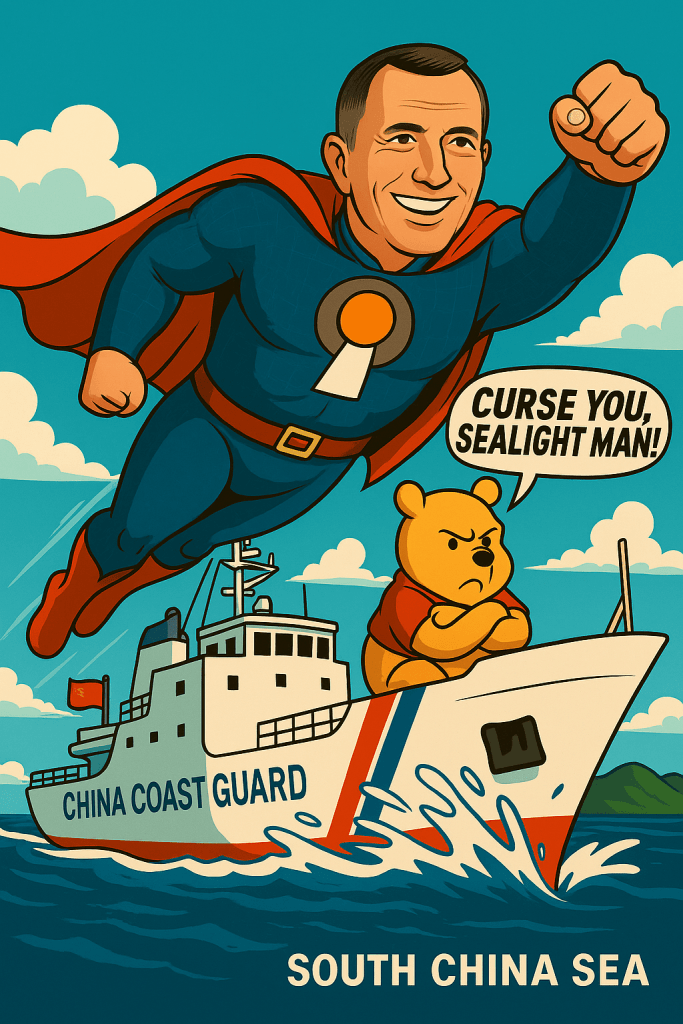
Capes, Cameras, and the Cult of Visibility: The SeaLight Crusade as White Savior Theater
By Tina Antonis
The South China Sea is more than a maritime dispute—it’s a theater of narrative warfare. While headlines focus on Chinese aggression and Philippine resistance, a quieter campaign unfolds in the background: one of satellite feeds, curated imagery, and Pentagon-backed storytelling. At the center of this effort is SeaLight, a project that claims to illuminate truth but often casts shadows of its own.
As explored in my article at Antiwar.com, SeaLight doesn’t just document—it performs. It reframes geopolitical tension through moral spectacle, positioning its creators as heroic arbiters of transparency. But when the messenger wears a cape and the funding flows from defense budgets, we must ask: is this clarity, or choreography?
Stage Left: The White Savior Enters
In the comic-strip cosmology of Ray Powell’s SeaLight project, transparency wears a cape. Clad in heroic postures and backed by satellite imagery, Powell casts himself as the guardian of maritime morality—unarmed, except with satellite feeds, theatrical flair, and strategic messaging.
Yet beneath the cartoon and Pentagon-funded optics lies a familiar archetype: the white savior, rebranded for the South China Sea.
China Is Imperialist? Says Who?
Calling China a “maritime occupier,” Powell positions himself as a bulwark against aggression. But that moral pose collapses under scrutiny. He speaks for a country with over 800 foreign military installations and a documented history of over 250 military interventions since 1991—wars in Iraq, Afghanistan, Libya, Syria, Somalia, and dozens more, all under the banner of peace, freedom, or preemption.
By comparison, China’s post–Cold War footprint includes no sustained foreign occupations and only scattered border conflicts and peacekeeping missions. The imbalance is staggering. And Powell’s framing doesn’t just ignore it—it performs around it.
As David Vine argues in The United States of War, this vast base empire is not a passive network—it’s an architecture of perpetual war. These outposts make military engagement not an exception but a structural habit, cloaked in strategic necessity and sold as global stewardship.
Powell’s cartoon rhetoric—calling China an occupier—obscures the scale of U.S. militarism. The term “occupation” is deployed not to analyze, but to project. When adversaries hold territory, it’s a crisis; when the U.S. spans the globe with armed installations, it’s policy.
Framing Conflict: The Optics of Consent
This isn’t irony. It’s performance. Powell’s language manufactures a moral frame for confrontation—costumed in transparency, but driven by escalation. The cape is literal. The conditioning is deliberate. And the stage is set for war.
SeaLight’s mission is not just visual documentation—it’s narrative warfare. As the Japan Times openly notes, its “chief weapon is photography, applied purposefully, generously and consistently over time.” These images—enhanced, curated, and distributed across media—are not neutral. They’re constructed to shape public perception, sway international opinion, and ultimately manufacture consent for confrontation.
Assertive transparency becomes a kind of ideological scaffolding—a stage on which geopolitical tension is dramatized, simplified, and morally polarized. The goal isn’t simply to reveal conflict; it’s to condition audiences for escalation.
And when the messenger dons a superhero’s cape, the spectacle transforms into something deeper: a story of rescue, of virtue, of intervention. This is not analysis—it’s soft propaganda dressed in heroic metaphor.
Consent for war doesn’t begin with missiles. It begins with mythmaking.
 Ms. Cat’s Chronicles
You must be logged in to post a comment.