Philippines’ Aggressive Territorial Claims In South China Sea: A New Threat to Regional Stability

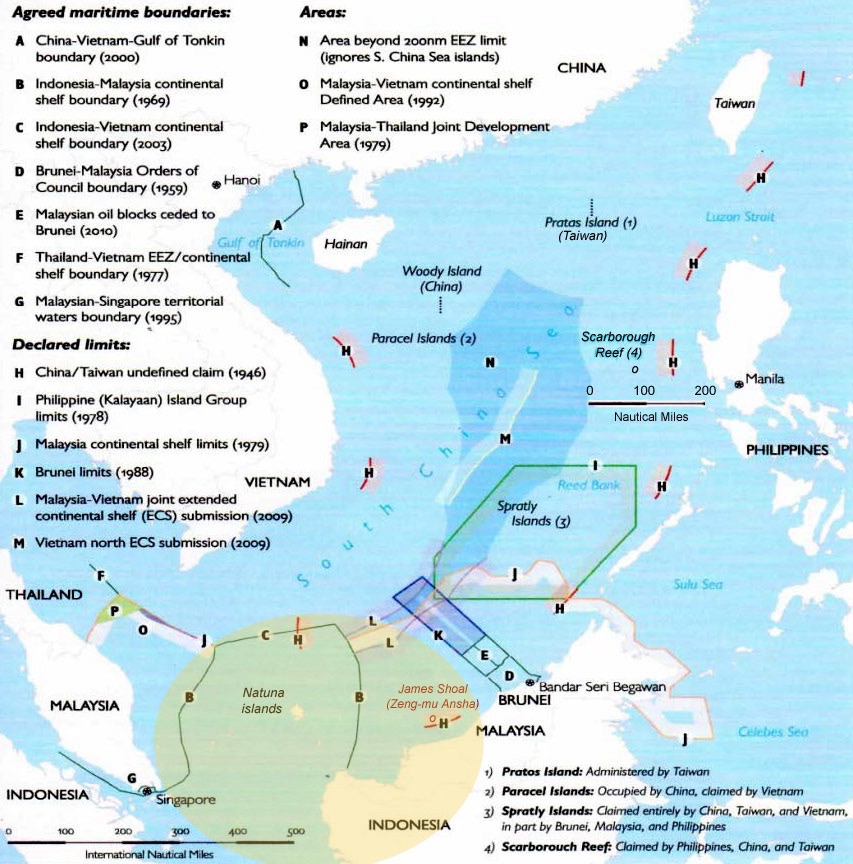
Philippine President Ferdinand Marcos Jr. has appointed a new Navy chief (Rear Admiral Jose Ma. Ambrosio Ezpeleta) amid tensions in the South China Sea, which include a number of maritime drills which are perceived as provocations by Beijing. One such military exercise earlier this month, for instance, included drills to simulate seizing an island in the disputed South China Sea. Last month Manila held military exercises in the same Sea together with Canada, Japan, and the United States, as part of Exercise Sama Sama 2024. The Philippines are also officially expanding their maritime claims. These developments are all connected.

Philippines’ Aggressive Territorial Claims In South China Sea: A New Threat to Regional Stability (archived)

Related:

What’s Really Going On In the South China Sea Between the Philippines and China

China looks to Indonesia for diplomatic resolution after coastguards’ Natuna encounters + More

China looks to Indonesia for diplomatic resolution after coastguards’ Natuna encounters

Source

Related:

[10-23-2024] Indonesian Coast Guard “Drives Out” Chinese Vessel Shadowing Seismic Ship (archived)

On Monday, Indonesia’s coast guard “drove out” a China Coast Guard cutter that was shadowing a survey vessel in Indonesian waters of the South China Sea. On Tuesday, the Chinese vessel was back again in the same spot, according to maritime security expert Ray Powell.

Geo Coral is a Norwegian-owned geophysical vessel flagged in Norway. She is operating under charter to PT Pertamina, Indonesia’s state-owned oil company, to conduct a 3D seismic survey off the Natuna Islands. “Pertamina East Natuna is focusing on oil and gas exploration activities in the East Natuna Working Area [East Natuna gas field], which has great potential to contribute to national energy security,” said a Pertamina spokesman on Tuesday. 

Read More »

Less politics more marine diplomacy – a fix for South China Sea?

Territorial wrangling over who owns the South China Sea has strangled local marine life, say scientists, urging China and the Philippines to set aside political differences and work to save the fish, coral and plants that live border-free.

Since 2013, China has built artificial islands that cover more than 3,000 acres of the Spratlys, according to U.S.-based policy organisation Asia Maritime Transparency Initiative.

A study last December by the Asia Maritime Transparency Initiative also blamed China’s dredging and clam harvesting for destroying almost 20,000 acres of reefs in the South China Sea.

Less politics more marine diplomacy – a fix for South China Sea?

The Asia Maritime Transparency Initiative (AMTI) is part of the Center for Strategic and International Studies (CSIS). Gregory Poling is director of the AMTI. The same Poling that told the U.S. government-funded Voice of America that “Vietnam’s use of cutter suction dredgers is much more environmentally destructive than its previous dredging methods.

According to the CIA’s World Factbook, Vietnam occupies around 50 outposts, The Philippines occupies nine, Malaysia occupies five, and China occupies seven in the disputed Spratly Islands.

Previously:

China unveils evidences showing Philippine grounded warship at Ren’ai Jiao destroys coral reefs, endangers marine organism

Experts warn of Philippines scheming for ‘new arbitration’ on South China Sea + More

Vietnamese Poachers using Cyanide and Dynamite Fishing in the Philippines’ EEZ

Philippine Coast Guard clarifies ‘assertive transparency’ tact

Chinese Missile Boat Undertakes ‘Alarming’ Action

Chinese Missile Boat Undertakes ‘Alarming’ Action (archived)

A Chinese navy missile craft shadowed a Philippine civilian ship on Friday in an unprecedented encounter that one analyst described as “alarming.”

The Fisheries and Aquatic Resources (BFAR) vessel the BRP Datu Romapenet was en route to a South China Sea feature known as Half Moon Shoal to deliver supplies to fishermen.

Half Moon Shoal is situated at the eastern edge of the Spratly Islands and about 60 miles from the Philippine province of Palawan, well within the Southeast Asian country’s recognized exclusive economic zone (EEZ).

According to the Philippines’ ABS-CBN News, which was onboard, the ship picked up a tail in the form of a Houbei-class (Type 22) guided-missile craft, easily identifiable by its wide camouflaged catamaran hull.

Chester Cabalza, founder of Manila-based think tank the International Development and Security Cooperation, told the news agency it was the first time a Type 22 had been spotted in the EEZ.

“This incident is alarming because a missile ship shadowed our BFAR ship,” Cabalza said, adding that it was a show of power intended to intimidate the Philippines.

Read More »

Alleged Chinese Nuclear Submarine Sinking: Separating Facts From Bullshit

Source

Western defence media has recently been buzzing with the story of a Chinese SSN allegedly sinking in the Yangtze River near Wuhan. But is it actually true? We take a look at the likelihood of this.

Alleged Chinese Nuclear Submarine Sinking: Separating Facts From Bullshit

Related:

China denies U.S. claim that its newest nuclear submarine sank at pier

A growing problem of ‘deepfake geography’: How AI falsifies satellite images (Archived)