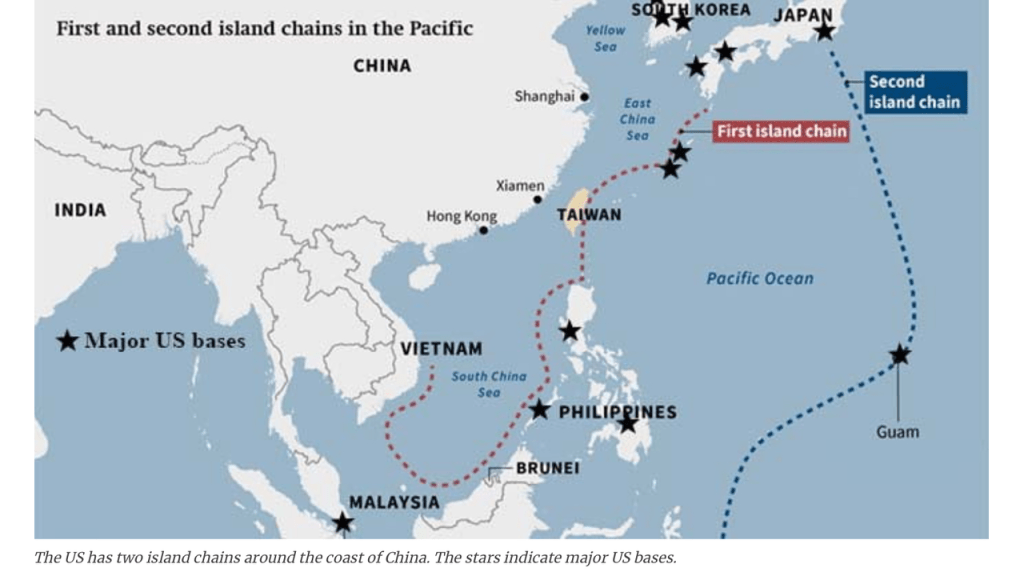
US Keeps Missile System in Philippines as China Tensions Rise, Tests Wartime Deployment

Source

MANILA (Reuters) – The United States has no immediate plans to withdraw a mid-range missile system deployed in the Philippines, despite Chinese demands, and is testing the feasibility of its use in a regional conflict, sources with knowledge of the matter said.

US Keeps Missile System in Philippines as China Tensions Rise, Tests Wartime Deployment

Previously:

Philippines aims to acquire Typhon missile launcher as regional arms race intensifies

Skies over South China Sea seen as new flashpoint as Manila begins ‘aerial provocations’

Source

According to the article, Philippine aircraft also frequently operate with their Automatic Dependent Surveillance-Broadcast (ADS-B) transponders deactivated, significantly increasing safety risks.

Deactivating such transponders means real-time positioning of the aircraft is not shared with air traffic controllers and other aircraft, making it more difficult to maintain situational awareness and avoid potential conflicts or collisions.

Skies over South China Sea seen as new flashpoint as Manila begins ‘aerial provocations’

Related:

How far is China-Philippines Aerial Collision in the South China Sea?

Since August 2024, the Philippines has repeatedly dispatched military aircraft to trespass into the airspace of the Spratly Islands and Macclesfield Bank, escalating tensions in the region. On August 7 and 8, the Philippines sent an NC-212i aircraft to intrude into the airspace near Scarborough Shoal for two consecutive days, disrupting China’s regular training activities. On August 19, a Cessna 208B Grand Caravan plane (C-208B) was dispatched to illegally enter the airspace of Scarborough Shoal. On August 22, the Bureau of Fisheries and Aquatic Resources of the Philippines again sent a C-208B to illegally intrude into the vicinity of Subi Reef.

On the other hand, the Philippine aircraft in use are primarily single-engine turboprop light utility aircraft, which are less equipped to handle complex maritime environments, increasing the likelihood of accidents during frequent operations. Moreover, Philippine military aircraft usually operate with ADS-B transponders turned off throughout their missions, posing potential safety risks. In the event of an accident, whatever the reasons, based on past behavior, the Philippines would likely blame China, leading to another cycle of victim-playing and diplomatic posturing.

Philippines aims to acquire Typhon missile launcher as regional arms race intensifies

Source

China is against the deployment of the Typhon in the Philippines, which has been used in joint military exercises involving US troops

Philippines aims to acquire Typhon missile launcher as regional arms race intensifies

Related:

Foreign Ministry Spokesperson Lin Jian’s Regular Press Conference on August 30, 2024:

Bloomberg: The Philippines’ top military official said that the deployment of the US missile system in the country was mainly for training. China has been in the past said that the weapon system could be destabilizing. Does the Foreign Ministry have any comments on the recent comments by the Philippines’ military chief?

Lin Jian: On the US deployment of Mid-Range Capability missile system in the Philippines, China has made clear our opposition more than once. This move by the US and the Philippines incites geopolitical confrontation, escalates tensions in the region, and harms regional peace and stability. It has aroused high vigilance and concerns of countries in the region. The Philippines needs to have a clear understanding of the real intention of the US, respond to the common concerns of regional countries, avoid acting as the cat’s paw for the US at the expense of its own security interest, and quickly pull out the missile system as publicly pledged.

Sabina shoal new US tension spot

Harry B. Harris Jr., former commander of INDOPACOM, explains that the United States doesn’t recognize anyone’s territorial claims. Full video.

While one side of the split personality of PBBM worked out with China a deesclation scheme for the Ayungin Shoal Rotation and Resupply (RORE) missions to the unrealizable U.S. Forward Operating Base (US-FOB) BRP Sierra Madre frustrating its “assertive transparency” strategy, the other lobotomized side of BBM’s brain taken over by the Americans thought up the Sabina Shoal BRP Sierra Teresa Magbanua US-FOB as a new locus for tension to propagandize.

Sabina shoal new US tension spot

Chinese and Philippine ships collide at Sabina Shoal, a new flash point + More

Source

The incident, the first time in decades that Beijing and Manila have clashed over the Sabina Shoal, may derail efforts to lower tensions in the South China Sea.

Chinese and Philippine ships collide at Sabina Shoal, a new flash point (archived)

Related:

CCG restricts repeated Philippine vessel intrusions near South China Sea reefs

Chen Xiangmiao, director of the World Navy Research Center at the National Institute for South China Sea Studies, told the Global Times on Monday that the Philippines sees Xianbin Jiao as a transfer station for its resupply missions to Ren’ai Jiao, as Xianbin Jiao is located between Ren’ai Jiao and the Philippines’ Palawan Province.

[08-16-24] Foreign Ministry Spokesperson’s Remarks on the Philippine Coast Guard Vessel’s Illegal Anchoring in the Lagoon of Xianbin Jiao

[08-14-24] Exclusive: Manila to deploy new vessel for ‘semi-permanent presence’ at China’s Xianbin Jiao, breaking its promise: source

Philippine media have hyped the China Coast Guard’s (CCG) presence in the Xianbin Jiao, but it is the Philippines that has sent the MRRV-9701 to the area in the first place. The Philippine ship anchored in the lagoon of the Xianbin Jiao in April, with a CCG ship arriving later in July.

Updated on 07-27-2024: SeaLight, formerly Project Myoushu

Powell’s storytelling:

Read More »

US military, seeking strategic advantages, builds up Australia’s northern bases amid China tensions

Source

DARWIN, July 26 (Reuters) – The U.S. military is building infrastructure in northern Australia to help it project power into the South China Sea if a crisis with China erupts, a Reuters review of documents and interviews with U.S. and Australian defence officials show.

US military, seeking strategic advantages, builds up Australia’s northern bases amid China tensions

Related:

US military eyes Australia’s Indian Ocean toehold to deter China

SYDNEY – A remote Australian island close to an Indian Ocean chokepoint for Chinese oil shipments is on a list of possible locations for US military construction aimed at deterring China, with the US saying it “may or may not” support American forces.

Australian-based Marines ready to support Manila in sea-territory skirmish

NO to US-BBM War, NO to EDCA Bases! Blinken-Austin Get Out, Stay Out!

The Philippines and China have just restored peace and stability in the areas of the South China Sea contested by the two countries in a July 21, 2024 “de-escalation” deal that aimed at “easing tensions.”

NO to US-BBM War, NO to EDCA Bases!
Blinken-Austin Get Out, Stay Out!

Related:

NO to US-BBM War, NO to EDCA Bases! – Cebu

NO to US-BBM War, NO to EDCA Bases! Blinken-Austin Get Out, Stay Out! Forum Statement

Washington’s Use and Abuse of the Philippines Takes Next Step

Australian-based Marines ready to support Manila in sea-territory skirmish

Australian-based Marines ready to support Manila in sea-territory skirmish

“We were given a warning order to support the Philippines defense forces in resupplying of the Second Thomas Shoal,” Marine Rotational Force — Darwin commander Col. Brian Mulvihill told Stars and Stripes on Wednesday at an Outback training camp in the Northern Territory.

The Marines have been monitoring events at the shoal over a drone feed, Mulvihill said.

“We were ready to support the Philippine defense forces,” he said, noting that Marines across the Pacific are also ready to back the U.S. ally.

The rotational force can airlift food and water by pushing pallets out of helicopters, he added.

“We can control airspace and aircraft from many nations,” he said. “We provide a range of options if a host nation, through the embassy, requires assistance.”

Darwin is an excellent platform for launching forces into Southeast Asia, according to Grant Newsham, a retired Marine colonel and senior researcher with the Japan Forum for Strategic Studies in Tokyo. 

“It’s good to see Darwin and Northern Territory being used this way … rather than just as a training area for Marines, Air Force, and Australian and other forces,” he said by email Thursday.

The Marines can offer the Philippines fire support coordination. They can help with logistics and intelligence, surveillance and reconnaissance and guard locations that support Philippine forces operating towards the disputed shoal, he said.

“Of course, Marines can deploy aboard Philippine resupply boats alongside [Philippine] personnel,” he said.

Marine engineers could repair the Sierra Madre at the shoal and Marine helicopters could resupply it, Newsham added.

“A U.S. amphibious ship or two with Marines and their aircraft and other hardware aboard deployed to Second Thomas Shoal would be a serious force — and also sending a clear message,” he said. “Deploying Marines in the Philippines with their aviation, long-range rockets, and other hardware has a political significance in itself.”

Related:

Japan Forum for Strategic Studies

South China Sea: Philippines says to solely run Second Thomas Shoal resupply missions

SeaLight, formerly Project Myoushu