
Will Trump Strike Iran? And other news items
Read More »Tag: Staging areas
Report: Kurdish Fighters Have Been Entering Iran From Iraq and Clashing With the IRGC
Report: Kurdish Fighters Have Been Entering Iran From Iraq and Clashing With the IRGC
By Dave DeCamp | The Libertarian Institute | January 14, 2026
Turkish intelligence has warned Iran’s Islamic Revolutionary Guard Corps (IRGC) that Kurdish fighters have been entering Iran from Iraq amid protests inside Iran, Reuters reported on Wednesday.
…
The US has a significant presence in Iraqi Kurdistan, including a military base and an $800 million consulate compound that it opened in December. The Israeli Mossad is also known for having a presence in the area, and Iran claimed that it attacked a Mossad base in Iraqi Kurdistan in 2024.
Previously:
Trump Has Strong Options for Iran /Alastair Crooke & Lt Col Daniel Davis
These are the same Iraqi Kurds for whom the U.S. established the post‑1991 autonomous zone. Erbil Governorate sits on the Iran‑facing side of Iraqi Kurdistan. The U.S. operates Harir Air Base there (active since 2003) and maintains the largest consulate compound in the world. This is a forward U.S. position on Iran’s border. The U.S./Coalition also has units in Sulaymaniyah Governorate, which likewise borders Iran.
Trump Has Strong Options for Iran /Alastair Crooke & Lt Col Daniel Davis
Hidden Story Behind Trump’s Pardon? Peter Theil’s $11B Lawsuit in Honduras
How the US is preparing a military staging ground near Venezuela + the 160th SOAR(A)
The United States military is upgrading a long-abandoned former Cold War naval base in the Caribbean, a Reuters visual investigation has found, suggesting preparations for sustained operations that could help support possible actions inside Venezuela.
…
“The land is going to be next,” he said.
How the US is preparing a military staging ground near Venezuela
Related:
Venezuela Flashpoint: Real-Time Intelligence Analysis
Compounding these indicators is also the confirmed presence of United States special forces support assets (Ocean Trader / Night Stalkers) in the theatre of operations. Washington also authorised Langley to conduct covert action in Venezuela through a presidential finding reported on October through credible media outlets. Grey Dynamics’ real-time monitoring and analysis of the situation aims to deliver continuous updates and verified intelligence on the ongoing flashpoint.
Night Stalkers = 160th Special Operations Aviation Regiment (Airborne)
The 160th Special Operations Aviation Regiment (Airborne), abbreviated as 160th SOAR(A), is a special operations force of the United States Army that provides helicopter aviation support for special operations forces. Its missions have included attack, assault, and reconnaissance, and these missions are usually conducted at night, at high speeds, low altitudes, and on short notice.
Former President Duterte and the farce of international justice
Capes, Cameras, and the Cult of Visibility
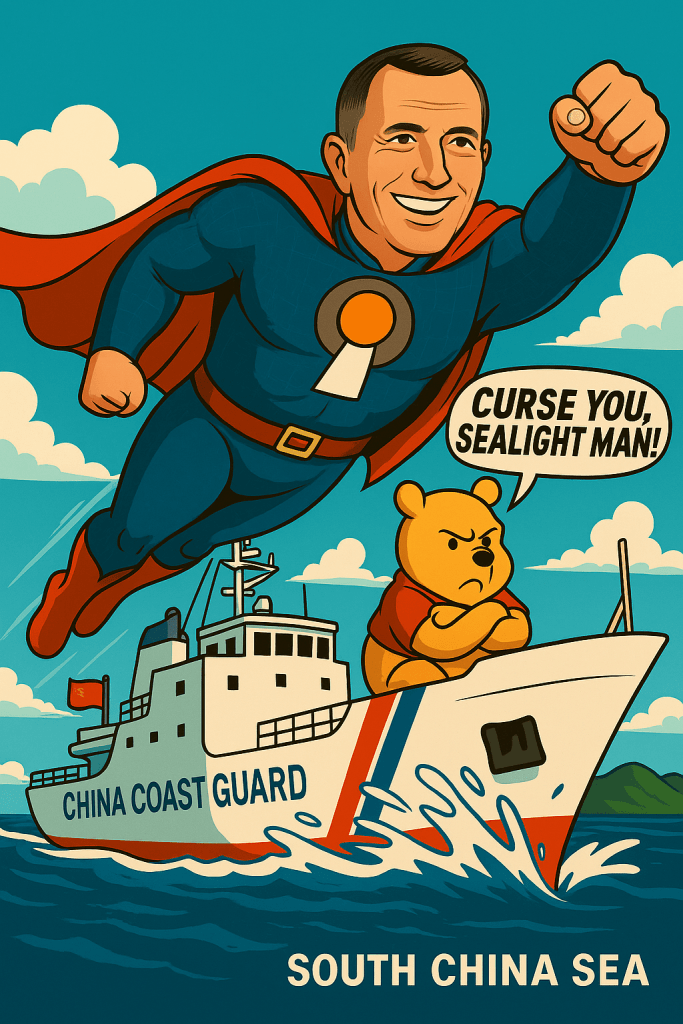
Capes, Cameras, and the Cult of Visibility: The SeaLight Crusade as White Savior Theater
By Tina Antonis
The South China Sea is more than a maritime dispute—it’s a theater of narrative warfare. While headlines focus on Chinese aggression and Philippine resistance, a quieter campaign unfolds in the background: one of satellite feeds, curated imagery, and Pentagon-backed storytelling. At the center of this effort is SeaLight, a project that claims to illuminate truth but often casts shadows of its own.
As explored in my article at Antiwar.com, SeaLight doesn’t just document—it performs. It reframes geopolitical tension through moral spectacle, positioning its creators as heroic arbiters of transparency. But when the messenger wears a cape and the funding flows from defense budgets, we must ask: is this clarity, or choreography?
Stage Left: The White Savior Enters
In the comic-strip cosmology of Ray Powell’s SeaLight project, transparency wears a cape. Clad in heroic postures and backed by satellite imagery, Powell casts himself as the guardian of maritime morality—unarmed, except with satellite feeds, theatrical flair, and strategic messaging.
Yet beneath the cartoon and Pentagon-funded optics lies a familiar archetype: the white savior, rebranded for the South China Sea.
China Is Imperialist? Says Who?
Calling China a “maritime occupier,” Powell positions himself as a bulwark against aggression. But that moral pose collapses under scrutiny. He speaks for a country with over 800 foreign military installations and a documented history of over 250 military interventions since 1991—wars in Iraq, Afghanistan, Libya, Syria, Somalia, and dozens more, all under the banner of peace, freedom, or preemption.
By comparison, China’s post–Cold War footprint includes no sustained foreign occupations and only scattered border conflicts and peacekeeping missions. The imbalance is staggering. And Powell’s framing doesn’t just ignore it—it performs around it.
As David Vine argues in The United States of War, this vast base empire is not a passive network—it’s an architecture of perpetual war. These outposts make military engagement not an exception but a structural habit, cloaked in strategic necessity and sold as global stewardship.
Powell’s cartoon rhetoric—calling China an occupier—obscures the scale of U.S. militarism. The term “occupation” is deployed not to analyze, but to project. When adversaries hold territory, it’s a crisis; when the U.S. spans the globe with armed installations, it’s policy.
Framing Conflict: The Optics of Consent
This isn’t irony. It’s performance. Powell’s language manufactures a moral frame for confrontation—costumed in transparency, but driven by escalation. The cape is literal. The conditioning is deliberate. And the stage is set for war.
SeaLight’s mission is not just visual documentation—it’s narrative warfare. As the Japan Times openly notes, its “chief weapon is photography, applied purposefully, generously and consistently over time.” These images—enhanced, curated, and distributed across media—are not neutral. They’re constructed to shape public perception, sway international opinion, and ultimately manufacture consent for confrontation.
Assertive transparency becomes a kind of ideological scaffolding—a stage on which geopolitical tension is dramatized, simplified, and morally polarized. The goal isn’t simply to reveal conflict; it’s to condition audiences for escalation.
And when the messenger dons a superhero’s cape, the spectacle transforms into something deeper: a story of rescue, of virtue, of intervention. This is not analysis—it’s soft propaganda dressed in heroic metaphor.
Consent for war doesn’t begin with missiles. It begins with mythmaking.
Hegseth visits Manila: Washington prepares for war with China + More
Hegseth visits Manila: Washington prepares for war with China
The language of Hegseth’s press conference in Manila is indicative of the openly aggressive face of US imperialism under Trump. Gone was any reference to what had been the political shibboleth of Washington in the Asia Pacific region: the defense of “freedom of navigation.” Hegseth spoke rather of “preparing for war,” using the phrase more than once. Every time Hegseth mentioned China he termed it “Communist China,” and spoke of its “aggression.” Hegseth referred to US Seventh fleet commander Admiral Samuel Paparo “and his war plans. Real war plans.”
Read More »
The Trumpists Agitating To Coup Honduras + More
The Trumpists Agitating To Coup Honduras
Prospera, a Peter Thiel-backed crypto ‘city’ running unregulated medical experiments on a Honduran island may very well be the spark for a US coup against Honduras this November.
…
Another group to have visited Prospera in recent weeks are Republicans for National renewal, a MAGA-aligned group founded by Mark Ivanyo, a former staffer in Trump’s first term Department of Justice. They touted Prospera as ‘similar to President Trump’s proposed Freedom Cities’ and also took aim at Castro, saying Prospera was ‘a bastion of pro-Americanism, economic freedom & Bitcoin acceptance in socialist Honduras.’
Prospera was also visited last week by Cremieux, an anonymous twitter account regularly retweeted by Elon Musk (and likely run by more than one white crypto-libertarian type) that helps set the libertarian discourse.
Given these links it’s inconceivable that Trump hasn’t heard about Prospera and the threats to its existence. Marco Rubio, a man aggressively hostile to anything that looks or smells like socialism in Latin America, almost certainly has as well. It was telling that he didn’t bother visiting Honduras on his recent trip to Latin America, his first outside the US.
I’ve strongly suspected that these so-called ‘Network States’ would be used as staging grounds for regime change operations. I am aware of the ones in Venezuela and Brazil, as well as a few others in Africa.
Related:
Read More »Syria Today, Iran Tomorrow, and Inevitably China
The collapse of the Syrian government in mid-December 2024 represents a pivotal moment for U.S. geopolitical strategies in the Middle East and beyond.
 Ms. Cat’s Chronicles
You must be logged in to post a comment.