
Washington’s “Second Coming” to Asia: Militants, Ports, and Pressure Points

Source

President Trump’s renewed focus on regaining the Bagram Air Base and developing Pakistan’s Pasni Port signals Washington’s attempt to reassert strategic influence in a region increasingly dominated by China, Russia, and Iran.

Washington’s “second coming” to Asia

Pakistan’s Pasni Port, located in Balochistan province, sits at the crossroads of strategic infrastructure and insurgent resistance. The Western-backed Baloch Liberation Army (BLA), active in the region, has long targeted Chinese-financed projects. The BLA maintains ties with both the Pakistan Taliban and ISIS-K—a faction recently linked to recruiting Uygur militants. Separately, U.S. support for Uygur militants predates this trend, with allegations tracing back to the 1970s/1980s. Rep. Perry has claimed that ISIS-K received backing from USAID, adding another layer to the region’s militant entanglements. 

This only deepens my suspicion that recapturing Bagram Air Base could serve as a launchpad—not merely for tactical leverage, but to stir Uygur militant resistance against Beijing or pressure China with a second front in the event of a future Pacific conflict.

Sources:

BLA: U.S. Proxies in Balochistan document

ISIS-K & Uygur militants: ISIS has its sights set on a new potential ally—Uyghur jihadi groups

CIA & Uygur militants: US & TERRORISM IN XINJIANG

Uygur militants: *Xinjiang*

USAID & ISIS-K: Rep. Perry reveals what some of us already knew about USAID

Bagram Air Base: Why Does Trump Want U.S. Troops Back in Afghanistan?
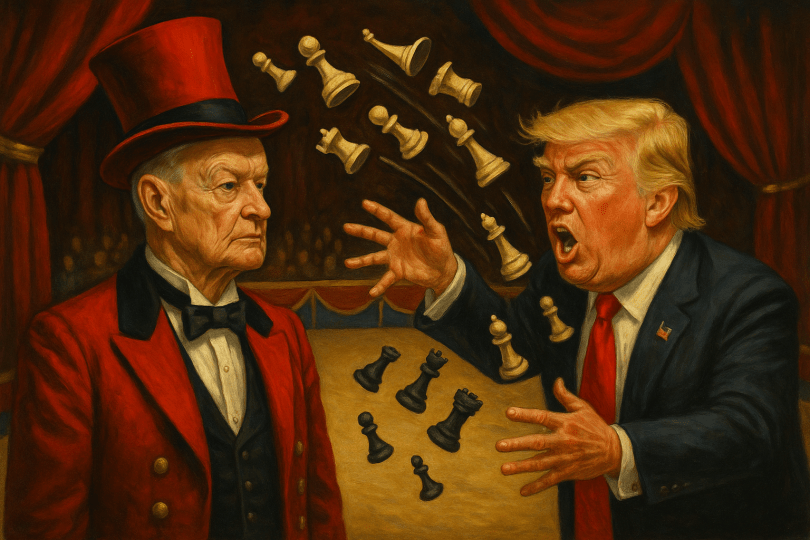
Bonus: Chokepoints Are The Focus Of A New Cold War

China Has Quietly Won the Trade War—and Now Leads the World

China has quietly won the trade war and is now reshaping global leadership—not through force, but through strategy, stability, and vision. It’s time for the West to learn, adapt, and embrace a shared future led by a preponderant China.

“There are decades where nothing happens; and there are weeks where decades happen.”
—Vladimir Lenin

China Has Quietly Won the Trade War—and Now Leads the World (archived)

H/T: The Most Revolutionary Act

Related:

Quote Origin: Days Into Which 20 Years Are Compressed

On Tariffs, It’s Good to Be “Tim Apple”

Tariffs are advertised in the name of helping American workers, but what do you know? They turn out to favor the powerful and politically connected. That’s the main message of President Trump’s decision to exempt smartphones and assorted electronic goods from his most onerous tariffs.

On Tariffs, It’s Good to Be Tim Cook

Related:

Tim Cook gifted Donald Trump a $6,000 Mac Pro after he lowered tariffs on parts Apple needed from China

At the time Apple and Cook were applying a charm offensive to persuade then-President Trump to remove tariffs on certain components that came from China. Cook asked Trump if he could meet him in person to make Apple’s case, a gesture the former president found “impressive,” he told Bloomberg. Trump was particularly pleased at the time that Cook reached out, especially considering his acrimonious relationship with other tech CEOs. 

[2019] Apple dodges iPhone tariff after Trump confirms trade deal agreement with China

Although the trade deal affects billions of dollars worth of goods, it’s a particular victory for Apple CEO Tim Cook, who has personally worked to keep communication open with the Trump administration. Cook’s charm offensive culminated last month when he gave Trump a tour of a Mac Pro assembly plant in Texas. That computer is assembled in the United States, and Apple was granted tariff waivers for several of its components.

USAID Updates

Trump aides circulate plan for complete revamp of foreign aid programs

— Placing the Millennium Challenge Corporation and the U.S. Trade and Development Agency under the auspices of the U.S. International Development Finance Corporation. The combined entity would focus on promoting private sector investment, especially in areas such as infrastructure, energy and technology. The document says the new approach would be a powerful counterweight to China’s Belt and Road Initiative, which Beijing has used to gain economic and diplomatic footholds in many countries.

Read More »

Bangladesh’s Constitution reform: Sweeping changes in the constitution

Source

Constitution reform: Sweeping changes in constitution

Expanding the fundamental rights to include food, clothing, shelter, education, internet, and vote, the Constitution Reform Commission proposes replacing nationalism, socialism, and secularism with equality, human dignity, social justice and pluralism as fundamental principles of state policy.

Modifying, the much discussed article 70, the commission recommends that parliamentarians be allowed to vote against party line except finance bills.

The constitution commission recommends deletion of the constitutional provision that stipulates inclusion of Bangabandhu Sheikh Mujibur Rahman’s speech of March 7, 1971, his declaration of independence and the proclamation of independence, which are included in the 5th, 6th and 7th schedules respectively.

FYI, it was written by International IDEA, which is funded by USAID, Open Society Foundations, and several Western governments.

Related:

Leaked files expose covert US government plot to ‘destabilize Bangladesh’s politics’

Atlantic Council’s Ali Riaz to lead commission on constitutional reforms for Bangladesh

Bangladesh and Kenya document