CSIS advises US to prepare for possible redeployment of tactical nukes to S. Korea

A Washington think tank is advising the US government to review military exercises in preparation for the redeployment of tactical nuclear weapons in South Korea. The think tank also advised the US to consider partial sanctions relief for North Korea on the condition that it ceases its nuclear weapons and missile tests.

CSIS advises US to prepare for possible redeployment of tactical nukes to S. Korea

H/T: WENT2THEBRIDGE.ORG

Biden calls global warming bigger threat to humanity than nuclear war during NYC speech

Twitter.

President Biden gave Manhattan donors an update on his thoughts about nuclear war Tuesday, saying that he currently views global warming as a greater threat — less than four months after he casually told a different set of New York City donors that the world was close to nuclear “Armageddon.”

Biden calls global warming bigger threat to humanity than nuclear war during NYC speech

Opinion: Blinken ponders the post-Ukraine-war order

Opinion: Blinken ponders the post-Ukraine-war order

Crimea is a particular point of discussion. There is a widespread view in Washington and Kyiv that regaining Crimea by military force may be impossible. Any Ukrainian military advances this year in Zaporizhzhia oblast, the land bridge that connects Crimea and Russia, could threaten Russian control. But an all-out Ukrainian campaign to seize the Crimean Peninsula is unrealistic, many U.S. and Ukrainian officials believe. That’s partly because Putin has indicated that an assault on Crimea would be a tripwire for nuclear escalation.

The administration shares Ukraine’s insistence that Crimea, which was seized by Russia in 2014, must eventually be returned. But in the short run, what’s crucial for Kyiv is that Crimea no longer serve as a base for attacks against Ukraine. One formula that interests me would be a demilitarized status, with questions of final political control deferred. Ukrainian officials told me last year that they had discussed such possibilities with the administration.

As Blinken weighs options in Ukraine, he has been less worried about escalation risks than some observers. That’s partly because he believes Russia is checked by NATO’s overwhelming power. “Putin continues to hold some things in reserve because of his misplaced fear that NATO might attack Russia,” explained the official familiar with Blinken’s thinking. This Russian reserve force includes strategic bombers, certain precision-guided weapons and, of course, tactical and strategic nuclear weapons.

Are they really this delusional?!

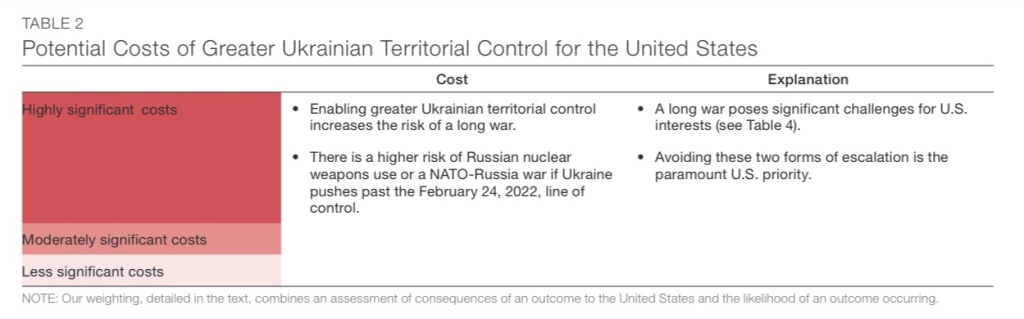
RAND: Avoiding a Long War – U.S. Policy and the Trajectory of the Russia-Ukraine Conflict

*Russian use of nuclear weapons is a plausible contingency that Washington needs to account for and a hugely important factor in determining the future trajectory of the conflict

*Although a Russian decision to attack a NATO member state is by no means inevitable, the risk is elevated while the conflict in Ukraine is ongoing.

*Chairman of the Joint Chiefs of Staff Mark Milley reportedly kept a list of “U.S. interests and strategic objectives” in the crisis: “No. 1” was “Don’t have a kinetic conflict between the U.S. military and NATO with Russia.” The second, closely related, was “contain war inside the geographical boundaries of Ukraine.”

*It is clear why Milley listed avoiding a Russia-NATO war as the top U.S. priority: The U.S. military would immediately be involved in a hot war with a country that has the world’s largest nuclear arsenal. Keeping a Russia-NATO war below the nuclear threshold would be extremely difficult, particularly given the weakened state of Russia’s conventional military.

*Since neither side appears to have the intention or capabilities to achieve absolute victory, the war will most likely end with some sort of negotiated outcome.

*Since avoiding a long war is the highest priority after minimizing escalation risks, the United States should take steps that make an end to the conflict over the medium term more likely.

*A major source of uncertainty about the future course of the war is the relative lack of clarity about the future of U.S. and allied military assistance to Ukraine.

Avoiding a Long War – U.S. Policy and the Trajectory of the Russia-Ukraine Conflict

Related:

Avoiding a Long War – U.S. Policy and the Trajectory of the Russia-Ukraine Conflict

US may not maintain military support for Ukraine, Navy secretary says

The US may not be able to continue its ongoing support for Ukraine if weapons makers do not ramp up production, US Secretary of the Navy Carlos Del Toro told Fox News on Wednesday evening.

US may not maintain military support for Ukraine, Navy secretary says

Propaganda (too much to debunk):

The war in Ukraine could be decided this year, former US Army general says, warning of dire consequences if Russia faces defeat

Unverified: “Certain credible sources report that a tactical nuclear option might be ‘on the table’ with at least some of the members of the Russian Security Council.”

Certain credible sources report that a tactical nuclear option might be “on the table” with at least some of the members of the Russian Security Council. Though TNW has never been on the table throughout the conflict in Ukraine and has never been discussed up until now, there are signals that a certain number of Security Council members are at least prepared to consider such a scenario.

The worst-case option under discussion is predetermined by increasing sophisticated military supplies from NATO countries to Ukraine. Security Council members are looking at the delivery of Western high-precision and long-range systems and munitions to the Ukrainian theatre, as well as the participation of Western military personnel in on-the-ground combat (so far, it appears that Poles will be operating certain equipment, as training Ukrainian soldiers takes time, and Western powers appear to be very short on time for further escalation).

It seems that the Russian Security Council operates on the idea that Western countries are prepared to supply even more sophisticated weaponry into the zone of conflict to try to derail the Russian offensive, no matter the cost to the Ukrainian side. According to Security Council estimates, the inclusion of NATO military hardware operators and the participation of NATO battalions on the ground in Ukraine will likely extend the ongoing conflict far beyond its current borders.

Western hostile movements and risky stakes-raising have already forced Putin to increase his military to up to 1.5 mln in a response to NATO redeployment in Europe closer to Russian borders.

POLITBLOGME