
Related:
US Congress Releases Latest Version of Defense Bill, Includes Taiwan Measures
Read More »China: Trump’s Plans to “Recognise” Taiwan Firmly Rejected! (4.12.2025)
Taiwan is a province of China, as recognized by the United Nations’ Resolution No. 2758.
Related:
Read More »Capes, Cameras, and the Cult of Visibility: The SeaLight Crusade as White Savior Theater
By Tina Antonis
The South China Sea is more than a maritime dispute—it’s a theater of narrative warfare. While headlines focus on Chinese aggression and Philippine resistance, a quieter campaign unfolds in the background: one of satellite feeds, curated imagery, and Pentagon-backed storytelling. At the center of this effort is SeaLight, a project that claims to illuminate truth but often casts shadows of its own.
As explored in my article at Antiwar.com, SeaLight doesn’t just document—it performs. It reframes geopolitical tension through moral spectacle, positioning its creators as heroic arbiters of transparency. But when the messenger wears a cape and the funding flows from defense budgets, we must ask: is this clarity, or choreography?
Stage Left: The White Savior Enters
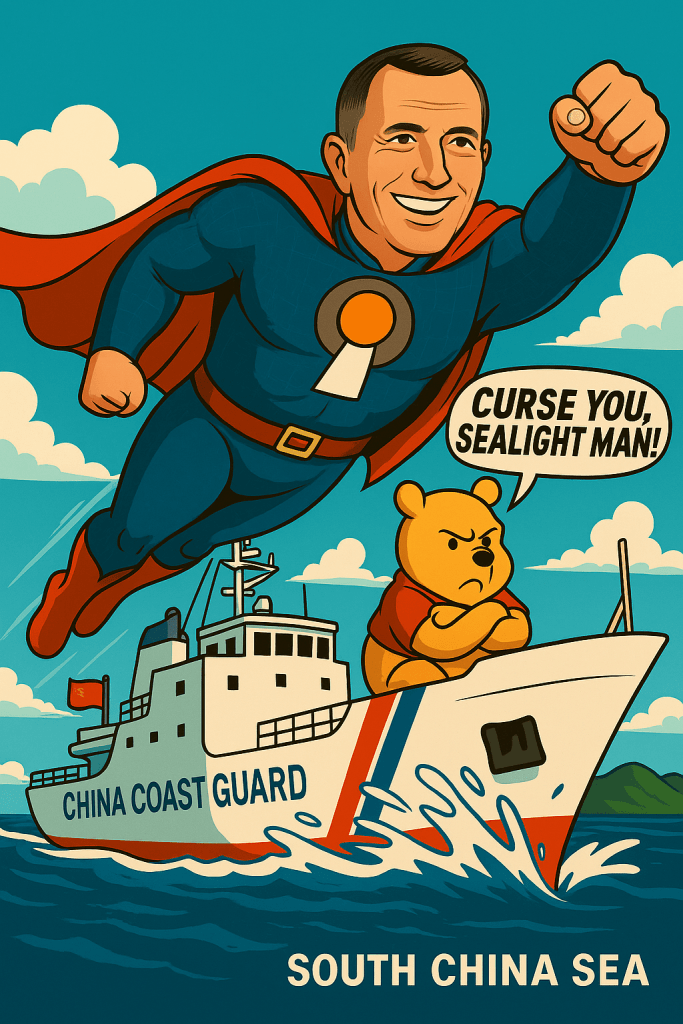
In the comic-strip cosmology of Ray Powell’s SeaLight project, transparency wears a cape. Clad in heroic postures and backed by satellite imagery, Powell casts himself as the guardian of maritime morality—unarmed, except with satellite feeds, theatrical flair, and strategic messaging.
Yet beneath the cartoon and Pentagon-funded optics lies a familiar archetype: the white savior, rebranded for the South China Sea.
China Is Imperialist? Says Who?
Calling China a “maritime occupier,” Powell positions himself as a bulwark against aggression. But that moral pose collapses under scrutiny. He speaks for a country with over 800 foreign military installations and a documented history of over 250 military interventions since 1991—wars in Iraq, Afghanistan, Libya, Syria, Somalia, and dozens more, all under the banner of peace, freedom, or preemption.
By comparison, China’s post–Cold War footprint includes no sustained foreign occupations and only scattered border conflicts and peacekeeping missions. The imbalance is staggering. And Powell’s framing doesn’t just ignore it—it performs around it.
As David Vine argues in The United States of War, this vast base empire is not a passive network—it’s an architecture of perpetual war. These outposts make military engagement not an exception but a structural habit, cloaked in strategic necessity and sold as global stewardship.
Powell’s cartoon rhetoric—calling China an occupier—obscures the scale of U.S. militarism. The term “occupation” is deployed not to analyze, but to project. When adversaries hold territory, it’s a crisis; when the U.S. spans the globe with armed installations, it’s policy.
Framing Conflict: The Optics of Consent
This isn’t irony. It’s performance. Powell’s language manufactures a moral frame for confrontation—costumed in transparency, but driven by escalation. The cape is literal. The conditioning is deliberate. And the stage is set for war.
SeaLight’s mission is not just visual documentation—it’s narrative warfare. As the Japan Times openly notes, its “chief weapon is photography, applied purposefully, generously and consistently over time.” These images—enhanced, curated, and distributed across media—are not neutral. They’re constructed to shape public perception, sway international opinion, and ultimately manufacture consent for confrontation.
Assertive transparency becomes a kind of ideological scaffolding—a stage on which geopolitical tension is dramatized, simplified, and morally polarized. The goal isn’t simply to reveal conflict; it’s to condition audiences for escalation.
And when the messenger dons a superhero’s cape, the spectacle transforms into something deeper: a story of rescue, of virtue, of intervention. This is not analysis—it’s soft propaganda dressed in heroic metaphor.
Consent for war doesn’t begin with missiles. It begins with mythmaking.
🇺🇸🇨🇳 Trump admin continues US tip-toe to war with China…
US State Dept. has JUST removed explicit rejection of Taiwan independence from its “US Relations with Taiwan” page.
Read More »
China says US ‘playing with fire’ by giving Taiwan more military aid
Related:
Why Should We Care About America’s Indo-Pacific Allies?, May 10, 2024:
Read More »We’re not obligated to defend Taiwan. What we are obligated to do is governed by the law and the law is the 1979 Taiwan Relations Act.
…
But defending Taiwan is not one of those things, but it means that we sell them equipment that they need to defend themselves and the like. And it makes it clear intent that we want a peaceful resolution of the Taiwan PRC issue, a peaceful resolution across the Taiwan Strait. And that we are opposed to a forceful reunification against the Taiwanese people’s will.
…
Is the United States going to defend Taiwan? If the answer to that question is yes, they’re going to lose hundreds of thousands of troops in that fight and they ought to know that. And then they can then make the calculus whether it’s worth it or not.
— Admiral Harry B. Harris, Jr., former commander of U.S. Indo-Pacific Command
What’s Really Going On In the South China Sea Between the Philippines and China
by Tina Antonis
Maritime clashes between the Philippines and China had been mostly over the Philippines’ military outpost, BRP (BRP—Barko ng Republika ng Pilipinas, which translates to “Ship of the Republic of the Philippines”—the ship prefix for the Philippines) Sierra Madre, in the Spratly Islands, which is disputed by Brunei, China, Malaysia, the Philippines, Taiwan (a province of China, as recognized by the United Nations’ Resolution No. 2758), and Vietnam. The BRP Sierra Madre was intentionally run aground on a reef near the Second Thomas Shoal in the disputed Spratly Islands, in 1997, so that the Philippines could stake their territorial claim.
Read More »US Navy Aircraft Transits Taiwan Strait, China Responds
Read More »The U.S. Navy’s 7th fleet said a P-8A Poseidon maritime patrol aircraft transited the Taiwan Strait on Tuesday.
…
Around once a month, U.S. military ships or aircraft pass through or above the waterway that separates
democratically governedTaiwan from China – missions that always anger Beijing. China claims sovereignty over the island of Taiwan and says it has jurisdiction over the strait. Taiwan and the United States dispute that, saying the strait is an international waterway.
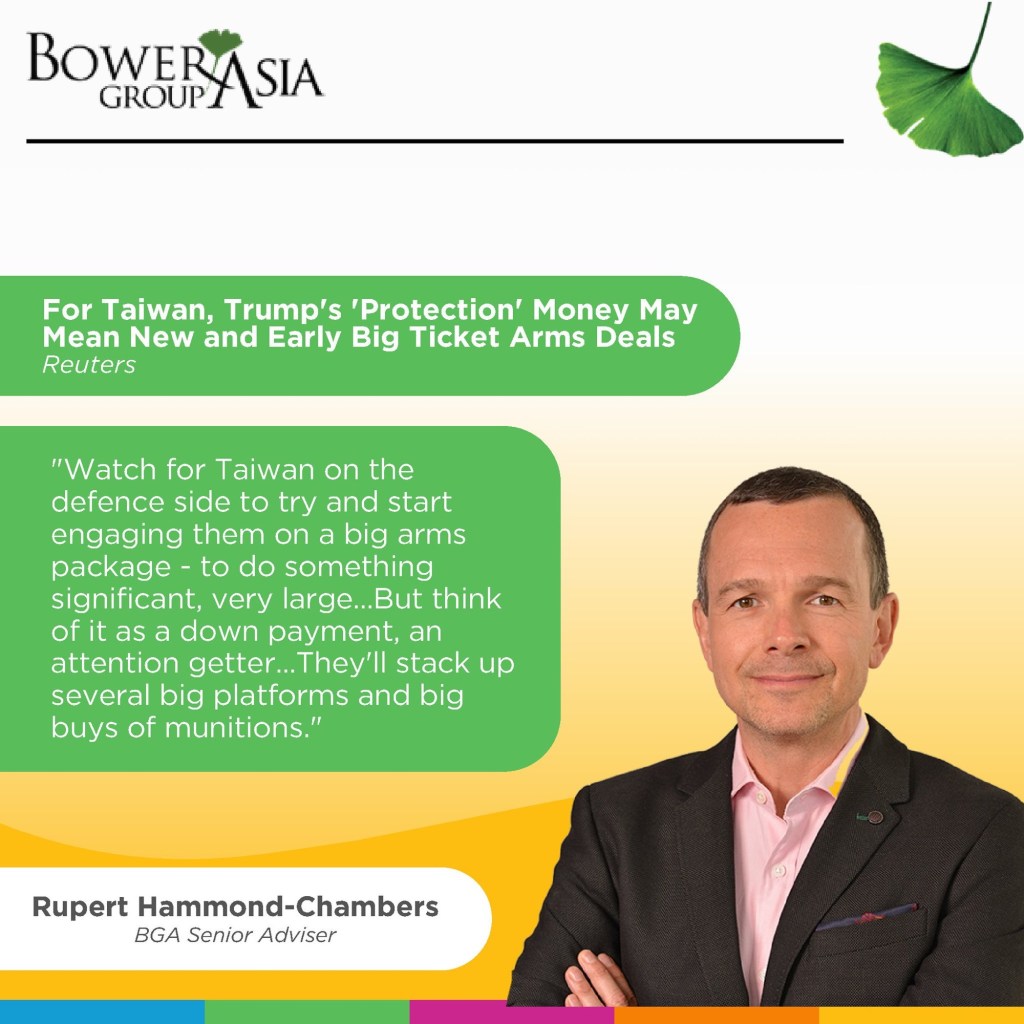
For Taiwan, Trump’s ‘protection’ money may mean new and early big ticket arms deals
“Watch for Taiwan on the defence side to try and start engaging them on a big arms package – to do something significant, very large,” Rupert Hammond-Chambers, president of the U.S.-Taiwan Business Council which helps broker defence exchanges between Washington and Taipei, told Reuters, adding it could come in the first quarter of next year.
“But think of it as a down payment, an attention getter,” he said. “They’ll stack up several big platforms and big buys of munitions.”
The U.S. is already Taiwan’s most important arms supplier, although Taiwan has complained of an order backlog worth some $20 billion. A new order, almost $2 billion of missile systems, was announced last month.
Related:
Profile at BowerGroupAsia: Rupert Hammond-Chambers

Brian Berletic, November 13 2024
In the weeks leading up to the 2024 US presidential election, Americans and many around the world invested hope that former-president and now President-elect Donald Trump would grind America’s wars abroad to a halt and instead invest in the United States itself.
The Trump Administration: From “No War Hawks” to ALL War Hawks
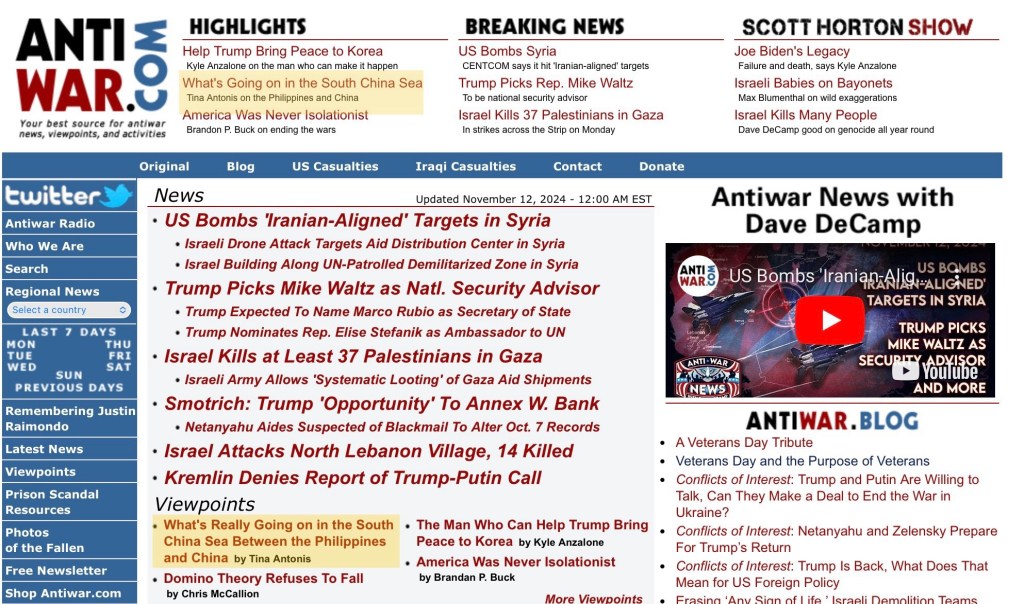
Read it at Antiwar.com or here with graphics. FYI, the “Ant” in Antonis is pronounced as 🐜.
 Ms. Cat’s Chronicles
You must be logged in to post a comment.