What does the Philippines want – a stable and conducive environment for its peaceful development, or to be trapped in the unpredictable game of geopolitics? Recently, the country’s actions and words have been filled with duplicity and complexity, but the trend is discernible – the Philippines is hot-headedly positioning itself as a vanguard, bridgehead, and even cannon fodder for the US.
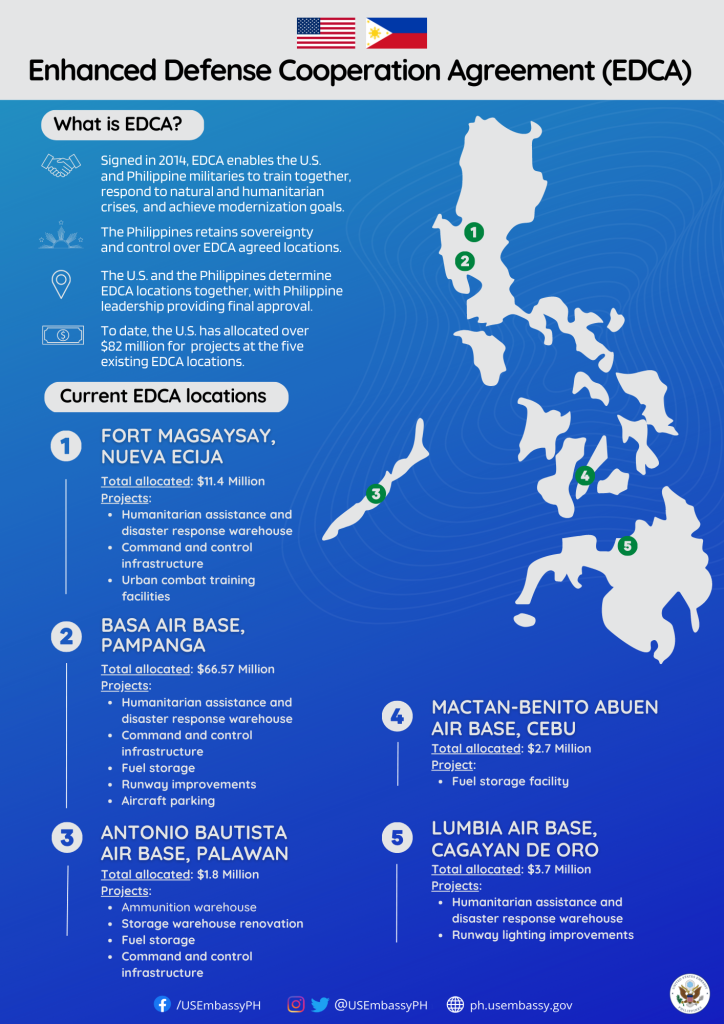
Moreover, the involvement of Subic Bay, a location not officially listed as a site/base under the expanded Enhanced Defense Cooperation Agreement (EDCA) as the alleged destination of US military fuel from Pearl Harbor, prompts a critical inquiry about its role and whether it might be serving as an unofficial or de-facto EDCA site. Hence, it begs to inquire if Subic Bay is now effectively functioning as a de-facto EDCA site. And if so, could there be other undeclared de-facto EDCA sites serving similar purposes other than the nine declared ones?
…
Could it be posited that the current Philippine administration appears to prioritize the demands and interests of the United States over its own national interests, sovereignty, and independence, suggesting a level of deference that could be interpreted as reminiscent of a vassal state? This perspective raises questions about the autonomy of the Philippine political leadership and the extent to which it serves the interests of its citizens first and foremost. The lack of public discussion, accountability, and transparency on matters that potentially impinge on national sovereignty could be seen as indicative of a disproportionate influence by the U.S. on Philippine domestic affairs and foreign policy, prompting a reevaluation of the true nature of the bilateral relationship between the two nations.
Lai, Taiwan’s vice president, reached more than three million votes by early evening after polls closed at 4 p.m. (0800 GMT), according by to a running tally by Taiwanese media, putting him comfortably ahead of his two rivals, though no party has conceded or claimed victory.
…
The parliamentary elections are equally important, especially if no party wins a majority, potentially hindering the new president’s ability to pass legislation and spending, especially for defence.
Beijing still has plenty of countermeasures it could use against Manila if tensions between the two countries continue to escalate in the South China Sea, according to a seasoned legal expert who specialises in the region.
Imagine a scenario where China, for whatever reason, announces a “no warships allowed” closure of the Taiwan Strait. It’s not an implausible scenario at all. The Chinese have spoken openly of the possibility. They regard the entirety of the strait as their sovereign waters, and assert the right to exercise control over them.
In another provocative move directed at Beijing, former Japanese prime minister and virulent anti-China hawk Taro Aso recently visited Taiwan for three days. He met with senior government officials, including President Tsai Ing-wen and declared that Japan, the US and Taiwan should ramp up plans for war with mainland China.
The Democratic Progressive Party (DPP) authorities’ stubborn insistence on the secessionist position of “Taiwan independence,” attempting to seek “independence” by relying on the US and by using force, begging for US arms sales or military aid, and enhancing military collusion with the US are moves that are making Taiwan a powder keg and ammunition depot, and have increased the danger and risk of a conflict in the Taiwan Straits, Chen said.
If the DPP is allowed to follow this path to the end, the youth will only become cannon fodder, the spokesperson said.
…
But no matter how “Taiwan independence” forces collude with external interference forces, the Chinese People’s Liberation Army is fully capable of crushing their attempts in seeking “independence” or resisting reunification by force, Wei said.
The commanding officer of the aircraft carrier USS Nimitz said Chinese vessels and planes that he encountered during a seven-month deployment in the western Pacific were “very polite and very professional.”
It’s sabotage, when it happens to Russia, but terrorism almost anywhere else! It’s spying, when it’s China, but it’s reconnaissance (or ISTAR) when the USG (US Government) does it! It’s freedom of navigation when the USG does it (despite not ratifying UNCLOS) but if China did it, it would be aggression! As I said before, the majority of those who want to stop arming Ukraine just want war with China!

 Ms. Cat’s Chronicles
You must be logged in to post a comment.