Philippine Army acquiring US missile system

Mao Ning

Philippine Army acquiring US missile system

“It is planned to be acquired because we see its feasibility and its functionality in our concept of archipelagic defense implementation,” Philippine Army chief Lt. Gen. Roy Galido told a news conference.

“I’m happy to report to our fellow countrymen that your army is developing this capability for the interest of protecting our sovereignty,” he said, adding the total number to be acquired would depend on “economics.”

As a rule, it takes at least two or more years for the Philippine military to acquire a new weapons system from the planning stage, Galido said, adding it was not yet budgeted for 2025.

Brawner already announced that they wanted one, three months ago. Shortly afterward, the U.S. said that they were keeping the Typhon in the Philippines, at the Laoag International Airport. Will this be a second unit? The only new information that I’ve learned, is that it’ll take at least two years for them to officially acquire the Typhon. Why announce it, again? Except to provoke China?

Related:

What’s Really Going On In the South China Sea Between the Philippines and China

China warns PH, slams US

Straight from the horse’s mouth. Source.

China warns PH, slams US

Senior Col. Wu Qian, a spokesman for China’s Ministry of National Defense, accused the Philippines of causing disturbances in various areas with the support and encouragement of the United States.

“From Ren’ai Jiao (Ayungin Shoal) to Xianbin Jiao (Sabina Shoal) and from Houteng Jiao to Huangyan Dao (Scarborough Shoal), such repeated provocations have allowed the international community to see clearly who is undermining peace and stability in the South China Sea and who is fabricating and spreading lies,” Wu said.

Read More »

The marriage of RAND and SeaLight

A Caricature of Marxism and Imperialist Economism: Monism And Dualism

Slowly, but surely, I’m going through both of the following RAND publications. I just recently noticed that “Understanding and Countering China’s Maritime Gray Zone Operations” was posted over at SeaLight on the 12th of December. Ray Powell, from SeaLight, is quoted at least 14 times in the first publication. So far, I’ve seen RAND “recommend” the same tactics as they’ve deployed in the Philippines; civilian society organizations, embedded journalism, information warfare, influencers, and online trolls.

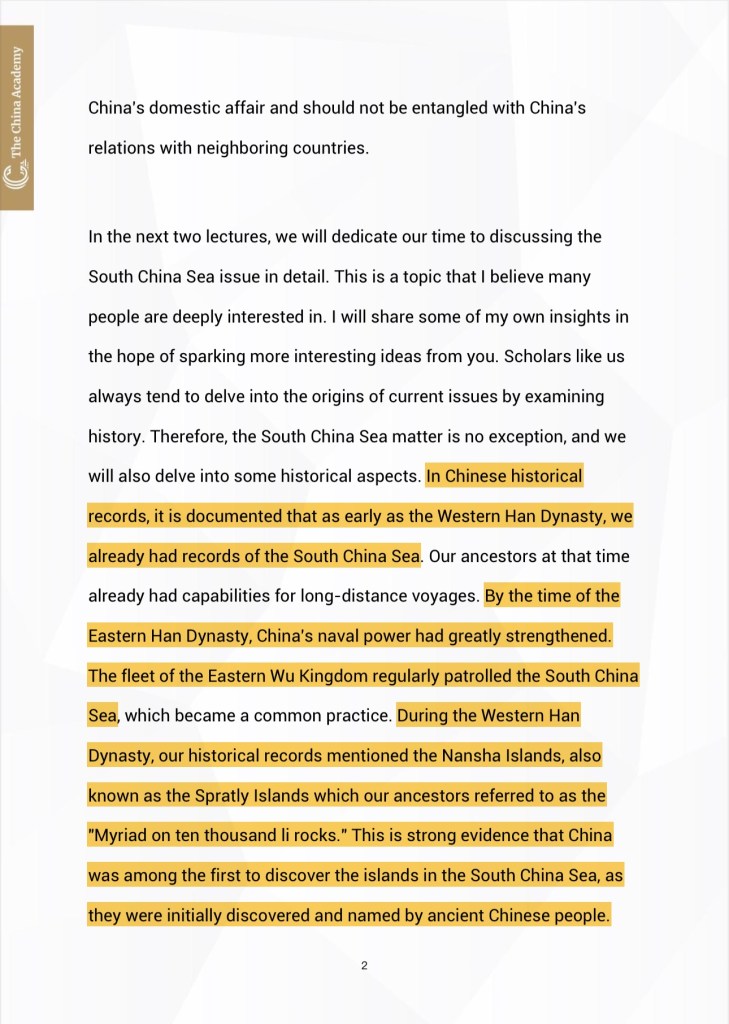
USS Beloit (LCS-29). Photo by EJ Hersom.

I’ve always known that they would try to expand their information operation to the other countries that are in ASEAN, just by following the SeaLight podcast. If not their information operation, regime change and terrorism (in Balochistan and Myanmar). I’ve also noticed that Powell has been referring to the Philippines’ “transparency initiative” as “non-violent resistance,” lately (RAND refers to it as “assertive transparency”). Ironic, considering that they’ve already succeeded in overthrowing the government of Bangladesh and are now attempting it in Cambodia, India and Pakistan. For those who don’t know about the regime change asset Gene Sharp and his neoliberal “nonviolence,” see the links on this page. Unfortunately, I don’t have as much time to dedicate to this right now due to other obligations.

Understanding and Countering China’s Maritime Gray Zone Operations | RAND

How the United States Can Support Allied and Partner Efforts to Counter China in the Gray Zone: Affirmative Engagement | RAND

RAND and SeaLight document (work in progress)

PART 2

Part 3a: RAND and SeaLight – Taiwan Relations Act

RAND and SeaLight Part 3b: Four Ways China Is Growing Its Media Influence in Southeast Asia

PH: Net FDI hits over 4-year low of $368M in Sept, BSP reports

NET foreign direct investments (FDI) remained positive in September but were markedly lower compared to a year ago, the Bangko Sentral ng Pilipinas (BSP) reported on Tuesday.

“Investors often prefer safe-haven assets in advanced economies under these conditions,” he explained, adding that heightened geopolitical tensions and economic uncertainties may have also further dampened investor confidence globally.

Net FDI hits over 4-year low of $368M in Sept, BSP reports

Marcos Says Philippines Won’t Send Warships After China Clashes

Philippine President Ferdinand Marcos Jr. said his nation won’t deploy Navy warships to the South China Sea in response to recent clashes with Beijing in disputed waters.

Marcos Says Philippines Won’t Send Warships After China Clashes

Previously:

Philippines to match China’s gray zone tactics in South China Sea

What’s Really Going On In the South China Sea Between the Philippines and China
What’s Really Going On In the South China Sea Between the Philippines and China
What’s Really Going On In the South China Sea Between the Philippines and China

by Tina Antonis

Maritime clashes between the Philippines and China had been mostly over the Philippines’ military outpost, BRP (BRP—Barko ng Republika ng Pilipinas, which translates to “Ship of the Republic of the Philippines”—the ship prefix for the Philippines) Sierra Madre, in the Spratly Islands, which is disputed by Brunei, China, Malaysia, the Philippines, Taiwan (a province of China, as recognized by the United Nations’ Resolution No. 2758), and Vietnam. The BRP Sierra Madre was intentionally run aground on a reef near the Second Thomas Shoal in the disputed Spratly Islands, in 1997, so that the Philippines could stake their territorial claim.

Read More »