South China Sea: Marcos inks laws on PH Maritime Zones, Archipelagic Sea Lanes + Responses of China and the United States

YouTube

MANILA – President Ferdinand R. Marcos Jr. on Friday signed laws declaring the maritime zones under Philippine jurisdiction and designating sea lanes in the country for foreign vessels and aircraft.

Marcos inks laws on PH Maritime Zones, Archipelagic Sea Lanes

Related:

South China Sea: Philippines’ legal moves reveal its expansionist goals

U.S. State Department On the Philippines Maritime Zones Act

Arnaud Bertrand’s Twitter thread (ThreadReader)

Regarding the South China Sea Arbitration:

The South China Sea Arbitration did not rule on sovereignty, and China does not recognize it because the Arbitral Tribunal lacked jurisdiction. “The Arbitral Tribunal violated the principle of state consent, exercised its jurisdiction ultra vires and rendered an award in disregard of the law. This is a grave violation of UNCLOS and general international law, Wang said.” The United Nations Convention on the Law of the Sea (UNCLOS) is an international treaty that establishes a legal framework for all marine and maritime activities.  The Permanent Court of Arbitration is not an agency of the United Nations. The PCA rents space in the same building as the UN’s International Court of Justice.  A Congressional Research Service report, dated August 2023, stated that the U.S. has not declared its position regarding sovereignty over any of the geographical elements that comprise the South China Sea.  

Japan’s Ground-Based Air Defense Options to the Philippines

Japan’s Ground-Based Air Defense Options to the Philippines

Bilateral defense relations between Japan and the Philippines come at an all-time high, signifying the continuous cooperation between both maritime nations that share a common adversary and similar situation regarding territorial domains and integrity in the Indo-Pacific region.

With the success of the export of the aforementioned radar systems to the Philippines from Japan, the latter is now raising up an idea of the likelihood of selling its surface-to-air missile batteries for the Philippine military to consider, with a wide variety of variants coming from the Japan Ground Self-Defense Force that might find its way for the likes of the Philippine Air Force. This is especially in line with the recently passed New Government Procurement Act or NGPA (Republic Act 12009), allowing the purchase of second-hand military hardware, provided it is economically preferable to the government.

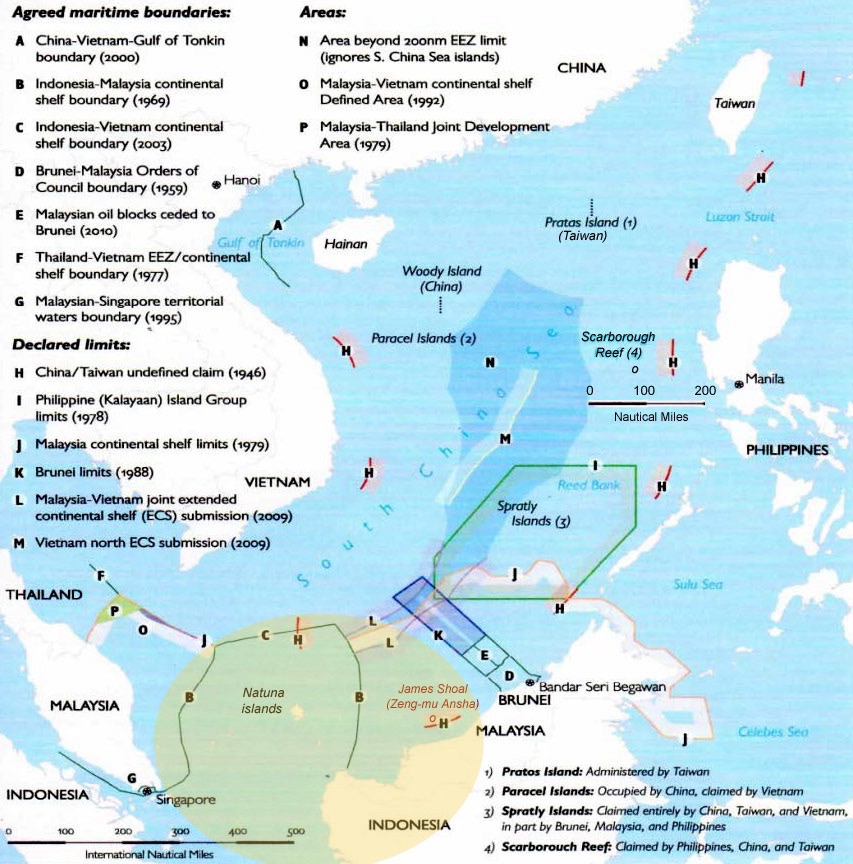
China looks to Indonesia for diplomatic resolution after coastguards’ Natuna encounters + More

China looks to Indonesia for diplomatic resolution after coastguards’ Natuna encounters

Source

Related:

[10-23-2024] Indonesian Coast Guard “Drives Out” Chinese Vessel Shadowing Seismic Ship (archived)

On Monday, Indonesia’s coast guard “drove out” a China Coast Guard cutter that was shadowing a survey vessel in Indonesian waters of the South China Sea. On Tuesday, the Chinese vessel was back again in the same spot, according to maritime security expert Ray Powell.

Geo Coral is a Norwegian-owned geophysical vessel flagged in Norway. She is operating under charter to PT Pertamina, Indonesia’s state-owned oil company, to conduct a 3D seismic survey off the Natuna Islands. “Pertamina East Natuna is focusing on oil and gas exploration activities in the East Natuna Working Area [East Natuna gas field], which has great potential to contribute to national energy security,” said a Pertamina spokesman on Tuesday. 

Read More »

Powell’s hit piece on “Media Unlocked”

Unlocking China’s “Media Unlocked” Propagandists

Recently, Media Unlocked unveiled its latest triumph–an interview with a former U.S. president’s brother, Neil Bush, whose George H.W. Bush Foundation For U.S.-China Relations has allegedly received millions of dollars from a group associated with CCP influence operations. Bush–apparently unconcerned that he was participating in Beijing’s propaganda campaign–helpfully sang the praise of China’s communist system, its electric vehicle industry and, incredibly, even announced that he was observing a “massive freedom movement” in today’s China.

Propagandists? Und das bist du nicht?

Now, let’s get into who’s funding the George H.W. Bush Foundation For U.S.-China Relations. Powell links to a Fox News article about its funding from the China–United States Exchange Foundation, based in Hong Kong. The Fox News article links to an Axios article (which is behind a paywall). Nowhere does Powell mention that the foundation also gets funding from the U.S. Department of State, The Rockefeller Foundation, etc.

Read More »

[Anonymous] US official accuses Russia and China of blocking Asia leaders’ statement

Full video

US official accuses Russia and China of blocking Asia leaders’ statement

WASHINGTON, Oct 12 (Reuters) – Russia and China blocked a proposed consensus statement for the East Asia Summit drafted by Southeast Asian countries, mainly over objections to language on the contested South China Sea, a U.S. official told Reuters on Saturday.

Read More »

Philippines sides with Vietnam in South China Sea dispute, hoping it will ‘return the favour’

Analysts believe that while Vietnam appreciates the gesture, it is unlikely to influence Hanoi’s strategy in the disputed waters.

Philippines sides with Vietnam in South China Sea dispute, hoping it will ‘return the favour’

Related:

BowerGroupAsia: Dr. Prashanth Parameswaran

Prashanth is concurrently a fellow at the Wilson Center, a senior columnist at The Diplomat magazine and an instructor for institutions including the U.S. State Department. He is the founder of the twice-weekly ASEAN Wonk newsletter, which offers research insights and analysis on the geopolitics and geoeconomics of Southeast Asia and the Indo-Pacific region. 

Stratbase ADR Institute Non-Resident Fellow: Dr. Prashanth Parameswaran

Dr. Parameswaran has held various roles across think tanks, governments, media and companies, including the Center for Strategic and International Studies, Singapore’s Ministry of Trade and Industry and the Associated Press. In those capacities, he worked on various issues including geopolitical and geoeconomic statecraft, Southeast Asia foreign and security policy, regional institutions, major power engagement in the Indo-Pacific as well as alliances and partnerships.   

Dr. Parameswaran holds a Ph.D. and MA focused on international business, international relations, Asian affairs, and U.S. foreign policy from the Fletcher School of Law and Diplomacy at Tufts University. He earned a BA from the University of Virginia, where he studied foreign affairs and peace and conflict studies with a focus on Asia. He regularly advises groups and individuals seeking to advance conversations on Indo-Pacific affairs and serves on the board of several institutions.  

Global Times: China and Vietnam capable to handle law enforcement conflict in S.China Sea properly; Philippines’ intention to stigmatize China ‘won’t work’

SeaLight document

Less politics more marine diplomacy – a fix for South China Sea?

Territorial wrangling over who owns the South China Sea has strangled local marine life, say scientists, urging China and the Philippines to set aside political differences and work to save the fish, coral and plants that live border-free.

Since 2013, China has built artificial islands that cover more than 3,000 acres of the Spratlys, according to U.S.-based policy organisation Asia Maritime Transparency Initiative.

A study last December by the Asia Maritime Transparency Initiative also blamed China’s dredging and clam harvesting for destroying almost 20,000 acres of reefs in the South China Sea.

Less politics more marine diplomacy – a fix for South China Sea?

The Asia Maritime Transparency Initiative (AMTI) is part of the Center for Strategic and International Studies (CSIS). Gregory Poling is director of the AMTI. The same Poling that told the U.S. government-funded Voice of America that “Vietnam’s use of cutter suction dredgers is much more environmentally destructive than its previous dredging methods.

According to the CIA’s World Factbook, Vietnam occupies around 50 outposts, The Philippines occupies nine, Malaysia occupies five, and China occupies seven in the disputed Spratly Islands.

Previously:

China unveils evidences showing Philippine grounded warship at Ren’ai Jiao destroys coral reefs, endangers marine organism

Experts warn of Philippines scheming for ‘new arbitration’ on South China Sea + More

Vietnamese Poachers using Cyanide and Dynamite Fishing in the Philippines’ EEZ

Philippine Coast Guard clarifies ‘assertive transparency’ tact