
Tag: territorial disputes
Philippines sides with Vietnam in South China Sea dispute, hoping it will ‘return the favour’
Analysts believe that while Vietnam appreciates the gesture, it is unlikely to influence Hanoi’s strategy in the disputed waters.
Philippines sides with Vietnam in South China Sea dispute, hoping it will ‘return the favour’
Related:
BowerGroupAsia: Dr. Prashanth Parameswaran
Prashanth is concurrently a fellow at the Wilson Center, a senior columnist at The Diplomat magazine and an instructor for institutions including the U.S. State Department. He is the founder of the twice-weekly ASEAN Wonk newsletter, which offers research insights and analysis on the geopolitics and geoeconomics of Southeast Asia and the Indo-Pacific region.
Stratbase ADR Institute Non-Resident Fellow: Dr. Prashanth Parameswaran
Dr. Parameswaran has held various roles across think tanks, governments, media and companies, including the Center for Strategic and International Studies, Singapore’s Ministry of Trade and Industry and the Associated Press. In those capacities, he worked on various issues including geopolitical and geoeconomic statecraft, Southeast Asia foreign and security policy, regional institutions, major power engagement in the Indo-Pacific as well as alliances and partnerships.
…
Dr. Parameswaran holds a Ph.D. and MA focused on international business, international relations, Asian affairs, and U.S. foreign policy from the Fletcher School of Law and Diplomacy at Tufts University. He earned a BA from the University of Virginia, where he studied foreign affairs and peace and conflict studies with a focus on Asia. He regularly advises groups and individuals seeking to advance conversations on Indo-Pacific affairs and serves on the board of several institutions.
Less politics more marine diplomacy – a fix for South China Sea?
Territorial wrangling over who owns the South China Sea has strangled local marine life, say scientists, urging China and the Philippines to set aside political differences and work to save the fish, coral and plants that live border-free.
…
Since 2013, China has built artificial islands that cover more than 3,000 acres of the Spratlys, according to U.S.-based policy organisation Asia Maritime Transparency Initiative.
…
A study last December by the Asia Maritime Transparency Initiative also blamed China’s dredging and clam harvesting for destroying almost 20,000 acres of reefs in the South China Sea.
Less politics more marine diplomacy – a fix for South China Sea?
The Asia Maritime Transparency Initiative (AMTI) is part of the Center for Strategic and International Studies (CSIS). Gregory Poling is director of the AMTI. The same Poling that told the U.S. government-funded Voice of America that “Vietnam’s use of cutter suction dredgers is much more environmentally destructive than its previous dredging methods.”
According to the CIA’s World Factbook, Vietnam occupies around 50 outposts, The Philippines occupies nine, Malaysia occupies five, and China occupies seven in the disputed Spratly Islands.
Previously:
Experts warn of Philippines scheming for ‘new arbitration’ on South China Sea + More
Vietnamese Poachers using Cyanide and Dynamite Fishing in the Philippines’ EEZ
Philippine Coast Guard clarifies ‘assertive transparency’ tact
MaryKay Carlson is The Cartoon + More
Part One: Americans Prospecting GenSan as EDCA Site
In a flash, May Kay Carlson proved she is part of the problem President Bongbong Marcos Jr. has created with China rather than any solution.
Related:
US envoy says China’s maritime claims a ‘cartoon’
Read More »PLA stages National Day drill in South China Sea in wake of 5-nation exercise
The drill in the disputed waters follows joint manoeuvres by the Philippines, US, Australia, Japan and New Zealand
PLA stages National Day drill in South China Sea in wake of 5-nation exercise
Related:
Biden Approves $567 Million in Military Aid for Taiwan, Angering China
Chinese Missile Boat Undertakes ‘Alarming’ Action
Chinese Missile Boat Undertakes ‘Alarming’ Action (archived)
Read More »A Chinese navy missile craft shadowed a Philippine civilian ship on Friday in an unprecedented encounter that one analyst described as “alarming.”
The Fisheries and Aquatic Resources (BFAR) vessel the BRP Datu Romapenet was en route to a South China Sea feature known as Half Moon Shoal to deliver supplies to fishermen.
Half Moon Shoal is situated at the eastern edge of the Spratly Islands and about 60 miles from the Philippine province of Palawan, well within the Southeast Asian country’s recognized exclusive economic zone (EEZ).
According to the Philippines’ ABS-CBN News, which was onboard, the ship picked up a tail in the form of a Houbei-class (Type 22) guided-missile craft, easily identifiable by its wide camouflaged catamaran hull.
…
Chester Cabalza, founder of Manila-based think tank the International Development and Security Cooperation, told the news agency it was the first time a Type 22 had been spotted in the EEZ.
“This incident is alarming because a missile ship shadowed our BFAR ship,” Cabalza said, adding that it was a show of power intended to intimidate the Philippines.
President Maduro Expresses Venezuela’s Solidarity With Palestine and Lebanon Against Zionist Aggression and Nasrallah’s Assassination
Venezuelan President Nicolás Maduro expressed the solidarity of the Venezuelan government and people with the peoples of Palestine and Lebanon, victims of military attacks carried out by Israeli occupation forces with the support of the US army. Before thousands of people in the city of La Guaira, President Maduro condemned the Zionist entity for killing more than a thousand people in its attacks on civilian areas of Lebanon this week, including around 500 children, a massacre added to the genocide being perpetrated for almost a year in the Gaza Strip, with nearly 42,000 people killed, around 10,000 missing, and some 100,000 wounded.
Alleged Chinese Nuclear Submarine Sinking: Separating Facts From Bullshit
Western defence media has recently been buzzing with the story of a Chinese SSN allegedly sinking in the Yangtze River near Wuhan. But is it actually true? We take a look at the likelihood of this.
Alleged Chinese Nuclear Submarine Sinking: Separating Facts From Bullshit
Related:
China denies U.S. claim that its newest nuclear submarine sank at pier
A growing problem of ‘deepfake geography’: How AI falsifies satellite images (Archived)
What I found on the secretive tropical island they don’t want you to see
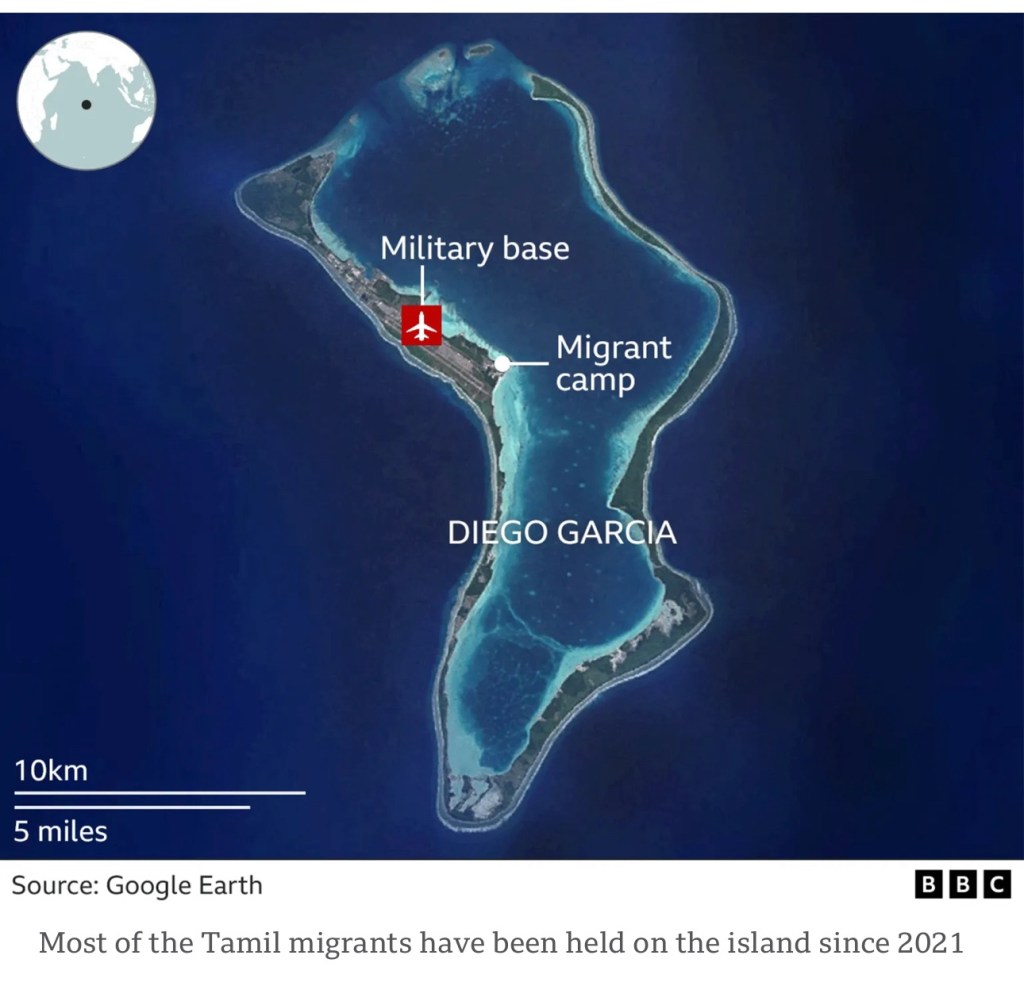
Diego Garcia, a remote island in the Indian Ocean, is a paradise of lush vegetation and white-sand beaches, surrounded by crystal blue waters.
What I found on the secretive tropical island they don’t want you to see
Previously:
DIEGO GARCIA: STEALING A NATION AND HOW ‘INTERNATIONAL RULES’ DON’T APPLY IF IT IS THE US OR UK
An open and free Indo-Pacific, or stability at home?
The Voice of America, in an article about why the Quad met in Washington this week, claims that the aims of the Quad are to create an open and free Indo-Pacific. Biden, in a prepared remark, suggested his Administration believes “Xi Jinping is looking to focus on domestic economic challenges and minimise the turbulence in China’s diplomatic relationships, and he’s also looking to buy himself some diplomatic space”.
 Ms. Cat’s Chronicles
You must be logged in to post a comment.