Why the West Pushes Serbia to Recognize Kosovo

The West continues pressuring Serbia to implicitly recognize Kosovo – the Serbian breakaway region that unilaterally declared independence in 2008. At the same time, the European Union and the United States expect Belgrade to resolutely support Ukraine’s ambitions to retake Crimea, the Donbass, as well as parts of the Zaporizhzhia and the Kherson regions that are still under Russia’s control.

Why the West Pushes Serbia to Recognize Kosovo

Related:

Serbia Rules Out Signing EU Plan Over Kosovo’s UN Membership

NATO majors float Ukraine negotiations plan – WSJ

UK, France and Germany reportedly offered weapons and security commitments as a way of starting talks with Russia

NATO majors float Ukraine negotiations plan – WSJ

Related:

WSJ: NATO’s Biggest European Members Float Defense Pact With Ukraine

In theory, any NATO member could veto the proposal from the U.K., France and Germany, but the organization operates on consensus and such an initiative wouldn’t even be discussed at a summit without enjoying widespread support in the alliance.

[2008] The Puppet Masters Behind Georgia President Saakashvili

The controversy over the Georgian surprise military attacks on South Ossetia and Abkhazia on 8.8.08 makes a closer look at the controversial Georgian President and his puppet masters important. An examination shows 41 year old Mikhail Saakashvili to be a ruthless and corrupt totalitarian who is tied to not only the US NATO establishment, but also to the Israeli military and intelligence establishment. The famous ‘Rose Revolution of November 2003 that forced the ageing Edouard Shevardnadze from power and swept the then 36 year old US university graduate into power was run and financed by the US State Department, the Soros Foundations, and agencies tied to the Pentagon and US intelligence community.

The Puppet Masters Behind Georgia President Saakashvili

Related:

NGOs, “Unions”, & Media Outlets in the Service of Imperialism

U.S. Wars and Hostile Actions (WW2 – 2014)

Opinion: Blinken ponders the post-Ukraine-war order

Opinion: Blinken ponders the post-Ukraine-war order

Crimea is a particular point of discussion. There is a widespread view in Washington and Kyiv that regaining Crimea by military force may be impossible. Any Ukrainian military advances this year in Zaporizhzhia oblast, the land bridge that connects Crimea and Russia, could threaten Russian control. But an all-out Ukrainian campaign to seize the Crimean Peninsula is unrealistic, many U.S. and Ukrainian officials believe. That’s partly because Putin has indicated that an assault on Crimea would be a tripwire for nuclear escalation.

The administration shares Ukraine’s insistence that Crimea, which was seized by Russia in 2014, must eventually be returned. But in the short run, what’s crucial for Kyiv is that Crimea no longer serve as a base for attacks against Ukraine. One formula that interests me would be a demilitarized status, with questions of final political control deferred. Ukrainian officials told me last year that they had discussed such possibilities with the administration.

As Blinken weighs options in Ukraine, he has been less worried about escalation risks than some observers. That’s partly because he believes Russia is checked by NATO’s overwhelming power. “Putin continues to hold some things in reserve because of his misplaced fear that NATO might attack Russia,” explained the official familiar with Blinken’s thinking. This Russian reserve force includes strategic bombers, certain precision-guided weapons and, of course, tactical and strategic nuclear weapons.

Are they really this delusional?!

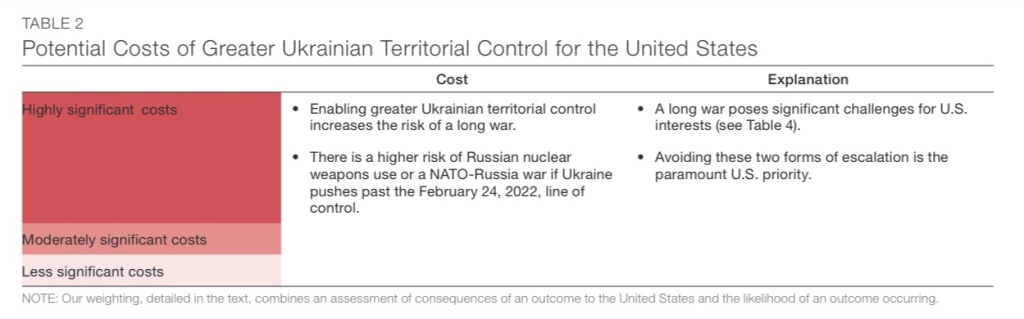
RAND: Avoiding a Long War – U.S. Policy and the Trajectory of the Russia-Ukraine Conflict

*Russian use of nuclear weapons is a plausible contingency that Washington needs to account for and a hugely important factor in determining the future trajectory of the conflict

*Although a Russian decision to attack a NATO member state is by no means inevitable, the risk is elevated while the conflict in Ukraine is ongoing.

*Chairman of the Joint Chiefs of Staff Mark Milley reportedly kept a list of “U.S. interests and strategic objectives” in the crisis: “No. 1” was “Don’t have a kinetic conflict between the U.S. military and NATO with Russia.” The second, closely related, was “contain war inside the geographical boundaries of Ukraine.”

*It is clear why Milley listed avoiding a Russia-NATO war as the top U.S. priority: The U.S. military would immediately be involved in a hot war with a country that has the world’s largest nuclear arsenal. Keeping a Russia-NATO war below the nuclear threshold would be extremely difficult, particularly given the weakened state of Russia’s conventional military.

*Since neither side appears to have the intention or capabilities to achieve absolute victory, the war will most likely end with some sort of negotiated outcome.

*Since avoiding a long war is the highest priority after minimizing escalation risks, the United States should take steps that make an end to the conflict over the medium term more likely.

*A major source of uncertainty about the future course of the war is the relative lack of clarity about the future of U.S. and allied military assistance to Ukraine.

Avoiding a Long War – U.S. Policy and the Trajectory of the Russia-Ukraine Conflict

Related:

Avoiding a Long War – U.S. Policy and the Trajectory of the Russia-Ukraine Conflict