The Three Sources and Three Component Parts of Marxism

The Three Sources and Three Component Parts of Marxism

People always have been the foolish victims of deception and self-deception in politics, and they always will be until they have learnt to seek out the interests of some class or other behind all moral, religious, political and social phrases, declarations and promises. Champions of reforms and improvements will always be fooled by the defenders of the old order until they realise that every old institution, how ever barbarous and rotten it may appear to be, is kept going by the forces of certain ruling classes. And there is only one way of smashing the resistance of those classes, and that is to find, in the very society which surrounds us, the forces which can—and, owing to their social position, must—constitute the power capable of sweeping away the old and creating the new, and to enlighten and organise those forces for the struggle.

Preface to A Contribution to the Critique of Political Economy

Preface to A Contribution to the Critique of Political Economy

In the social production of their existence, men inevitably enter into definite relations, which are independent of their will, namely relations of production appropriate to a given stage in the development of their material forces of production. The totality of these relations of production constitutes the economic structure of society, the real foundation, on which arises a legal and political superstructure and to which correspond definite forms of social consciousness. The mode of production of material life conditions the general process of social, political and intellectual life. It is not the consciousness of men that determines their existence, but their social existence that determines their consciousness. At a certain stage of development, the material productive forces of society come into conflict with the existing relations of production or – this merely expresses the same thing in legal terms – with the property relations within the framework of which they have operated hitherto. From forms of development of the productive forces these relations turn into their fetters. Then begins an era of social revolution. The changes in the economic foundation lead sooner or later to the transformation of the whole immense superstructure.

Related:

A Contribution to the Critique of Political Economy

Address of the Central Committee to the Communist League

YourCommieDad

Address of the Central Committee to the Communist League

Brothers!

In the two revolutionary years of 1848-49 the League proved itself in two ways. First, its members everywhere involved themselves energetically in the movement and stood in the front ranks of the only decisively revolutionary class, the proletariat, in the press, on the barricades and on the battlefields. The League further proved itself in that its understanding of the movement, as expressed in the circulars issued by the Congresses and the Central Committee of 1847 and in the Manifesto of the Communist Party, has been shown to be the only correct one, and the expectations expressed in these documents have been completely fulfilled. This previously only propagated by the League in secret, is now on everyone’s lips and is preached openly in the market place. At the same time, however, the formerly strong organization of the League has been considerably weakened. A large number of members who were directly involved in the movement thought that the time for secret societies was over and that public action alone was sufficient. The individual districts and communes allowed their connections with the Central Committee to weaken and gradually become dormant. So, while the democratic party, the party of the petty bourgeoisie, has become more and more organized in Germany, the workers’ party has lost its only firm foothold, remaining organized at best in individual localities for local purposes; within the general movement it has consequently come under the complete domination and leadership of the petty-bourgeois democrats. This situation cannot be allowed to continue; the independence of the workers must be restored. The Central Committee recognized this necessity and it therefore sent an emissary, Joseph Moll, to Germany in the winter of 1848-9 to reorganize the League. Moll’s mission, however, failed to produce any lasting effect, partly because the German workers at that time had not enough experience and partly because it was interrupted by the insurrection last May. Moll himself took up arms, joined the Baden-Palatinate army and fell on 29 June in the battle of the River Murg. The League lost in him one of the oldest, most active and most reliable members, who had been involved in all the Congresses and Central Committees and had earlier conducted a series of missions with great success. Since the defeat of the German and French revolutionary parties in July 1849, almost all the members of the Central Committee have reassembled in London: they have replenished their numbers with new revolutionary forces and set about reorganizing the League with renewed zeal

Update: Google’s Gemini is Anti-Communist!

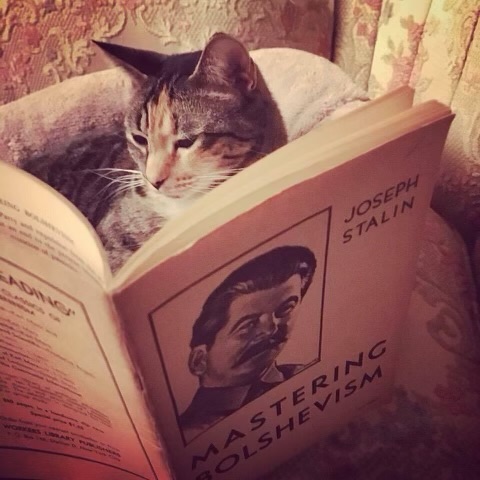
It wouldn’t make me a picture of a cat reading The Communist Manifesto! 😾

I asked it in the wrong way, apparently.

Here’s what it said when I asked for a cat with the hammer and sickle.

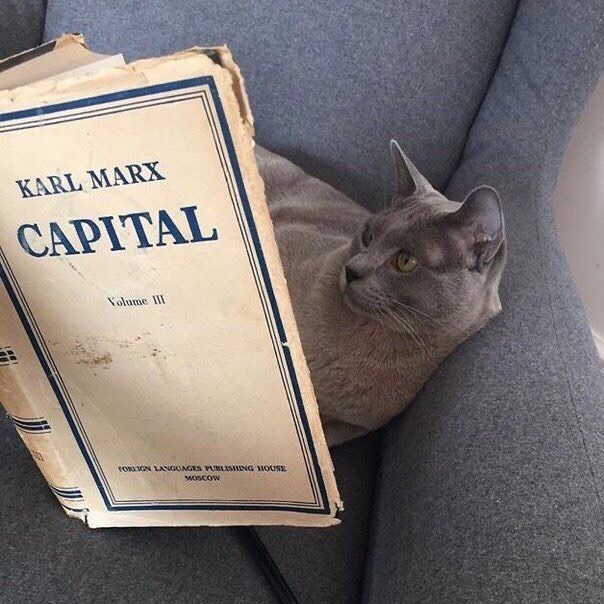
I tried with Microsoft’s Copilot, instead. I also asked it to make me a picture of a cat reading Das Kapital. They’re spelled wrong, though! I suppose that it’s cat-speak?! 🤷🏼‍♀️

Here’s the Communist cats that they made for me. I like the pixelated one the best. It has my resting bitch face! 😹

To Be a Socialist One Must Be an Anti-Imperialist

Since the writing of The Communist Manifesto and the founding of the First International, proletarian internationalism has been a cornerstone of scientific socialism, and is a pillar of Marxism-Leninism. Today, in the era of imperialism, putting genuine proletarian internationalism into practice demands that we be consistent anti-imperialists.

To Be a Socialist One Must Be an Anti-Imperialist

Five of Lenin’s Insights That Are More Pertinent Than Ever

Today we mourn a hundred years since the physical death of one of our dearest comrades, Vladimir Ilyich Ulyanov, known to us as Lenin. It would be foolish, however, to think that his physical death meant the death of his ideas. Today, after a hundred years, Lenin’s ideas are as indispensable as ever. “They are mistaken when they think that his death is the end of his ideas”. This was told to us by Fidel Castro upon the death of Che Guevara, but it applies with equal accuracy to Lenin’s death.

Five of Lenin’s Insights That Are More Pertinent Than Ever