
Tag: The Economist
Fixing the rot in Ukraine
Things are going wrong away from the front line. Europe needs to help
Read More »
Ukraine: The Dystopia of War
The dystopia of war (La distopía de la guerra)
On Monday, Le Monde reported on one of Ukraine’s flagship construction projects, very much in line with the limited possibilities for reconstruction under wartime conditions and the needs of the moment: a large military cemetery. According to the French outlet, the site will have a bunker to protect against possible bombing—although the dead have not been a specific target of Russian troops, as they have been of Israeli troops in Gaza—places to pay tribute to fallen warriors, and more space to bury soldiers now that existing cemeteries are overflowing. Without even minimally realistic data on casualties in either army, the warnings from sympathetic journalists are indicative when they state, as one Ukrainian blogger recently did, that “currently, the Ukrainian Armed Forces lack infantry. Completely. The infantry has fled, is in the hospital, or in the cemetery.” The growth of cemeteries is undoubtedly another important indicator. According to Le Monde , the new facilities will initially house graves, although the number could reach 130,000 or 160,000 in the future, indicating the current very high level of casualties and the possibility that such losses will continue in the future.
Read More »
Why Washington is Worried About Burkina Faso’s Young Revolutionary Leader
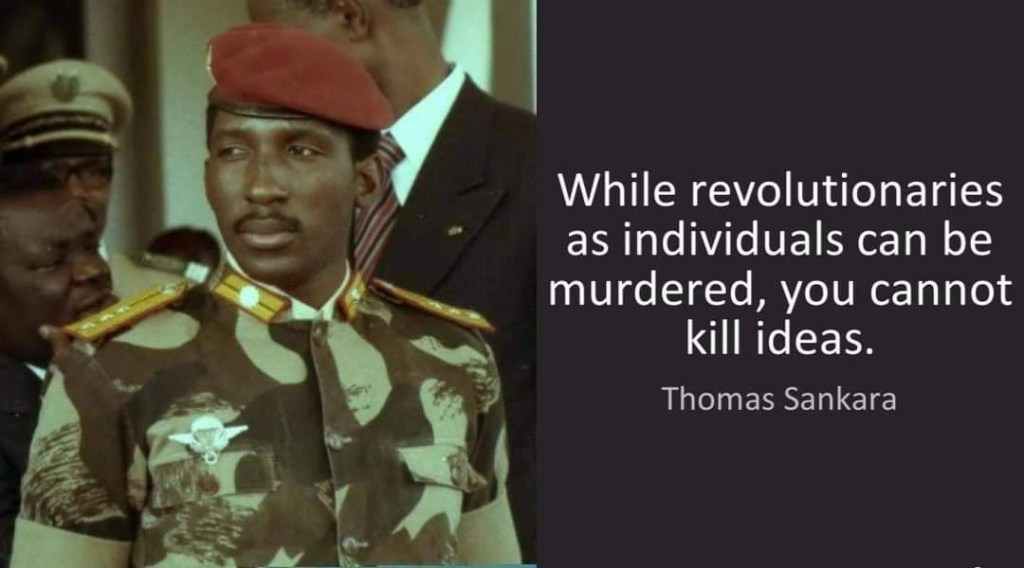
Why Washington is Worried About Burkina Faso’s Young Revolutionary Leader
Related Videos:
HRW accused Burkina Faso of war crimes
Related Articles:
The US/EU/NATO’s Regime Change Playbook for Burkina Faso and Captain Ibrahim Traoré
The Rising Star of Cpt. Ibrahim Traore – Burkina Faso’s Spirit of Sankara
In February 2024, Traoré ordered the suspension of the issuance of export permits for small-scale private gold production, a move aimed at tackling illegal trade. According to the World Gold Council’s 2023 figures, Burkina Faso is the 13th-largest gold producer in the world, producing about 100 tonnes, equivalent to about US$6 billion in value, each year.
Document: Burkina Faso
Recruitment and far right: “I Love the Third Brigade”
Recruitment and far right: “I Love the Third Brigade”
The United States is putting pressure on Zelensky to lower the age of conscription again, but for the moment the Ukrainian president is rejecting this possibility. This is what Ukrainian media such as Ukrainska Pravda reported this week, referring to the mobilization of men between 18 and 25 years old, a very small population group in which the country’s future cannot afford to lose. Even before the law on mobilization was approved, which is very unpopular despite not being as harsh as foreign allies demanded, prominent figures and self-proclaimed friends of Ukraine such as US Senator Lindsey Graham have publicly encouraged Ukraine to recruit those over 18 years old despite the demographic risk that this implies for the country they claim to defend. These suggestions seem to have become a demand that is confirmed even by people who belong to the state apparatus. “If this information has come to light, it may confirm that American politicians from both parties are putting pressure on President Zelensky on the question of why there is no mobilisation for those aged 18-25 in Ukraine,” said Serhiy Leshchenko, one of Andriy Yermak’s advisers and a figure who has gone from representing the third sector, civil society in Maidan Ukraine to all kinds of well-paid positions in government or in the few state-owned companies that Kiev has not yet privatised. The past ten years show a double standard between those who have been privileged and those who have been impoverished and marginalised thanks to the European and liberal reforms of the peacetime years. However, Ukraine’s refusal to recruit its most vulnerable population group strictly responds to the future needs of the state, which, if it hopes to rebuild itself, must maintain minimum levels of youth population.
Read More »
The 4 Key Strengths of China’s Economy — and What They Mean for Multinational Companies
China’s hybrid “state capitalist” system, driven by centralized planning and fierce competition, has led to dominance in critical technological fields and emerging markets. Western multinational corporations are advised to adopt a pragmatic approach to capitalize on four key strengths of China’s economy: its innovation ecosystem, its investment in the Global South, its ultra-competitive markets, and its vast consumer base. Those who fail to engage risk losing global revenue and strategic opportunities.
The 4 Key Strengths of China’s Economy — and What They Mean for Multinational Companies
The Gaza Maritime Route Was Netanyahu’s Idea, Maritime Aid Corridor Will Advance the Overthrow of Hamas, & When Will US boots be on the Ground in Gaza?
Diplomatic source to ‘Post’: Gaza maritime route was Netanyahu’s idea
According to the source, on October 22, two weeks following the war’s outbreak, Netanyahu discussed with President Biden the concept of “delivering humanitarian aid to Gaza via the sea, contingent on an Israeli inspection in Cyprus.”
…
Years before the Gaza war, Israel Katz, now the Foreign Minister, had drawn up plans for a maritime route via Cyprus involving a floating island.
The project was never executed. But he revived it after the war began on October 7.
Related:
Gallant: Maritime Aid Corridor Will Advance Overthrow of Hamas
“The process is designed to facilitate aid directly to civilians and in this way, it advances [our goal] of overthrowing Hamas’ rule in Gaza,” the minister said.
“We will facilitate aid via the maritime route that is coordinated with the United States (security and humanitarian aspects), with the assistance of the United Arab Emirates on the civilian side,” he said. “It will include the appropriate inspections in Cyprus, and the goods will be brought by international organizations with American assistance.”
Air, sea, and land: When will US boots be on the ground in Gaza? Authored by Yonah Jeremy Bob*
Then suddenly, last Thursday, US President Joe Biden announced that the US would also supply maritime aid to Gaza, including building a makeshift artificial port off the coast.
This already imposes a long-term US military footprint in Israeli-Gaza territorial waters rather than a “mere” series of fly-throughs.
…
How hard would it be for a small complement of US Marines accompanying the aid deliveries to travel a kilometer or so into Gaza and to place themselves squarely in the middle of where Israel
does notwant them?…
Moreover, US forces have been and are already on the ground.
US generals and counter-terror experts have been in and out of Israel since the start of the war, including visits to Gaza.
There are also a variety of US military personnel regularly in Israel on military and intelligence exchange programs.
US attempts to reform the PA
Speaking of intelligence, multiple times when a decision was made to try to improve and reform the Palestinian Authority security forces, it was the CIA and US special forces who came to the West Bank and Gaza to help train and prepare these forces.
It seems quite likely that the Jewish state, at some point, will ask Washington to perform the same service again in Gaza.
…
A broader version could involve a US-led peacekeeping force handling internal Gaza security for an indefinite period until enough Gazan Palestinians disconnected from Hamas can be convinced that taking on this role will not lead to them being slaughtered later by a resurgent Hamas.
From this perspective, the question about US forces on the ground in Gaza seems less of an if than it does a when, how many, and under more or less coordinated circumstances with Israel.
*Yonah Jeremy Bob was raised in Baltimore and graduated from Columbia University and Boston University Law School, respectively. He previously worked for the Israeli Ministry of Foreign Affairs, the Israeli Military International Law Division, and the Israeli Justice Ministry. – Wikipedia
Can’t make this up 🤦🏼♀️
“The Imperial March” plays over the loudspeaker of a US Army vessel departing on a mission to construct a temporary port for aid deliveries to Gaza
Twitter
Related:
2. THE EMPIRE WAS NAZI GERMANY
From stormtroopers to Imperial officers’ uniforms and even Darth Vader’s helmet, which resembles those worn by the Wehrmacht during WWII, the analogies between Nazi Germany and the Galactic Empire are not exactly subtle.
The gradual rise of Hitler from German chancellor to Nazi dictator is further mirrored in the rise of Darth Sidious, or Sheev Palpatine, from chancellor to world’s most horrific-looking emperor.
MAY THE FOURTH BE WITH YOU: HOW WWII INSPIRED ‘STAR WARS’
PFLP Warns of Suspicious US Plan for Gaza Pier, ‘Humanitarian Aid’
PFLP Warns of Suspicious US Plan for Gaza Pier, ‘Humanitarian Aid’
The movement emphasized that the US plan is “suspicious and dubious” and goes beyond the goal of aiding the Palestinian people, opening the door to executing other alarming objectives, such as forced displacement plans under humanitarian and other pretexts.
…
“No US boots will be on the ground,” Biden claimed. [He’s lying]
…
Five Palestinians, including two children, were killed on Friday due to an aid airdrop mishap, where at least one parachute malfunctioned, causing a package to fall on them. The tragic incident occurred in the al-Shati refugee camp in northern Gaza at approximately 11:30 am local time.
…
According to Politico, the airdrops expose Biden’s very limited approach with “Israel” since the US usually delivers airdrops to areas that are occupied by “terrorist groups or hostile regimes, not allies.”
Related:
U.S. Says Building Gaza Pier ‘Likely’ to Take Up to 60 Days
Although the massive U.S. military operation will involve both soldiers and sailors, the U.S. military will not be deploying troops ashore — even temporarily to anchor the dock to the beach, said Pentagon spokesperson Air Force Major General Patrick Ryder. [He’s lying, as well]
Video: Gaza Pier Pressure | How the US Military Builds a Pier | Joint Logistics Over the Sea (JLOTS)
David Villamar interviewed about Ecuador’s violent crime disaster

Despite the ongoing genocide in Gaza, Ecuador’s violent crime problem is such an incredible disaster that it manages to attract international attention. Criminals have recently taken over live newscasts. Supporters of the rightwing governments that created the disaster (for example, The Economist) have declared Ecuador to be the deadliest country in the Americas. It’s difficult for Ecuador to get international news coverage. In recent years, it generally has to be something very bad (or sports-related).
David Villamar interviewed about Ecuador’s violent crime disaster
Related:
How Did Ecuador Spiral into This Nightmare? It Was the Neoliberal Dismantling of the State
 Ms. Cat’s Chronicles
You must be logged in to post a comment.