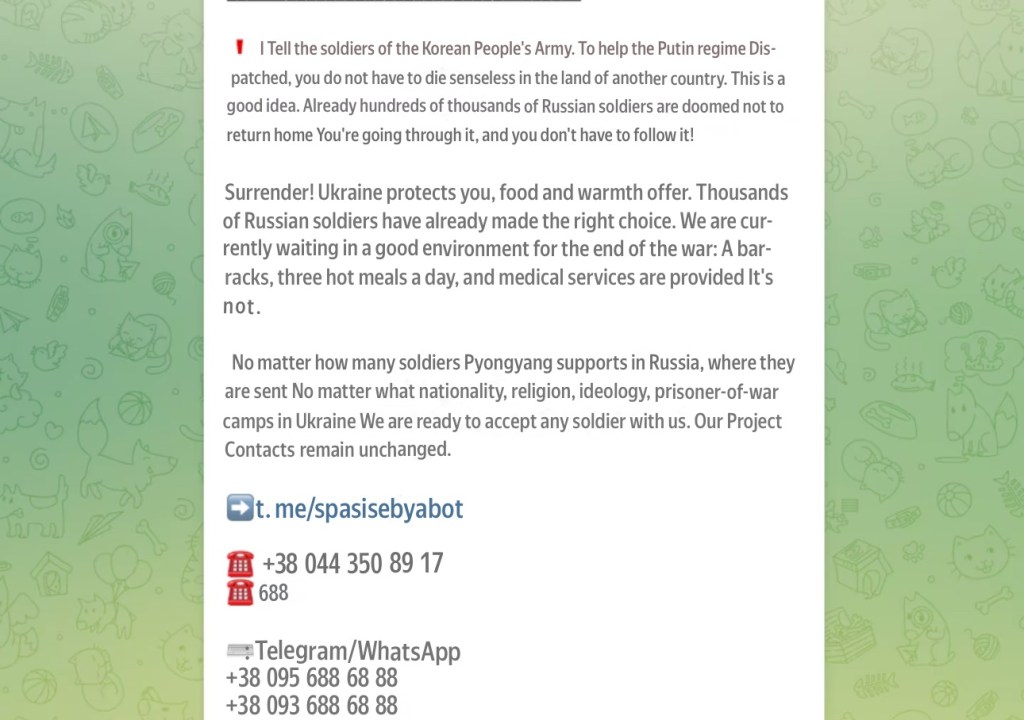
Days before a flurry of evidence-free reports emerged that North Korea sent 10,000 soldiers to help Russia in Ukraine, a Pentagon-linked think tank proposed a disinfo campaign aimed at DPRK & Russia.
Given the differences in the objectives of Russia, China, and North Korea, the United States should be mounting major information operations against these three countries to highlight their differences and fuel distrust among them. Doing so would increase the likelihood of decoupling at least some of their partnerships. Some examples of potential information operations seem obvious.
Defense Priorities was established in early 2016 by supporters of United States Senator Rand Paul and funded by conservative donors Charles Koch and his brother David Koch. Early leadership included William P. Ruger of the Charles Koch Institute and Edward King of a pro-Paul political action committee. The organization was founded to advance Paul’s foreign policy views, which argued for a ‘more prudent, restrained’ United States foreign policy. – Wikipedia
To obtain a competitive edge, information operations and warfare entail obtaining intelligence on opponents and disseminating propaganda.
Definition: Information operations are tactics used to sway people’s opinions and affect how decisions are made.
Propaganda: Messages intended to sway public opinion and affect target audiences’ behavior can be distributed in a variety of ways as propaganda.
Competitive Advantage: The ultimate aim of these activities is to gain a strategic edge over rivals in a variety of settings, including the political, military, and economic spheres.
Tools and Techniques: Information operations can be carried out using a variety of instruments and methods, such as traditional media and social media platforms.
Ethical Considerations: Concerning the effects of such operations on truth and trust in society, the use of disinformation and manipulation presents ethical concerns.
IF advocates of the United States’ access to bases of the Armed Forces of the Philippines (AFP) and US deployment of intermediate-range missiles prove the above headline unduly alarmist, this writer would be most thankful.
CATL and SMIC are two giant Chinese companies that are often singled out by Western think tanks as two firms who benefit from China’s subsidies, at the expense of foreign competition.
But all industrialized countries employ government subsidies, which help favored domestic industries grow. China, however, uniquely can invest in preferred sectors by channeling its massive trading surpluses, and providing low-cost access to its world-leading supply chains and logistics systems.
In contrast, North American and European companies who seek government incentives and subsidies are competing with other spending priorities, as all the funds come from taxpayers. This reality requires of companies seeking government help to do so through proxies, lobbying efforts, and through think-tanks who create research that can be published and used by lawmakers to justify the use of taxpayer funds.
From the ongoing US involvement in Ukraine, to an enduring US military presence in the Middle East, and growing US-Chinese tensions in the Asia-Pacific region, regardless of who controls the US Congress and regardless of who sits in the White House, these conflicts continue forward – often with a Democratic president setting the stage for his Republican successor, and vice versa.
DARWIN, July 26 (Reuters) – The U.S. military is building infrastructure in northern Australia to help it project power into the South China Sea if a crisis with China erupts, a Reuters review of documents and interviews with U.S. and Australian defence officials show.
SYDNEY – A remote Australian island close to an Indian Ocean chokepoint for Chinese oil shipments is on a list of possible locations for US military construction aimed at deterring China, with the US saying it “may or may not” support American forces.


 Ms. Cat’s Chronicles
You must be logged in to post a comment.