
Why Are There Fears of War in the South China Sea?
Read More »Australian-based Marines ready to support Manila in sea-territory skirmish
“We were given a warning order to support the Philippines defense forces in resupplying of the Second Thomas Shoal,” Marine Rotational Force — Darwin commander Col. Brian Mulvihill told Stars and Stripes on Wednesday at an Outback training camp in the Northern Territory.
…
The Marines have been monitoring events at the shoal over a drone feed, Mulvihill said.
“We were ready to support the Philippine defense forces,” he said, noting that Marines across the Pacific are also ready to back the U.S. ally.
The rotational force can airlift food and water by pushing pallets out of helicopters, he added.
“We can control airspace and aircraft from many nations,” he said. “We provide a range of options if a host nation, through the embassy, requires assistance.”
…
Darwin is an excellent platform for launching forces into Southeast Asia, according to Grant Newsham, a retired Marine colonel and senior researcher with the Japan Forum for Strategic Studies in Tokyo.
“It’s good to see Darwin and Northern Territory being used this way … rather than just as a training area for Marines, Air Force, and Australian and other forces,” he said by email Thursday.
The Marines can offer the Philippines fire support coordination. They can help with logistics and intelligence, surveillance and reconnaissance and guard locations that support Philippine forces operating towards the disputed shoal, he said.
“Of course, Marines can deploy aboard Philippine resupply boats alongside [Philippine] personnel,” he said.
Marine engineers could repair the Sierra Madre at the shoal and Marine helicopters could resupply it, Newsham added.
“A U.S. amphibious ship or two with Marines and their aircraft and other hardware aboard deployed to Second Thomas Shoal would be a serious force — and also sending a clear message,” he said. “Deploying Marines in the Philippines with their aviation, long-range rockets, and other hardware has a political significance in itself.”
Related:
Japan Forum for Strategic Studies
South China Sea: Philippines says to solely run Second Thomas Shoal resupply missions
The Trump-Media Circus and Continuity of Agenda
How the US Presidency Really Works
Imagine the United States is a corporation. It thus has a board of directors (Wall Street). It has a CEO (the US President). The candidates for CEO and the CEO are all chosen by the board of directors merely under the guise of “democratic elections.” The CEO then implements the desires of the unelected board of directors, serving also as a spokesperson for the board and a representative of the board’s overarching agenda.This explains how, over the past 16 years from US President George Bush Jr. to now President-elect Donald Trump, singular agendas, including unending war in Iraq and Afghanistan, still rage and expanding confrontations with Russia, China, and Iran continue unabated regardless of who is president, and regardless of the alleged principles, political ideals, and campaign promises they respectively represented.
Rhetorically and ideologically, Presidents Bush Jr. and Obama could not have been any more diametrically opposed, yet the continuity of agenda from one 8-year administration to the other was almost seamless. Upon closer examination of the actual corporate-financier interests underpinning both presidencies’ policies, we find the same profiteering special interests and their agendas at play; from big-defense and big-auto to big-oil and mega-finance. From big-pharma to big-ag, and all of these industries sponsoring the same circle of “policy experts” within the halls of corporate-financier funded “think tanks.”
The presidency of Donald Trump will be no different. There is nothing about either Trump or those he has surrounded himself with that makes him any more “independent” from the defacto “board of directors” that runs corporate America than the administrations of Bush or Obama.
15-07-2024: The East African nation of Kenya was rocked by deadly protests mainly composed of youth during June, ostensibly in response to the Kenyan parliament’s Finance Bill 2024. By the end of the month around 30 protestors had lost their lives, despite forcing the government to withdraw the Bill, which contained some $2.7 billion in tax hikes.[1] The protests were mainly composed of “Gen Z” youth (those born during the late 90s and early 2000s) which gives the impression of young people fighting for their future. Kenya has a population of some 50 million, with 5 million inhabiting the capital Nairobi, and 4 million in the city of Mombasa on the shores of the Indian Ocean. Those aged between 15 and 29 make up roughly 30% of the population,[2] meaning such protests can draw in larger number than is generally the case in the ageing populations of the West. In the wake of the violence, Uasin Gishu Governor Jonathan Bii urged the Gen Z protestors to give dialogue with President William Ruto a chance. Despite goons and looters infiltrating the protests and causing mayhem, Bii conceded that the protestors have genuine issues that need to be addressed.[3]
Related:
The Postwar Vision That Sees Gaza Sliced Into Security Zones
A plan that is gaining currency in the government and military envisions creating geographical “islands” or “bubbles” where Palestinians who are unconnected to Hamas can live in temporary shelter while the Israeli military mops up remaining insurgents.
Other members of Prime Minister Benjamin Netanyahu’s Likud party are backing another, security-focused plan that seeks to slice up Gaza with two corridors running across its width and a fortified perimeter that would allow Israel’s military to mount raids when it deems them necessary.
The ideas come from informal groups of retired army and intelligence officers, think tanks, academics and politicians, as well as internal discussions inside the military. While Israel’s political leadership has said almost nothing about how the Gaza Strip will look and be governed after the heaviest fighting ends, these groups have been working on detailed plans that offer a glimpse of how Israel is thinking about what it calls the Day After.
The plans—whether or not they get adopted in full—reveal hard realities about the aftermath that rarely get voiced. Among them, that Palestinian civilians could be confined indefinitely to smaller areas of the Gaza Strip while fighting continues outside, and that Israel’s army could be forced to remain deeply involved in the enclave for years until Hamas is marginalized.
…
According to people familiar with the effort, it aims to work with local Palestinians who are unaffiliated with Hamas to set up isolated zones in northern Gaza. Palestinians in areas where Israel believes Hamas no longer holds sway would distribute aid and take on civic duties. Eventually, a coalition of U.S. and Arab states would manage the process, these people said.
Ziv, who oversaw Israel’s exit from Gaza in 2005, proposes that Palestinians who are ready to denounce Hamas could register to live in fenced-off geographic islands located next to their neighborhoods and guarded by the Israeli military. This would entitle them to reconstruction of their homes.
The process would be gradual, and in the longer term, Ziv envisages bringing the West Bank-based Palestinian Authority back to Gaza as a political solution, with the whole process taking roughly five years as the military fights Hamas insurgents. Under his plan, Hamas could be part of Gaza’s administration, if it frees all the hostages held there and disarms, becoming purely a political movement.
…
Northern Gaza, under the plan, would remain without reconstruction, and Palestinians there wouldn’t be allowed back to their homes until Hamas’s miles-long tunnel network was destroyed. Like the bubbles plan, it promotes the notion of de-escalation zones where aid can be delivered by the Israeli military or by international forces, but stops short of articulating an idea for governance.
…
Another plan published by the Washington-based Wilson Center* also advocates a coalition-style approach to the conflict but refrains from calling for Israel to consider the adoption of a Palestinian state. It says the U.S. should establish an international police force to manage security in Gaza and over time hand the job to a yet-to-be-defined Palestinian administration.
Robert Silverman**, a former U.S. diplomat in Iraq who is a co-author, said his team discussed the plan with Israeli officials for months, even changing parts of the proposal to make it more agreeable to Israel’s war objectives and political dynamics, but it stalled with the prime minister’s office.
“He believes we finish the war first and then plan the postwar,” Silverman said of Netanyahu. “All the people who have done this before say that’s a huge mistake.”
…
Another document, drafted by Israeli academics, that has made its way to the prime minister’s desk draws on historical precedents in rebuilding the war zones in Germany and Japan after World War II, and more recently in Iraq and Afghanistan. It considers how to tackle Hamas’s Islamist doctrine by learning from the defeat of ideologies such as Nazism and that of Islamic State.
Related:
The Strategic Hamlet Program (SHP; Vietnamese: Ấp Chiến lược) was a plan by the government of South Vietnam in conjunction with the US government and ARPA during the Vietnam War to combat the communist insurgency by pacifying the countryside and reducing the influence of the communists among the rural population through the creation of concentration camps.
…
The Strategic Hamlet Program was unsuccessful, failing to stop the insurgency or gain support for the government from rural Vietnamese, it alienated many and helped contribute to the growth in influence of the Viet Cong. After President Ngo Dinh Diem was overthrown in a coup in November 1963, the program was cancelled. Peasants moved back into their old homes or sought refuge from the war in the cities. The failure of the Strategic Hamlet and other counterinsurgency and pacification programs were causes that led the United States to decide to intervene in South Vietnam with air strikes and ground troops.
The *Wilson Center plan isn’t much better. 👇🏻
Related:
Read More »😹

Fight Back News Service is circulating the following statement from the Communist Party of the Philippines.
Former US air force colonel, Raymond M. Powell, is an active psywar operative, interventionist, war-monger and American agent-provocateur. From an obscure career in the US military, he has been receiving much air time from big Philippine media organizations since last year, touted as a “security analyst” and “expert on maritime issues.”
Philippines: Expose and denounce the American warmonger Col. Raymond Powell
Previously:
Welcome to Kenya’s Gen Z Revolution!
Kenya had been praised to the heavens by the West in yesteryear: it was a beacon of hope and prosperity; East Africa’s most prosperous nation; a success story of capitalism and “development”; and (most important of all) a bulwark of the West amidst encroaching Chinese influence on the continent.
Kenya is a member of China’s Belt and Road Initiative, and Ruto just sent the Kenyan Police to Haiti. 🤷🏼♀️
Related/Notes:
Gen Z Will Lead the People’s Revolution in Kenya (The Elephant*)
Read More »World Spending On Nukes Explodes To More Than $90 Billion
Honeywell International, Northrop Grumman, BAE Systems, Lockheed Martin, and General Dynamics topped the list of companies profiting from nuclear weapons expenditures.
That flood of public funds to private contractors was coupled by significant spending by these companies on efforts to shape the debate around government spending. The companies spent $118 million lobbying governments in the U.S. and France in 2023 and donated more than $6 million to think tanks researching and writing about nuclear weapons.
Lockheed Martin contributed to the most think tanks, including: Atlantic Council, Brookings Institution, Chatham House, Center for a New American Security, Center for Strategic and International Studies, Hudson Institute, and Observer Research Foundation.
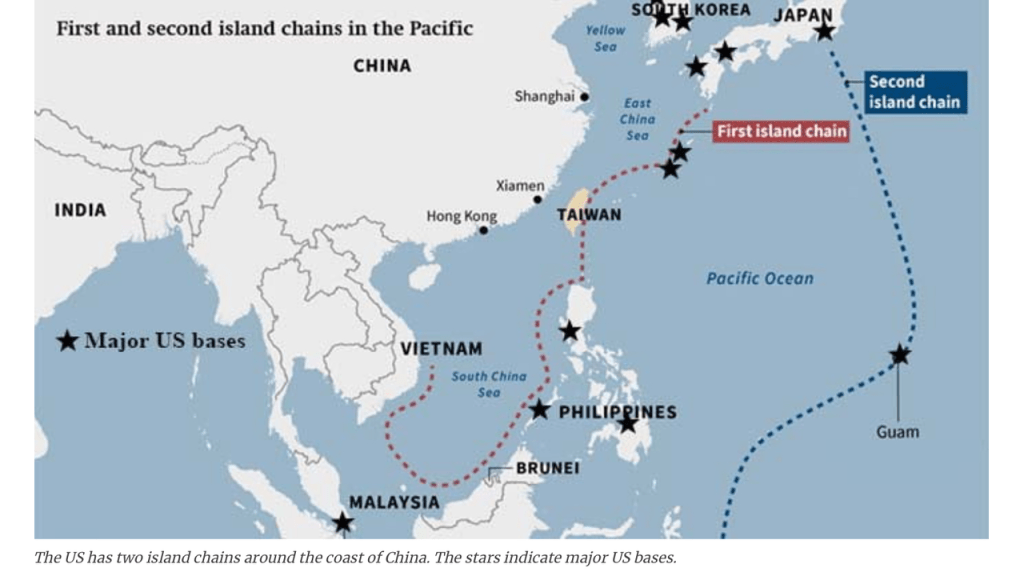
The Chinese Island province of Taiwan continues to be targeted by the US and its political proxies through efforts to further consolidate political control over it and transform it into a geopolitical “battering ram” against the rest of China.
Previously:
Containing China: US Using Taiwan as East Asian “Ukraine”
Report: US Military Advisors Deployed to Taiwan-Controlled Islands on China’s Coast
The US-backed NED candidate Willy Lie from the NED-backed party won
 Ms. Cat’s Chronicles
You must be logged in to post a comment.