Sweater Girl is back with another lesson. This time she’s teaching Gene Sharp tactics. I really need to research her background. Yes, Trump leans into authoritarian theatrics, but the people amplifying these tactics aren’t fighting for socialism, and the funding streams behind them aren’t exactly grassroots. There’s an infrastructure here—front groups, donor networks, polished manuals—dressed up as spontaneous resistance. The aesthetics say “community,” but the playbook says something else entirely.
The video opens with a provocation—What if we weren’t afraid to get arrested? It’s time to learn about OTPOR!—but skips over the basic context of the organization being invoked. Angela Baker’s recommendation fits a pattern I’ve seen before: presenting Otpor as a neutral protest model while leaving out the political landscape that shaped it. Blueprint for Revolution, the book she cites, was written by Srđa Popović, one of Otpor’s leaders. The group received support from the National Endowment for Democracy, USAID, and pro‑democracy funding networks that included George Soros’ foundations, which Soros later acknowledged supporting during the 2000 uprising against Milošević. None of this automatically discredits the material, but it does mean the playbook isn’t organic or context‑free.
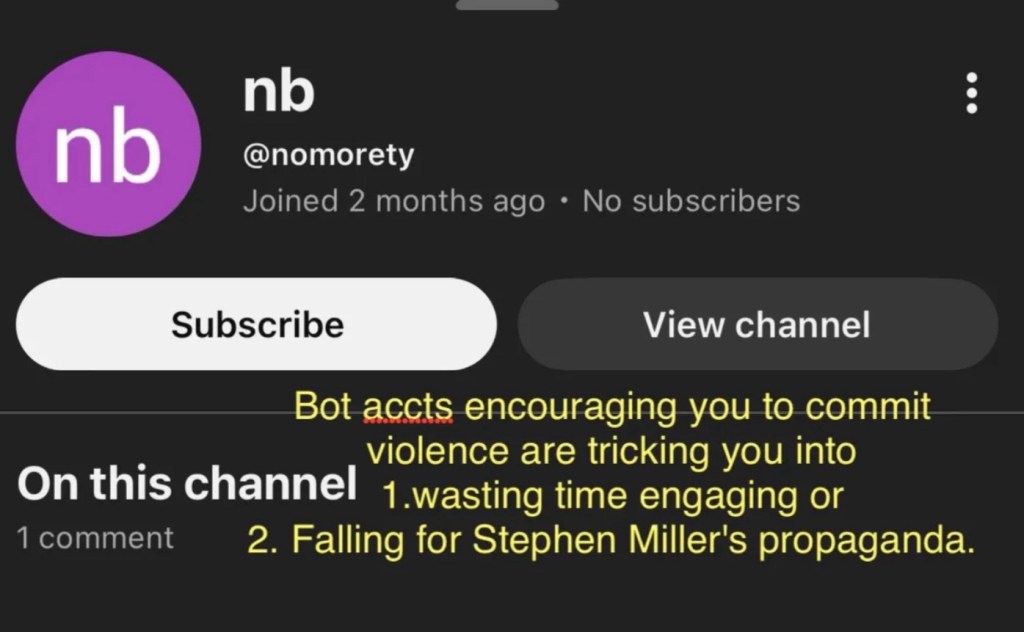
I’m sitting down to film now, but I wanted to remind you that the bots and agent provocateurs are working overtime right now in my comments and all over the Internet.
I just blocked more than a dozen accounts telling Americans to riot or shoot ICE agents or commit other acts of violence. Please understand that when the regime is trying this hard to get you to do something, and all of the bots are aligned in their messaging and messaging aligns with the desires of Stephen Miller, we cannot possibly be foolish enough to fall for it.
Hold the line. Do not give up and lay down. Do not give in to their manipulations and your rage and make stupid devastating mistakes right now. We must move in ways that are tactical and well-planned and help our cause.
(Internet slang, intransitive) To post violent threats on the Internet, ostensibly as an everyday citizen, but actually working as an undercover federal agent. “How do you do fellow channers? Any bombings planned for today?” “Stfu glowie, stop fedposting”.
The Philippine STAR reported that presidential press officer Claire Castro brought up the idea at the tri-committee hearing on fake news, saying that forming another regulatory body for such could help fight the proliferation of fake news on the Internet.
As noted, there appear to be real challenges working through the necessary technologies to support command messaging efforts from being able to acquire simple programs, such as Adobe [1], that can help improve image quality of released content to access to social media. It would seem prudent that an assessment of such issues should be conducted by the command with necessary remediation actions undertaken when the new commander comes into USINDOPACOM.
…
The Global Engagement Center (GEC) at the U.S. Department of State [2], for example, partially funds the Asia Maritime Transparency Initiative [Center for Strategic and International Studies]. The GEC, the State Department, or DoD should seek to identify other voices that can support and that can more credibly communicate key messages.
A superseding indictment against Steve Bannon’s longtime patron identified anti-CCP groups the two founded, as well as social media app Gettr, as part of a fraudulent enterprise.
The Free Russia Foundation (FRF), a Washington-based NGO, has confirmed running a network of paid online commenters focused on influencing Russian current affairs and the Ukrainian crisis.
The State Department has awarded the following five grants since September 1:
An $18,000 grant to the Albanian-based non-governmental organization (NGO) the Institute for Democracy, Media, and Culture* to ensure a “whole-of-society response to cyber incidents and misinformation.” The associated program began on September 1, 2023.
A $14,500 grant to Paraguay’s American Cultural Center [Centro Cultural Paraguayo Americano] that will be used to implement workshops that “seek to combat misinformation and promote responsible digital citizenship.” The associated program began on September 1, 2023.
A $15,000 grant to the Faculty of Social and Political Sciences at Udayana University to “raise digital literacy among selected amcors communities, journalists, and social media influencers to combat misinformation, pre-2024 general election.” The associated program is due to start on October 1, 2023.
A $50,000 grant to New York University to complete the implementation of a speaker series that supports “countering misinformation.” The associated program is due to start on October 1, 2023.
A $50,000 grant to the non-profit Digital Rights Nepal*** “to create a sustainable network of youth to promote digital rights, safer internet use and a collective resilience towards misinformation and disinformation.” The associated program is due to start on October 2, 2023.

 Ms. Cat’s Chronicles
You must be logged in to post a comment.