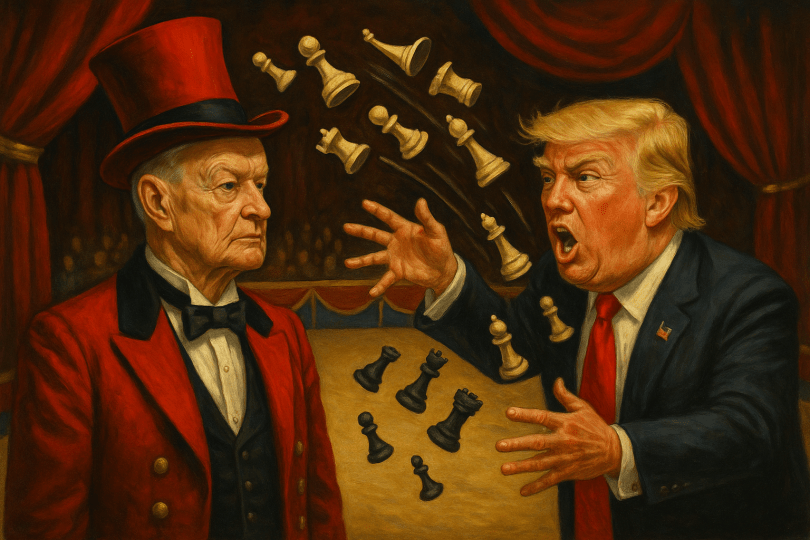
Washington’s “Second Coming” to Asia: Militants, Ports, and Pressure Points

Source

President Trump’s renewed focus on regaining the Bagram Air Base and developing Pakistan’s Pasni Port signals Washington’s attempt to reassert strategic influence in a region increasingly dominated by China, Russia, and Iran.

Washington’s “second coming” to Asia

Pakistan’s Pasni Port, located in Balochistan province, sits at the crossroads of strategic infrastructure and insurgent resistance. The Western-backed Baloch Liberation Army (BLA), active in the region, has long targeted Chinese-financed projects. The BLA maintains ties with both the Pakistan Taliban and ISIS-K—a faction recently linked to recruiting Uygur militants. Separately, U.S. support for Uygur militants predates this trend, with allegations tracing back to the 1970s/1980s. Rep. Perry has claimed that ISIS-K received backing from USAID, adding another layer to the region’s militant entanglements. 

This only deepens my suspicion that recapturing Bagram Air Base could serve as a launchpad—not merely for tactical leverage, but to stir Uygur militant resistance against Beijing or pressure China with a second front in the event of a future Pacific conflict.

Sources:

BLA: U.S. Proxies in Balochistan document

ISIS-K & Uygur militants: ISIS has its sights set on a new potential ally—Uyghur jihadi groups

CIA & Uygur militants: US & TERRORISM IN XINJIANG

Uygur militants: *Xinjiang*

USAID & ISIS-K: Rep. Perry reveals what some of us already knew about USAID

Bagram Air Base: Why Does Trump Want U.S. Troops Back in Afghanistan?

Bonus: Chokepoints Are The Focus Of A New Cold War

Western Media Urges Public: Believe Our Lies, Not Your Own Eyes

YouTube / Rumble
  • The West has spent years accusing China of “genocide” in its western region of Xinjiang despite producing no evidence to substantiate such claims;
  • China has since opened up Xinjiang to international tourism where people from around the globe including the West can see for themselves there is no “genocide;”
  • The collective West now seeks to reassert control over the narrative by questioning travel vloggers reporting back from China regarding their experiences;

Western Media Urges Public: Believe Our Lies, Not Your Own Eyes (archived)

Sources:

Read More »

Canadian Politicians Cry About Non-existent ‘Repression’ of Islam and Ethnic Culture in Xinjiang

Full video

The Xinjiang Uygur Autonomous Region of the People’s Republic of China is a truly controversial place in the world, thanks to the machinations of Western imperialists and their Uygur separatist proxies.

Canadian Politicians Cry About Non-existent ‘Repression’ of Islam and Ethnic Culture in Xinjiang

Related:

About URAP

UYGHUR RIGHTS ADVOCACY PROJECT HAS COMMENCED ITS ADVOCACY WORK ON MAY 1, 2020, WITH THE GRANT PROVIDED BY THE NATIONAL ENDOWMENT FUND FOR DEMOCRACY.

*Xinjiang*

Xinjiang: Gateway to China’s future, where culture meets commerce!

Once at the crossroads of East and West on the ancient Silk Road, the vast expanse of Xinjiang is set to take a pivotal role again as China builds 21st century trade routes to take its goods to the world. In this culturally rich and climatically harsh region, the potential for growth appears as endless as the landscape.

Xinjiang: Gateway to China’s future, where culture meets commerce!

*Xinjiang*

Why Is Arab Media Silent About the Uyghur Separatists Supporting “Israel”?

We no longer hear much about the Uyghur issue, which Arab and international media outlets often promoted as a narrative to tarnish the reputation of the Chinese government and pressure it. This issue has always been framed through the lens of “generality” implying that “China is persecuting Muslims within its borders,” which is certainly not true, since the Uyghurs are not the only Muslim ethnic group in China; there are ten Muslim ethnicities in China.

Why Is Arab Media Silent About the Uyghur Separatists Supporting “Israel”?