
Part Three: Sternenko and the Promoters of Judicial Reform in Ukraine (Tercera parte: Sternenko y los promotores de la reforma judicial en Ucrania)
Read More »Tag: Ukrainian Nationalism
“Horrific murder” in Lviv

Verkhovna Rada: “Meeting with Parliament’s interns, Andriy Parubiy and Geoffrey Pyatt,” 2016
“Horrific murder” in Lviv (original)
Read More »The Importance of Donbass

Putin fears him — 20,000 Ukrainians want to fight for him
Heard about this via Scott Horton’s interview with Larry Johnson (timestamp: 28:00).
Putin fears him — 20,000 Ukrainians want to fight for him
Read More »Azov vs. Azov
Two weeks ago, masked men attacked Major Andriy Korynevych, a recruitment officer from the Azov Brigade in the National Guard of Ukraine (NGU), and beat him in broad daylight near his home in Ivano-Frankivsk, western Ukraine. About ten days later, he dropped a bombshell: police identified his attackers and their accomplices, all of them from the Azov movement’s 3rd Assault Brigade (AB3). Furthermore, Korynevych suggested that the assault took place on the orders of Andriy Biletsky, the leader of the Azov movement, who he said is “closely connected” to the attackers. NGU Azovites are evidently furious—their unit published a statement denouncing the alleged assailants—and many AB3 Azovites are no less enraged at their counterparts’ betrayal, for going to the police and airing their dirty laundry.
Related:
Seven Decades of Nazi Collaboration: America’s Dirty Little Ukraine Secret (Archived)
Andriy Biletsky’s Third Corps
Note: The 3rd Assault Brigade is widely regarded as the successor to the Azov Battalion, a unit originally founded by Neo-Nazi Andriy Biletsky. The battalion, later expanded and reorganized into the Azov Regiment, underwent rebranding amid evolving military and political dynamics, eventually forming the core of the current brigade.
El Tercer Cuerpo de Andriy Biletsky (Andriy Biletsky’s Third Corps)
On March 14, Colonel Andriy Biletsky, commander of the Third Assault Brigade, announced its conversion into the Third Corps of the Armed Forces of Ukraine, a formation that will remain under his command. In a video sharing the news on Instagram, Biletsky stated:
Read More »
Oh, the Irony: Flags of Contradiction
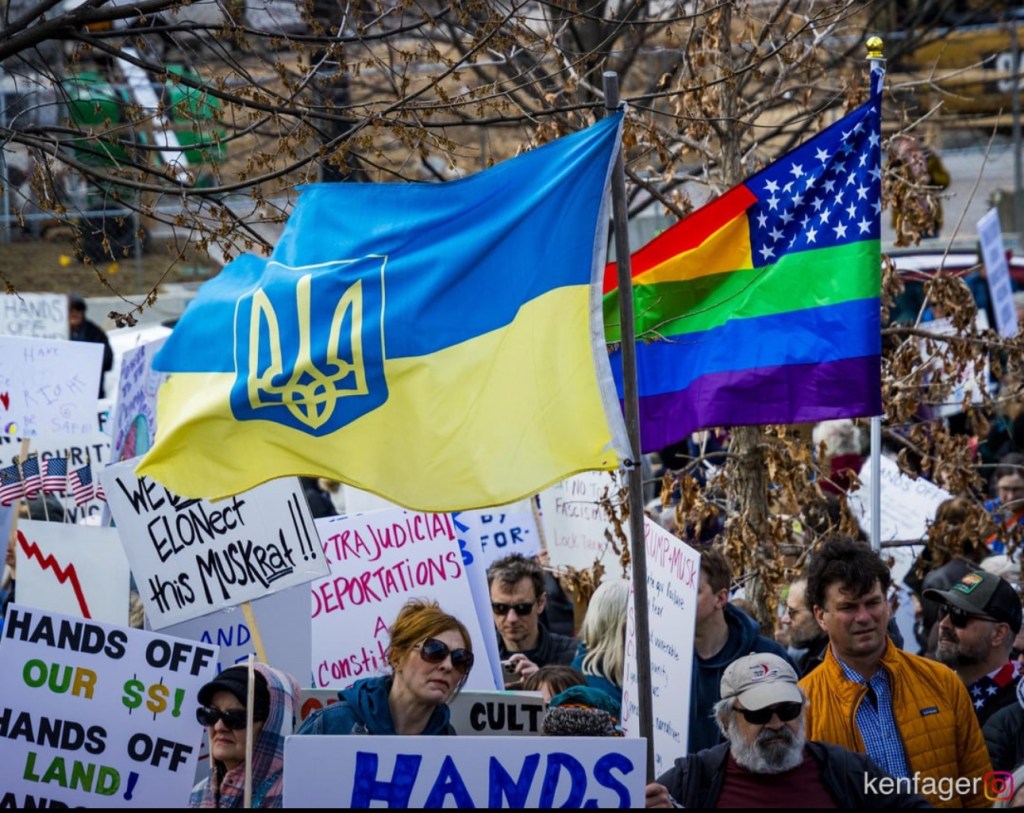
Juxtaposing these two flags creates a stark contradiction, given the Ukrainian Ultranationalists’ oppressive policies toward LGBTQ+ communities.
Related:
Protesters tee off against Trump and Musk in “Hands Off!” rallies across the U.S.
Gallery: Thousands of protesters gather on State Street, at Capitol to protest Trump administration
Democrats join Republicans in passing fascistic “Crucial Communism Teaching Act” + More

Congress Considers Neocon Lesson Plans to Keep Kids Off Communism
Congress Considers Neocon Lesson Plans to Keep Kids Off Communism
In the latest front in the culture war over school curricula, the House of Representatives is set to vote Friday on a bill that would give a congressional stamp of approval to the lesson plans of the Victims of Communism Memorial Foundation, a group closely linked to fervently hawkish corners of the foreign policy blob.
Read More »
Zelensky’s wear and tear
Zelensky’s wear and tear (original)
For more than two and a half years, war has been the raison d’être of the Ukrainian state. The budget presented by Kyiv this week allocates more than 50% of the budget to the defence sector – to which must be added the cost of veterans – something that has been repeated since 2022. Maintaining the front, avoiding its collapse and ensuring that there is still enough support to continue fighting until the objectives are achieved is the priority of the government team, which has set aside practically all other obligations of the state, which today depends entirely on foreign subsidies that make it possible to pay salaries and pensions. One of the aspects that has completely disappeared under the cover of the unity demanded by the war is precisely domestic politics. The Russian invasion gave Zelensky’s team the opportunity to create for the president the image of a war leader, the representation of the nation, a savior capable of achieving what he sets out to do, the only person capable of rescuing the country from certain ruin.
Read More »
 Ms. Cat’s Chronicles
You must be logged in to post a comment.