Information Pipeline of Krushchev’s Secret Speech

ChatGPT

This is just a small part of the research I’ve been working on for quite some time regarding the Soviet Union. My investigation covers various aspects of its history and ideology, as well as the narratives that have influenced how we view this complex entity. By examining primary sources and historical accounts, I’m trying to piece together a more nuanced understanding of the Soviet experience and its lasting effects on global politics.

—Tina Antonis


Read More »

Capes, Cameras, and the Cult of Visibility

Capes, Cameras, and the Cult of Visibility: The SeaLight Crusade as White Savior Theater

By Tina Antonis

The South China Sea is more than a maritime dispute—it’s a theater of narrative warfare. While headlines focus on Chinese aggression and Philippine resistance, a quieter campaign unfolds in the background: one of satellite feeds, curated imagery, and Pentagon-backed storytelling. At the center of this effort is SeaLight, a project that claims to illuminate truth but often casts shadows of its own.

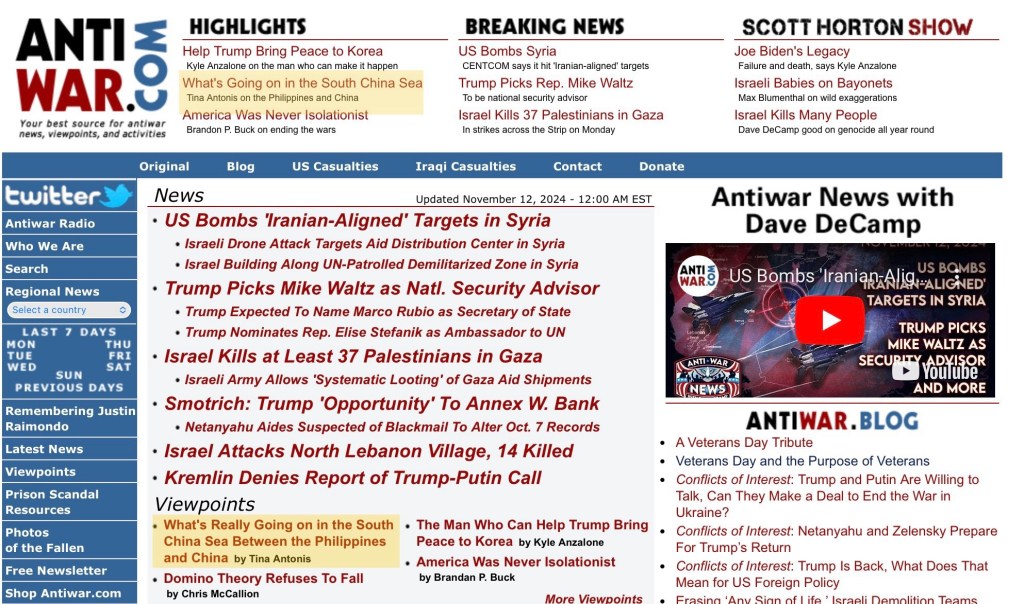
As explored in my article at Antiwar.com, SeaLight doesn’t just document—it performs. It reframes geopolitical tension through moral spectacle, positioning its creators as heroic arbiters of transparency. But when the messenger wears a cape and the funding flows from defense budgets, we must ask: is this clarity, or choreography?

Stage Left: The White Savior Enters

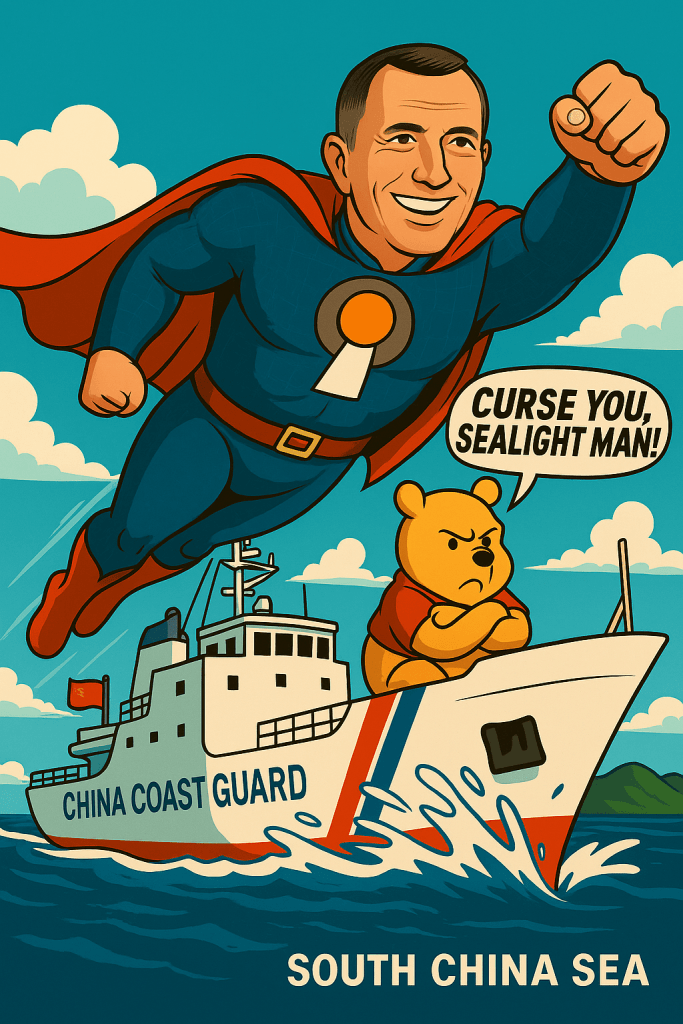
In the comic-strip cosmology of Ray Powell’s SeaLight project, transparency wears a cape. Clad in heroic postures and backed by satellite imagery, Powell casts himself as the guardian of maritime morality—unarmed, except with satellite feeds, theatrical flair, and strategic messaging. 

Yet beneath the cartoon and Pentagon-funded optics lies a familiar archetype: the white savior, rebranded for the South China Sea.

China Is Imperialist? Says Who?

Calling China a “maritime occupier,” Powell positions himself as a bulwark against aggression. But that moral pose collapses under scrutiny. He speaks for a country with over 800 foreign military installations and a documented history of over 250 military interventions since 1991—wars in Iraq, Afghanistan, Libya, Syria, Somalia, and dozens more, all under the banner of peace, freedom, or preemption.

By comparison, China’s post–Cold War footprint includes no sustained foreign occupations and only scattered border conflicts and peacekeeping missions. The imbalance is staggering. And Powell’s framing doesn’t just ignore it—it performs around it.

As David Vine argues in The United States of War, this vast base empire is not a passive network—it’s an architecture of perpetual war. These outposts make military engagement not an exception but a structural habit, cloaked in strategic necessity and sold as global stewardship.

Powell’s cartoon rhetoric—calling China an occupier—obscures the scale of U.S. militarism. The term “occupation” is deployed not to analyze, but to project. When adversaries hold territory, it’s a crisis; when the U.S. spans the globe with armed installations, it’s policy.

Framing Conflict: The Optics of Consent

This isn’t irony. It’s performance. Powell’s language manufactures a moral frame for confrontation—costumed in transparency, but driven by escalation. The cape is literal. The conditioning is deliberate. And the stage is set for war.

SeaLight’s mission is not just visual documentation—it’s narrative warfare. As the Japan Times openly notes, its “chief weapon is photography, applied purposefully, generously and consistently over time.” These images—enhanced, curated, and distributed across media—are not neutral. They’re constructed to shape public perception, sway international opinion, and ultimately manufacture consent for confrontation.

Assertive transparency becomes a kind of ideological scaffolding—a stage on which geopolitical tension is dramatized, simplified, and morally polarized. The goal isn’t simply to reveal conflict; it’s to condition audiences for escalation.

And when the messenger dons a superhero’s cape, the spectacle transforms into something deeper: a story of rescue, of virtue, of intervention. This is not analysis—it’s soft propaganda dressed in heroic metaphor.

Consent for war doesn’t begin with missiles. It begins with mythmaking.

What’s Really Going On In the South China Sea Between the Philippines and China

What’s Really Going On In the South China Sea Between the Philippines and China

by Tina Antonis

Maritime clashes between the Philippines and China had been mostly over the Philippines’ military outpost, BRP (BRP—Barko ng Republika ng Pilipinas, which translates to “Ship of the Republic of the Philippines”—the ship prefix for the Philippines) Sierra Madre, in the Spratly Islands, which is disputed by Brunei, China, Malaysia, the Philippines, Taiwan (a province of China, as recognized by the United Nations’ Resolution No. 2758), and Vietnam. The BRP Sierra Madre was intentionally run aground on a reef near the Second Thomas Shoal in the disputed Spratly Islands, in 1997, so that the Philippines could stake their territorial claim.

Read More »

Atlantic Council’s Ali Riaz to lead commission on constitutional reforms for Bangladesh

Ali Riaz to lead commission on constitutional reforms

The government yesterday named Professor Ali Riaz as head of the Constitutional Reform Commission, replacing Supreme Court lawyer Shahdeen Malik.

Prof Yunus announced the formation of six reform commissions in his address to the nation on September 11.

They were formed to reform the judiciary, the election system, the administration, the police, the Anti-Corruption Commission, and the constitution. Prof Yunus also named the chiefs of the commissions.

Ali Riaz, a Bangladeshi-American, is a distinguished professor of politics and government at Illinois State University, US. He was the chair of the Department of Politics between 2007 and 2017.

He is a nonresident senior fellow of the Atlantic Council and the president of the American Institute of Bangladesh Studies.

Related:

About Ali Riaz

Atlantic Council, American Institute of Bangladesh Studies, BBC World Service, Claflin University (South Carolina), Illinois State University, ISEAS – Yusof Ishak Institute (Singapore), University of Hawai’i (East-West Center), University of Lincoln (U.K.), V-Dem Institute (funders), Woodrow Wilson International Center for Scholars (2023 donors), Testified at U.S. Congress in 2013, 2015, and the US Commission on International Religious Freedom in 2008.

See Page 2 for more:

Yes, there is the book “1984” in Xinjiang bookstore

Hi, everyone,

I visited Xinjiang recently. Before I went, I asked my followers what they would like me to see for them, and one of them wanted me to check whether there is the book of “1984” by George Orwell in Xinjiang’s bookstores and libraries.

Yes, there is the book “1984” in Xinjiang bookstore

Ironic, considering that the CIA and Britain’s FCDO used the snitch Orwell’s works in their cultural war against Communism.

Related:

Orwell and the CIA

The Cultural Cold War: The CIA and the World of Arts and Letters (PDF)

*Xinjiang*

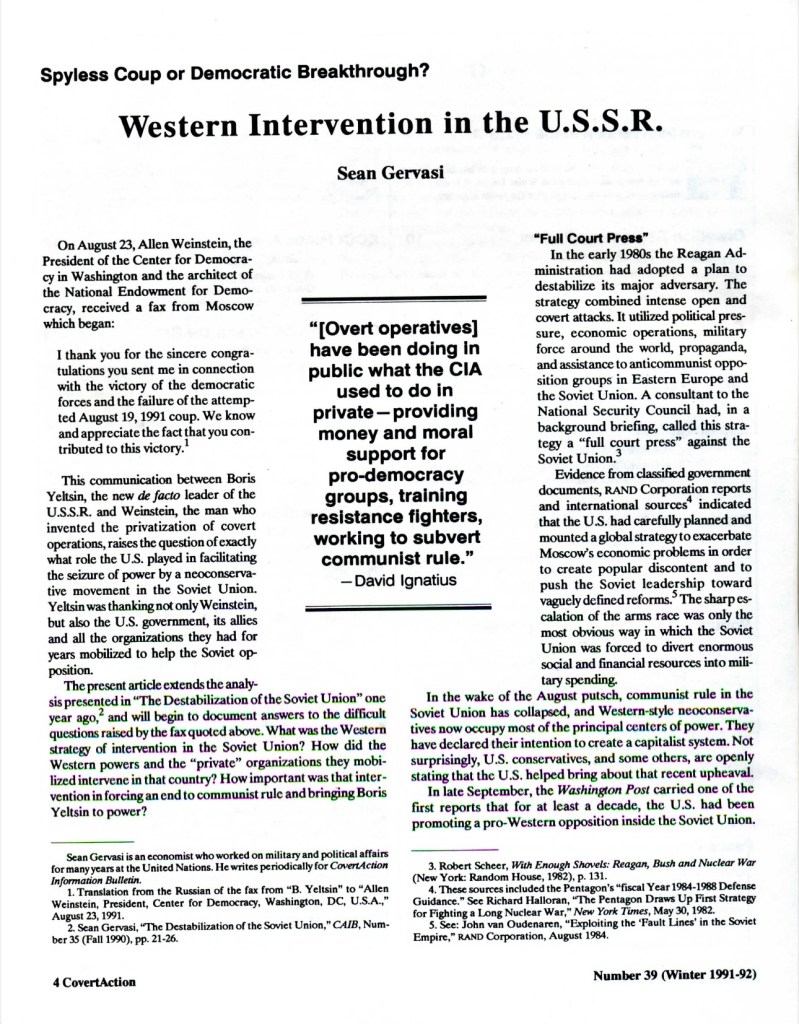
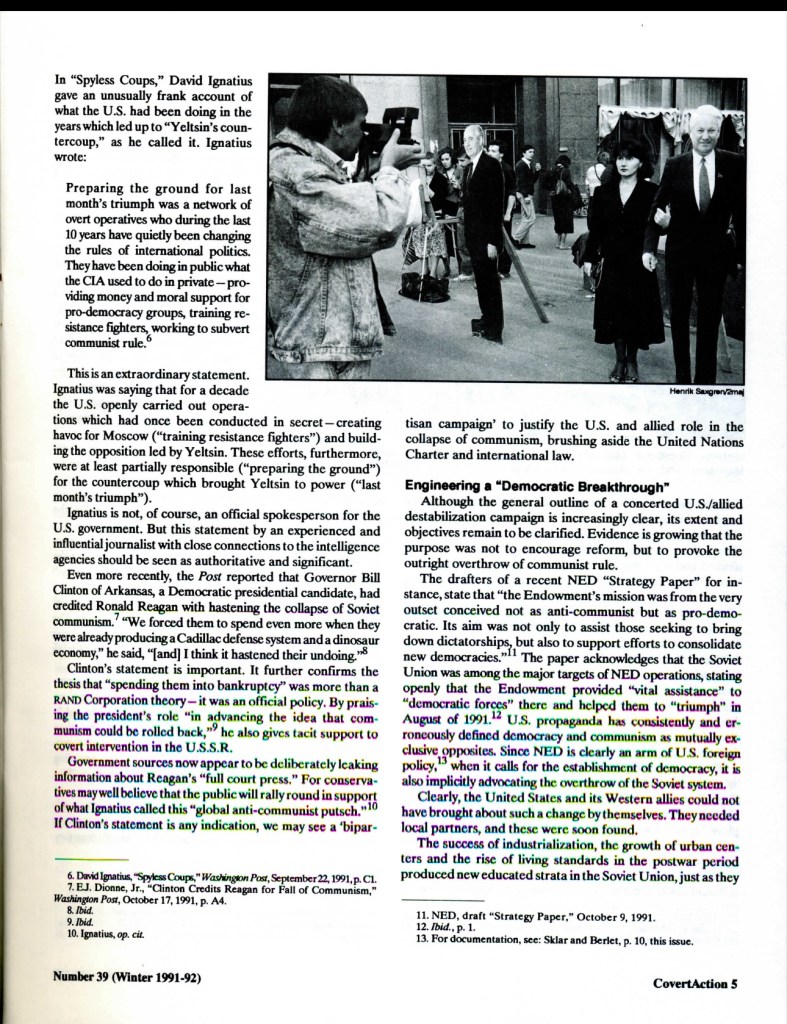
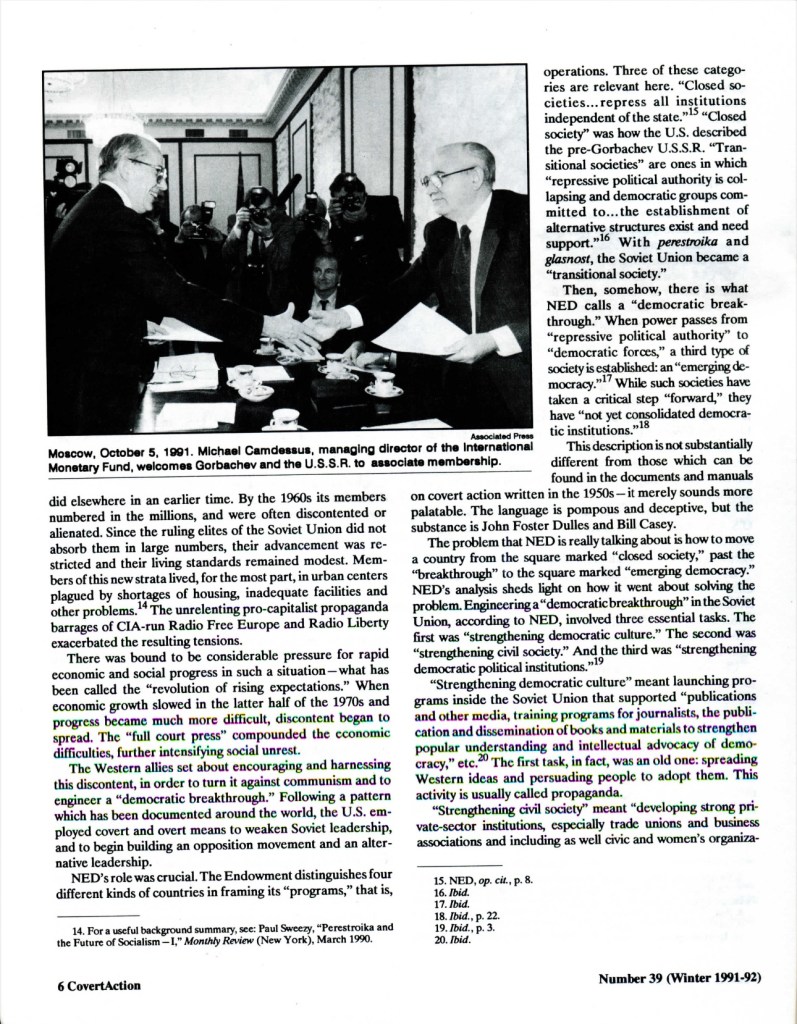
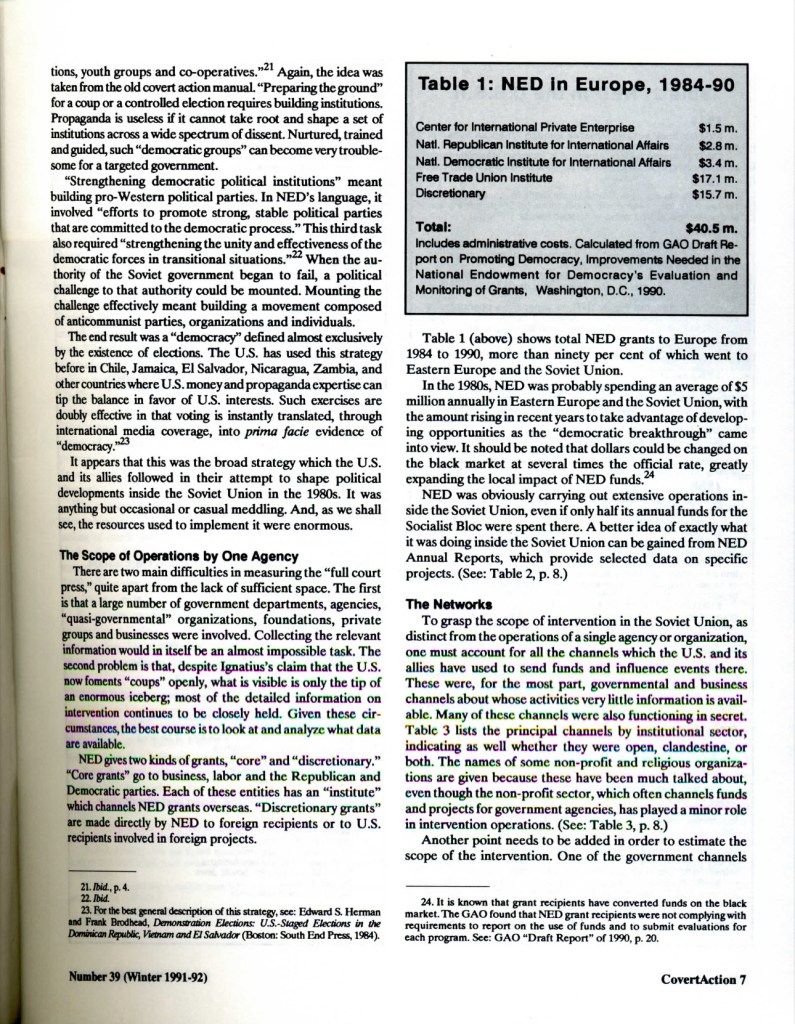
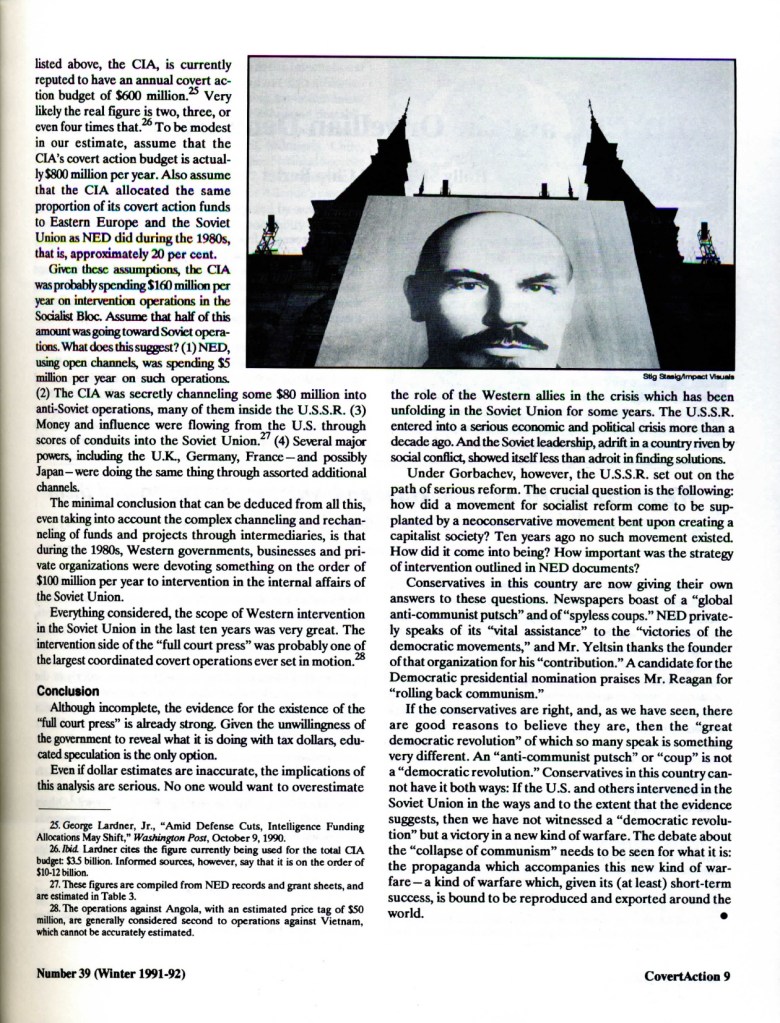
Western Intervention in the U.S.S.R.

Since the early 1980s the USA has waged and intense political and economic war against the Soviet Union. A former UN military and political analyst puts the pieces together.

Western Intervention in the U.S.S.R. by Sean Gervasi

Related:

Exploiting ‘fault lines’ in the Soviet empire: an overview

INNOCENCE ABROAD: THE NEW WORLD OF SPYLESS COUPS

Free Trade Union Institute

US gov’t-linked firm is source of exit poll claiming Venezuelan opposition won election

Venezuela’s opposition and US media outlets claim there was fraud in the July 28 election based on an exit poll done by US government-linked firm Edison Research, which works with CIA-linked US state propaganda organs and was active in Ukraine, Georgia, and Iraq.

US gov’t-linked firm is source of exit poll claiming Venezuelan opposition won election

Related:

The US government funds election observers and exit polls for regime change

All of my recent posts about the 2024 Venezuelan presidential election are linked below:

As predicted: violence by the far-right Venezuelan opposition breaks out across Caracas

Covert Cultural Influence: How the US Embassy’s Cultural Attaché Targets Yemeni Society

Yemen: The cultural attaché office is one of the most active divisions within the US Embassy, assisting the CIA and the political and economic attachés in reaching targeted individuals. This office collects intelligence that benefits American interests in Yemen, each according to their specialization and field.

Covert Cultural Influence: How the US Embassy’s Cultural Attaché Targets Yemeni Society

Related (J Adam Ereli):

Presenting Yemeni Art to the World [Archives:1997/44/Culture]

Adam Ereli: “Yemen’s press has an important role to play. But it must check and double check its information.” [Archives:1998/31/Law & Diplomacy]

Middle East in turmoil:

Linda Heard speaks with former #US Director of the Office of Press and Public Affairs and Ambassador to Bahrain, #J._Adam_Ereli to get an informed overview of a troubled region undergoing historical transformation.

It’s Official: “Arab Spring” Subversion is US Funded