Turkish protestors demand expulsion of US warship docking in Izmir Port + More

Press TV – September 3, 2024

Turkish citizens have taken to the streets in Izmir to demonstrate against the docking of an American warship, expressing solidarity with Palestinians and their opposition to US all-out military support for Israel amid the Gaza genocide.

Turkish protestors demand expulsion of US warship docking in Izmir Port

Related:

Full video

Two US Marines Assaulted by Turkish Nationalist Group in Izmir

10 people arrested in attack on 2 US Marines in Turkey

As a safety precaution, U.S. service members ported in Izmir are restricted to their ship, a U.S. official told ABC News on Tuesday.

Çuval Olayı – the “hood event” revisited

Philippines aims to acquire Typhon missile launcher as regional arms race intensifies

Source

China is against the deployment of the Typhon in the Philippines, which has been used in joint military exercises involving US troops

Philippines aims to acquire Typhon missile launcher as regional arms race intensifies

Related:

Foreign Ministry Spokesperson Lin Jian’s Regular Press Conference on August 30, 2024:

Bloomberg: The Philippines’ top military official said that the deployment of the US missile system in the country was mainly for training. China has been in the past said that the weapon system could be destabilizing. Does the Foreign Ministry have any comments on the recent comments by the Philippines’ military chief?

Lin Jian: On the US deployment of Mid-Range Capability missile system in the Philippines, China has made clear our opposition more than once. This move by the US and the Philippines incites geopolitical confrontation, escalates tensions in the region, and harms regional peace and stability. It has aroused high vigilance and concerns of countries in the region. The Philippines needs to have a clear understanding of the real intention of the US, respond to the common concerns of regional countries, avoid acting as the cat’s paw for the US at the expense of its own security interest, and quickly pull out the missile system as publicly pledged.

Navy to sideline 17 vessels due to manpower shortage

Full video

The Navy will reportedly sideline 17 vessels due to a manpower shortage that makes it difficult to properly crew and operate ships across the fleet. 

Navy to sideline 17 vessels due to manpower shortage, operating crews will be redistributed: report

Related:

Navy Could Sideline 17 Support Ships Due to Manpower Issues

“This is basically the result of many years of neglect and mismanagement of their force,” Sal Mercogliano, former MSC mariner and associate professor of history at Campbell University told USNI News on Thursday.
“They are just burning through people.”

While the order has yet to be signed, Mercogliano has tracked EPFs beginning to return to the U.S. from aboard far from the end of their expected service lives.

“These ships have a lot of life in them,” he said.

China gathers naval leaders worldwide to discuss maritime security while US conducts drills to ‘destabilize S. China Sea’

US and Philippines launch Balikatan joint military drills in South China Sea

This year’s staging of Balikatan, the allies’ largest annual military drill, will include a joint sail in the disputed South China Sea outside the Philippines’ territorial waters. The French navy, a first-time Balikatan participant, and the Australian navy will also join the manoeuvres.

While the US and the Philippines resumed joint naval patrols in the area last year, and the US has in the past sailed there with other allies and partners, it will be the first time that the Balikatan drills have extended beyond 12 nautical miles off the Philippine coast and into waters claimed by China.

Six Philippine coast guard vessels will also participate in the drill, the first time the service — which has been at the forefront of frequent clashes with China over the past year — has been included in a military exercise.

Another closely watched component of the drills will be the Strategic Mid-Range Fires missile system, known as Typhon, which has a range of up to 2,500km. The US Army airlifted the system to the Philippines this month, the first such deployment in the Indo-Pacific. Intermediate-range ground-launched missiles had been banned under the Intermediate-Range Nuclear Forces Treaty, but the pact collapsed in 2019 after both the US and Russia left it.

Troops will also practise tracking and targeting air and missile threats, retaking enemy-occupied islands in the Philippines’ far north, just south of Taiwan, and sinking a ship off the coast facing the South China Sea, expanding on drills last year.

The exercise coincides with an annual conference by China’s Navy, which will be attended by senior military officers including from the US. It also comes as US secretary of state Antony Blinken is heading to China on Wednesday in the two countries’ latest effort to manage tense relations.

Related:

China gathers naval leaders worldwide to discuss maritime security while US conducts drills to ‘destabilize S. China Sea

Read More »

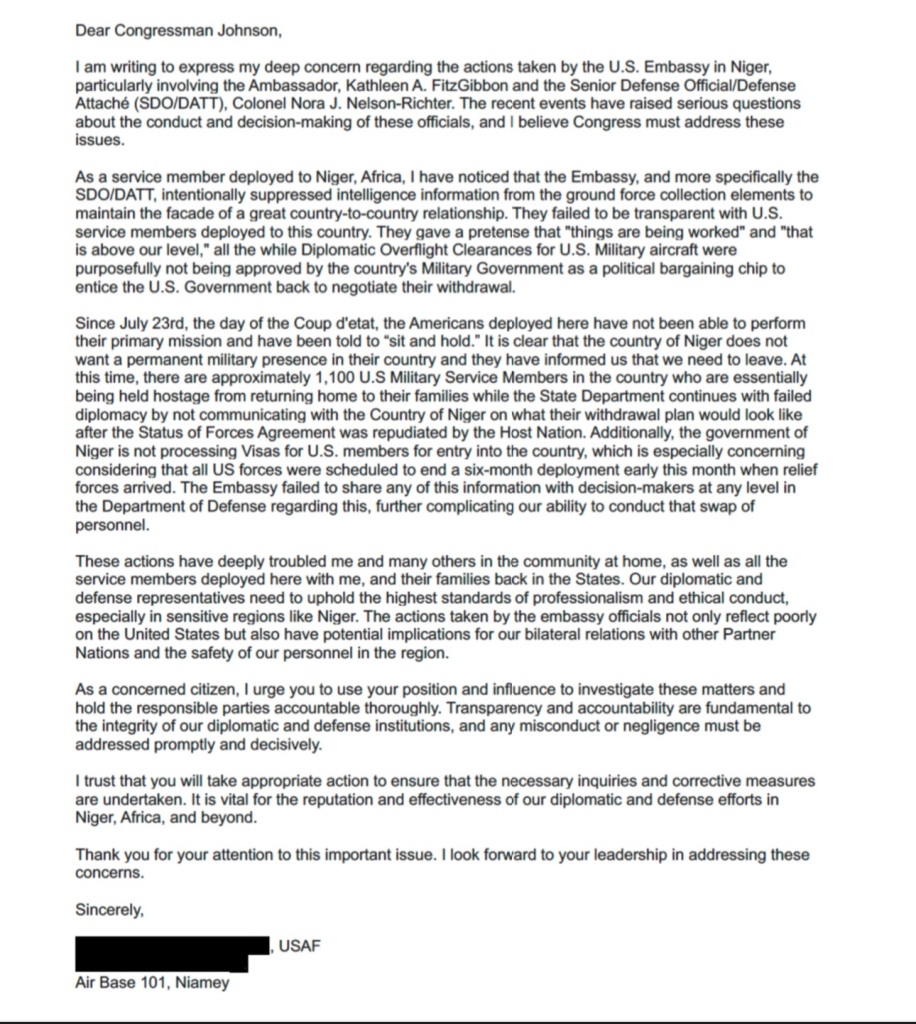
Defying Niger exit order leaves U.S. troops vulnerable, whistleblower says

Defying Niger exit order leaves U.S. troops vulnerable, whistleblower says

“We have Army soldiers right now in Niger who aren’t getting their troop rotations, who aren’t getting their medicine, who aren’t getting their supplies, who aren’t getting their mail and the two senior people in the United States Army are sitting before me and it’s like ‘hear no evil, see no evil, speak no evil,’” said Gaetz.

Previously:

BBC: Niger’s Junta Revokes Military Agreement With US

He [Col Amadou Abdramane] also alleged that the US delegation had accused Niger of making a secret deal to supply uranium to Iran. Col Abdramane described the accusation as “cynical” and “reminiscent of the second Iraq war”.

US to change Japan command posture to boost deterrence in face China -US envoy

US to change Japan command posture to boost deterrence in face China -US envoy

Sources with knowledge of the planning have told Reuters Washington will consider appointing a four-star commander for Japan to match the rank of the head of Japan’s new military headquarters. Experts say a U.S. officer of that rank could lay the groundwork for a future unified Japanese-U.S. command.

Related:

A Vital Next Step for the U.S.-Japan Alliance: Command and Control Modernization

Reimagining U.S. Forces Japan

The current structure of alliance command and control is not sufficient for the task. U.S. Forces Japan (USFJ) has changed little since the 1960s, when Japan was viewed as little more than a platform for U.S. military operations across the region. USFJ’s authorities and staffing are limited primarily to administering alliance agreements related to the 50,000-plus U.S. personnel stationed in Japan with the U.S. Navy, Marine Corps, Air Force, and Army. U.S. forces in Japan represent some of the most important U.S. military capabilities in the Indo-Pacific, but the three-star USFJ commander has limited joint operational authorities, and the separate U.S. service elements in Japan report back to their component headquarters in Hawaii.