
China getting rid of US debt holdings amid Washington DC’s escalatory actions and overall US decline

This year marks exactly 50 years since the establishment of ties between the United States and the People’s Republic of China. US President Richard Nixon visited China in 1972 and initiated an unprecedented thaw in relations, the first ever between a Communist power and a leading capitalist one. It was a very unusual occurrence, especially as the (First) Cold War was reaching its zenith precisely at that time. Although Mao Zedong himself and Nixon paved the way for the establishment of this relationship, it was only after Deng Xiaoping took power that the modern Sino-American relationship grew and in many ways shaped the economic and geopolitical realities of our time.

China getting rid of US debt holdings amid Washington DC’s escalatory actions and overall US decline

Related:

US debt held by China drops to lowest in 12 years

Speaking at a Senate Banking Committee hearing, Federal Reserve Chairman Jerome Powell acknowledged that the recent battle with inflation could tip the country into another recession.

Patrushev: The West Has Created an Empire of Lies Presupposing the Destruction of Russia

Nikolay Patrushev, Secretary of the Russian Security Council, in an interview with Rossiyskaya Gazeta, spoke about the tasks of the Russian special operation and the role of the United States in supporting neo-nazis. And also – about the near future of Europe, the Russian gold and foreign exchange reserves and sanctions. And also about what changes await our country in the near future.

Patrushev: The West Has Created an Empire of Lies Presupposing the Destruction of Russia

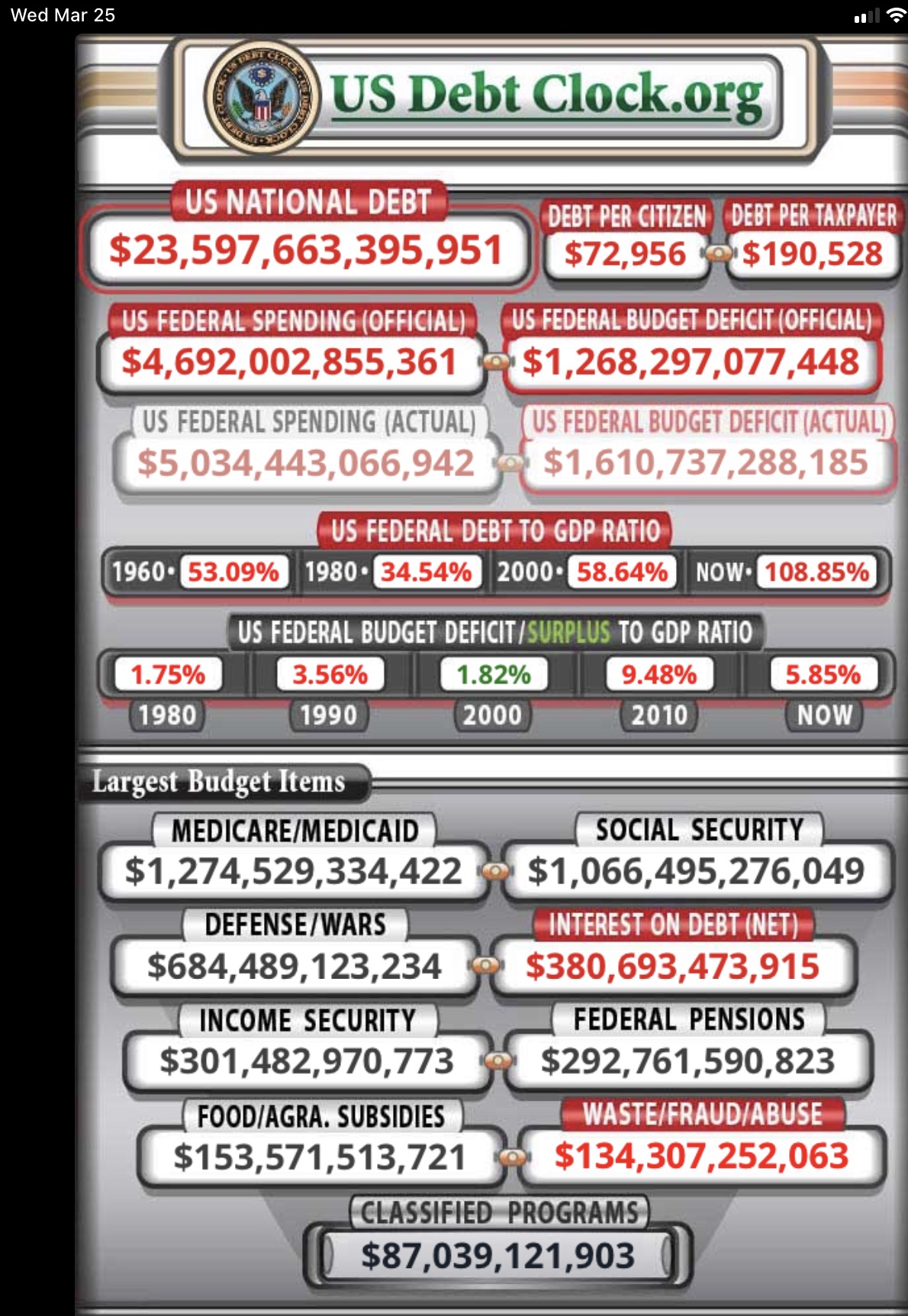
The Federal Government Is on an Unsustainable Fiscal Path

The Federal Government is on an Unsustainable Fiscal Path

Growing debt is not just a number—it represents a threat to our economy and our ability to meet national needs and priorities. The federal deficit (the amount of money spent vs. the amount collected) increased for the fourth consecutive year. This year—and for the foreseeable future—the annual deficit is expected to top $1 trillion.

Transcript.

Related:

FASAB Statement 56: Understanding New Government Financial Accounting Loopholes