
RAND: Avoiding a Long War – U.S. Policy and the Trajectory of the Russia-Ukraine Conflict

*Russian use of nuclear weapons is a plausible contingency that Washington needs to account for and a hugely important factor in determining the future trajectory of the conflict

*Although a Russian decision to attack a NATO member state is by no means inevitable, the risk is elevated while the conflict in Ukraine is ongoing.

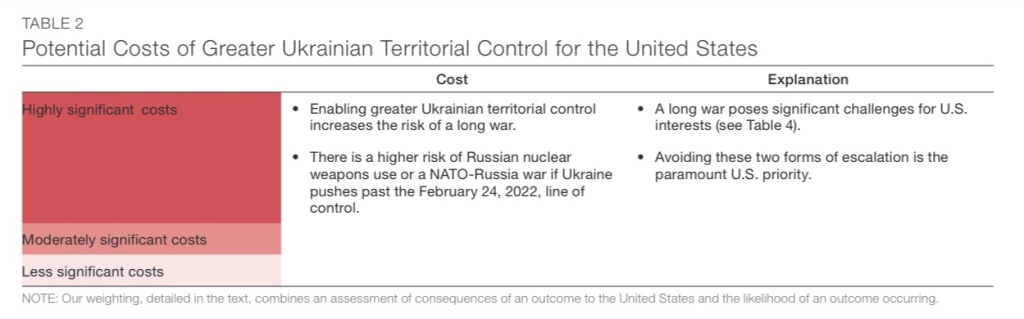
*Chairman of the Joint Chiefs of Staff Mark Milley reportedly kept a list of “U.S. interests and strategic objectives” in the crisis: “No. 1” was “Don’t have a kinetic conflict between the U.S. military and NATO with Russia.” The second, closely related, was “contain war inside the geographical boundaries of Ukraine.”

*It is clear why Milley listed avoiding a Russia-NATO war as the top U.S. priority: The U.S. military would immediately be involved in a hot war with a country that has the world’s largest nuclear arsenal. Keeping a Russia-NATO war below the nuclear threshold would be extremely difficult, particularly given the weakened state of Russia’s conventional military.

*Since neither side appears to have the intention or capabilities to achieve absolute victory, the war will most likely end with some sort of negotiated outcome.

*Since avoiding a long war is the highest priority after minimizing escalation risks, the United States should take steps that make an end to the conflict over the medium term more likely.

*A major source of uncertainty about the future course of the war is the relative lack of clarity about the future of U.S. and allied military assistance to Ukraine.

Avoiding a Long War – U.S. Policy and the Trajectory of the Russia-Ukraine Conflict

Related:

Avoiding a Long War – U.S. Policy and the Trajectory of the Russia-Ukraine Conflict

Netanyahu Says US Must ‘Reaffirm’ Alliance With Saudi Arabia + More [Abraham Accords]

Netanyahu Says US Must ‘Reaffirm’ Alliance With Saudi Arabia

The incoming prime minister said that he wants to build on the Abraham Accords, which his former government signed in 2020 to establish diplomatic ties with Bahrain and the UAE. Netanyahu said it’s “up to the leadership of Saudi Arabia if they want to partake in this effort.”

Saudi officials recently reaffirmed that they seek a Palestinian state as a precondition for normalizing with Israel. But in order to form a coalition government, Netanyahu gave Religious Zionism party leader Bezalel Smotrich, an ultranationalist settler, sweeping powers over the West Bank.

Related:

Read More »

Railroads Have Invested Heavily in Congress. They Need Their Payoff in the Senate.

A showdown over a looming railroad strike heads to the Senate floor this week, after a group of progressive Democrats, led by Rep. Jamaal Bowman, D-N.Y., pushed to modify a tentative agreement to include seven days of sick leave. The expanded agreement passed the House 220-206 on Wednesday, and the fight now moves to the Senate, where it remains unclear if there is enough Republican support to overcome a filibuster and send the agreement to President Joe Biden’s desk.

Railroads Have Invested Heavily in Congress. They Need Their Payoff in the Senate.

Related:

Why America’s Railroads Refuse to Give Their Workers Paid Leave

The answer, in short, is “P.S.R.” — or precision-scheduled railroading

Biden calls on Congress to impose rail contract in a major assault on workers’ democratic rights

President Biden published a statement Monday night calling on Congress to intervene to block a national rail strike and impose a contract which tens of thousands of railroad workers voted down. A few hours later, outgoing Speaker Nancy Pelosi announced the House of Representatives would take up such a bill this week and send it to the Senate with the “hope that this necessary, strike-averting legislation will earn a strongly bipartisan vote…”

Biden calls on Congress to impose rail contract in a major assault on workers’ democratic rights