
Tag: US Marine Corps

The Pentagon’s IPO for War: Now With 100% More Cowbell
The Pentagon’s acquisition system is being overhauled into a “Warfighting Acquisition System,” turbocharging weapons production, slashing bureaucracy, and empowering officials to deliver arms at “wartime speed.” Portfolio Acquisition Executives now wield sweeping authority, startups are courted like prom queens, and the defense industrial base is being rebranded as Silicon Valley with missiles.
So much for the “peace president”—Trump’s arsenal of freedom looks more like an IPO for war, where venture capital meets missile launchers and bureaucrats cosplay as battlefield commanders.
Forging the Arsenal of Freedom
Related:
How the US is preparing a military staging ground near Venezuela + the 160th SOAR(A)
The United States military is upgrading a long-abandoned former Cold War naval base in the Caribbean, a Reuters visual investigation has found, suggesting preparations for sustained operations that could help support possible actions inside Venezuela.
…
“The land is going to be next,” he said.
How the US is preparing a military staging ground near Venezuela
Related:
Venezuela Flashpoint: Real-Time Intelligence Analysis
Compounding these indicators is also the confirmed presence of United States special forces support assets (Ocean Trader / Night Stalkers) in the theatre of operations. Washington also authorised Langley to conduct covert action in Venezuela through a presidential finding reported on October through credible media outlets. Grey Dynamics’ real-time monitoring and analysis of the situation aims to deliver continuous updates and verified intelligence on the ongoing flashpoint.
Night Stalkers = 160th Special Operations Aviation Regiment (Airborne)
The 160th Special Operations Aviation Regiment (Airborne), abbreviated as 160th SOAR(A), is a special operations force of the United States Army that provides helicopter aviation support for special operations forces. Its missions have included attack, assault, and reconnaissance, and these missions are usually conducted at night, at high speeds, low altitudes, and on short notice.
Project AERODYNAMIC 2.0?
Neo-Nazi group with US links may be backed by Russian intelligence
Read More »Suspicions of Russian influence have persisted since the group’s founding in 2018 due to the fact that Nazzaro, a former FBI intelligence analyst and onetime U.S. civilian analyst supporting military operations in Afghanistan and Iraq, now lives in St. Petersburg.
Operation Optics
A suspected drug vessel reduced to wreckage by a missile that dwarfed it. No arrests, no evidence, just spectacle. Toxic masculinity masquerading as strategy. This wasn’t interdiction. It was theater.
VIDEO: U.S. Military Strikes Suspected Drug Vessel as Warships Gather in the Caribbean
Previously:
Capes, Cameras, and the Cult of Visibility
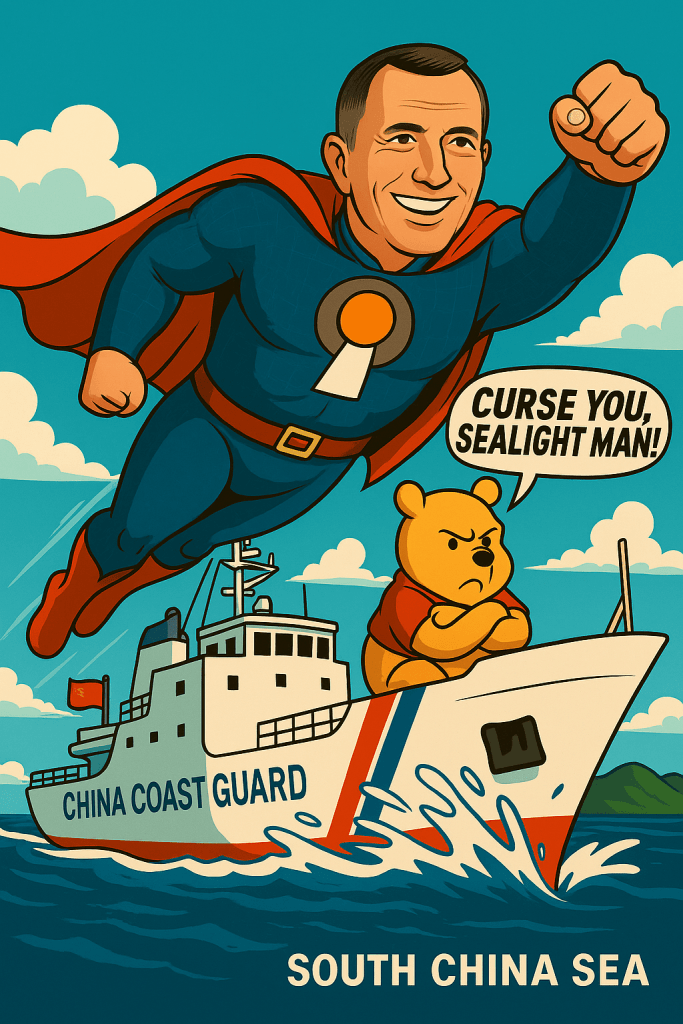
Capes, Cameras, and the Cult of Visibility: The SeaLight Crusade as White Savior Theater
By Tina Antonis
The South China Sea is more than a maritime dispute—it’s a theater of narrative warfare. While headlines focus on Chinese aggression and Philippine resistance, a quieter campaign unfolds in the background: one of satellite feeds, curated imagery, and Pentagon-backed storytelling. At the center of this effort is SeaLight, a project that claims to illuminate truth but often casts shadows of its own.
As explored in my article at Antiwar.com, SeaLight doesn’t just document—it performs. It reframes geopolitical tension through moral spectacle, positioning its creators as heroic arbiters of transparency. But when the messenger wears a cape and the funding flows from defense budgets, we must ask: is this clarity, or choreography?
Stage Left: The White Savior Enters
In the comic-strip cosmology of Ray Powell’s SeaLight project, transparency wears a cape. Clad in heroic postures and backed by satellite imagery, Powell casts himself as the guardian of maritime morality—unarmed, except with satellite feeds, theatrical flair, and strategic messaging.
Yet beneath the cartoon and Pentagon-funded optics lies a familiar archetype: the white savior, rebranded for the South China Sea.
China Is Imperialist? Says Who?
Calling China a “maritime occupier,” Powell positions himself as a bulwark against aggression. But that moral pose collapses under scrutiny. He speaks for a country with over 800 foreign military installations and a documented history of over 250 military interventions since 1991—wars in Iraq, Afghanistan, Libya, Syria, Somalia, and dozens more, all under the banner of peace, freedom, or preemption.
By comparison, China’s post–Cold War footprint includes no sustained foreign occupations and only scattered border conflicts and peacekeeping missions. The imbalance is staggering. And Powell’s framing doesn’t just ignore it—it performs around it.
As David Vine argues in The United States of War, this vast base empire is not a passive network—it’s an architecture of perpetual war. These outposts make military engagement not an exception but a structural habit, cloaked in strategic necessity and sold as global stewardship.
Powell’s cartoon rhetoric—calling China an occupier—obscures the scale of U.S. militarism. The term “occupation” is deployed not to analyze, but to project. When adversaries hold territory, it’s a crisis; when the U.S. spans the globe with armed installations, it’s policy.
Framing Conflict: The Optics of Consent
This isn’t irony. It’s performance. Powell’s language manufactures a moral frame for confrontation—costumed in transparency, but driven by escalation. The cape is literal. The conditioning is deliberate. And the stage is set for war.
SeaLight’s mission is not just visual documentation—it’s narrative warfare. As the Japan Times openly notes, its “chief weapon is photography, applied purposefully, generously and consistently over time.” These images—enhanced, curated, and distributed across media—are not neutral. They’re constructed to shape public perception, sway international opinion, and ultimately manufacture consent for confrontation.
Assertive transparency becomes a kind of ideological scaffolding—a stage on which geopolitical tension is dramatized, simplified, and morally polarized. The goal isn’t simply to reveal conflict; it’s to condition audiences for escalation.
And when the messenger dons a superhero’s cape, the spectacle transforms into something deeper: a story of rescue, of virtue, of intervention. This is not analysis—it’s soft propaganda dressed in heroic metaphor.
Consent for war doesn’t begin with missiles. It begins with mythmaking.
Navy using munitions at ‘alarming’ speed to defend Israel
Navy using munitions at ‘alarming’ speed to defend Israel
Admiral James Kilby, Naval Operations acting chief, made the remark in his testimony during a Senate Appropriations Committee hearing on the Navy’s budget in Washington when Sen. Brian Schatz, D-Hawaii, asked about the Navy’s available munitions to defend against global threats.
“The latest round of conflict in the Middle East utilized large amounts of munitions to defend Israel from Iranian strikes,” Schatz said. “Does the Navy currently have all the SM-3s it needs for global threats?”
“We do, sir,” Kilby responded, “but we are, to your point, using them at an alarming rate. As you know, those are missiles procured by the Missile Defense Agency and then delivered to the Navy for our use. And we are using them quite effectively in the defense of Israel.”
Related:
Israel and US exhausting supplies of ballistic missile interceptors, source says
Meet the American military veterans fasting for Gaza
Hundreds of US veterans and allies have been fasting for weeks across the country, in protest against the ongoing war in Gaza
As Trump Sets Military Against Civilians, Service Members Have Duty to Disobey
The Marines are trained in combat, not crowd control. People are likely to get hurt.
As Trump Sets Military Against Civilians, Service Members Have Duty to Disobey
Related:
If your conscience troubles you… you may have options
In recent years, we have gotten calls on the GI Rights Hotline from service members concerned about having to police the US-Mexican border and/or police demostrations in the US. Others feel disturbed by US support for specific overseas operations, like Israel’s actions in Gaza and the West Bank. Many call us with a troubled conscience, and some ask about applying for a conscientious objection (CO) discharge. Military regulations spell out very specific criteria for military members to qualify as a conscientious objector. Keep reading to see if a CO discharge may be appropriate for you. Even if you don’t meet the definition of a conscientious objector, you may still qualify for a different discharge. You can call us on the hotline to discuss your options: 877-447-4487.
Trump Called Threat to Journalistic Freedom After Foreign Press Hit by ‘Non-Lethal’ Rounds
Trump Called Threat to Journalistic Freedom After Foreign Press Hit by ‘Non-Lethal’ Rounds
Trump Called Threat to Journalistic Freedom After Foreign Press Hit by ‘Non-Lethal’ Rounds
Protests Were Largely Peaceful Before Being Inflamed by Trump
Read More »
 Ms. Cat’s Chronicles
You must be logged in to post a comment.