
To prosecute war against Russia, China, or Iran, protection of the major forward bases of the United States Air Force would be the prerequisite upon which success would be predicated.
To adequately cover even one of these large airbases against missile strikes of just 100-200 units of high-performance drones, cruise-missiles, ballistic missiles, and hypersonic missiles — plus numerous decoys — would easily require an entire Patriot battalion.
Even with a 100% interception rate, a pair of 100-missile strike packages over the course of a day would still compel a PAC-3 burn rate of at least 300 missiles, given that, as a general rule, two PAC-3 missiles are launched at every incoming target.
But of course, the interception rate would be considerably lower than 100%. And given that the Patriot command, radar, and launcher units — along with missile storage sites — would be primary targets, there would be a substantial attrition rate of the highly immobile Patriot systems themselves. (The Russians have already clearly demonstrated the vulnerability of the Patriot systems to counter-battery missile strikes. At least three Patriot batteries have been destroyed in Ukraine.)
In an attempt to cover just three large airbases against a series of salvos of 100+ missiles of various types, the entire US stockpile of PAC-3 interceptors could very conceivably be exhausted in little more than a week or two.
Current annual production could easily be consumed in little more than a day or two.
This is the reality of 21st century high-intensity conflict against an adversary with the capability to shoot back — a kind of war for which the United States military is woefully ill-prepared, both materially and doctrinally.
Tag: US Military
Biden Says Strikes Against Houthis Aren’t Working as US Bombs Yemen for 5th Time
The president said he’ll continue the strikes even though they’re not stopping the Houthis.
Biden Says Strikes Against Houthis Aren’t Working as US Bombs Yemen for 5th Time
Reviving ISIS: A US weapon against the Resistance Axis, by The Cradle’s Iraq Correspondent

The U.S. has never hesitated to use those it calls terrorists as a means for its own ends. From The Cradle’s Iraq Correspondent at thecradle.co:
Is it a coincidence that the world’s foremost terror organization is being revived just as the US struggles under a multi-front assault on its hegemony in West Asia? More curiously, both ISIS and Washington’s targets are exactly the same.
Reviving ISIS: A US weapon against the Resistance Axis, by The Cradle’s Iraq Correspondent
H/T: Der Friedensstifter
Expect a hit piece, by The Daily Beast, on Ritter in the coming days.
Russian Media Monitor is maintained by Julia Davis, of the Daily Beast. I’m familiar with the host, of the show, but can’t recall his name. Fun fact, the makers of Amazon’s ‘Reacher’ have links to the USG and US Military.
RFK Jr.’s ‘Unconditional’ Support for Israel Is Costing His Campaign for President
Robert F. Kennedy Jr.’s staffers keep resigning
Many antiwar Americans were thrilled when Kennedy announced last spring that he’d be running against Joe Biden in this year’s primaries and that he’d hired former Democratic congressman Dennis Kucinich to be his campaign manager. But Kucinich quit in the middle of October.
RFK Jr.’s ‘Unconditional’ Support for Israel Is Costing His Campaign for President
US-British Attacks on Yemen a Portent for Wider War
In the opening weeks of 2024, the US and British unilaterally launched several large-scale missile and air strikes on targets in territory held by Ansar Allah (referred to as the “Houthis” across the Western media) in Yemen.
US-British Attacks on Yemen a Portent for Wider War
Visualizing the ACE Concept (China)
U.S. tech companies prepare for potential drone attacks as international strikes spark concern
U.S. tech companies and government agencies are racing to develop defenses against potential terrorist drone attacks, a threat that has security experts increasingly concerned as they’ve watched the rise of drone warfare in Israel, Ukraine and Yemen.
U.S. tech companies prepare for potential drone attacks as international strikes spark concern
Sponsored by Raytheon or something like that. /s
When Do We Say Enough is Enough?: Philippines’ Tipping Point in Upholding Sovereign Integrity
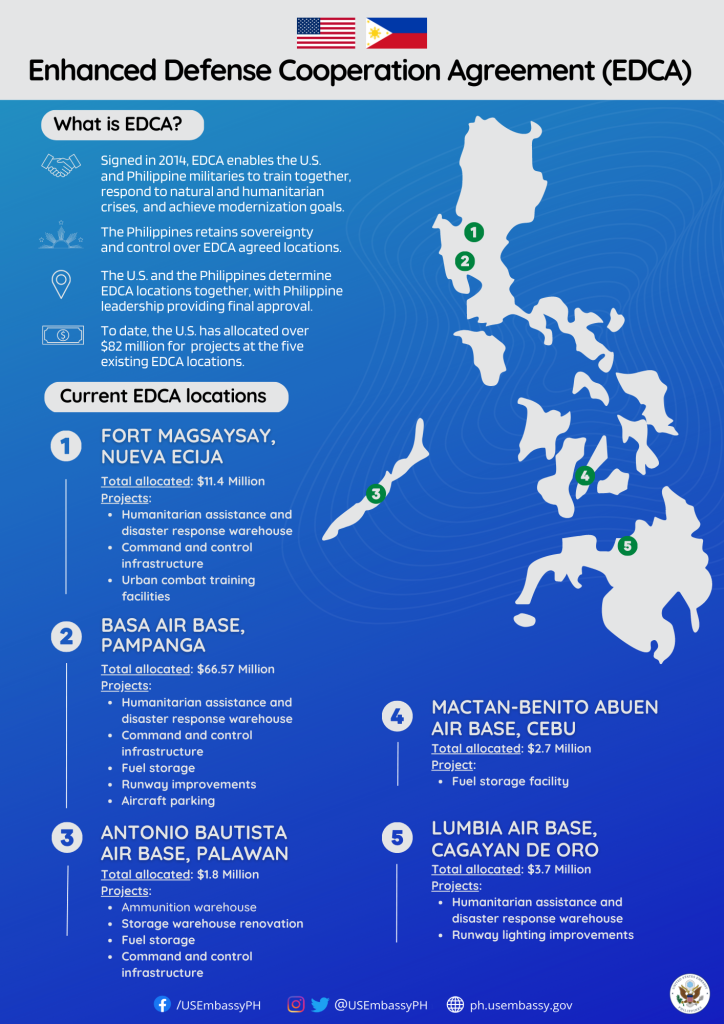
When Do We Say Enough is Enough?: PH’s Tipping Point in Upholding Sovereign Integrity
Moreover, the involvement of Subic Bay, a location not officially listed as a site/base under the expanded Enhanced Defense Cooperation Agreement (EDCA) as the alleged destination of US military fuel from Pearl Harbor, prompts a critical inquiry about its role and whether it might be serving as an unofficial or de-facto EDCA site. Hence, it begs to inquire if Subic Bay is now effectively functioning as a de-facto EDCA site. And if so, could there be other undeclared de-facto EDCA sites serving similar purposes other than the nine declared ones?
…
Could it be posited that the current Philippine administration appears to prioritize the demands and interests of the United States over its own national interests, sovereignty, and independence, suggesting a level of deference that could be interpreted as reminiscent of a vassal state? This perspective raises questions about the autonomy of the Philippine political leadership and the extent to which it serves the interests of its citizens first and foremost. The lack of public discussion, accountability, and transparency on matters that potentially impinge on national sovereignty could be seen as indicative of a disproportionate influence by the U.S. on Philippine domestic affairs and foreign policy, prompting a reevaluation of the true nature of the bilateral relationship between the two nations.
Related:
81 percent of Filipinos worried over US-China tensions
POLITICIANS like Jinggoy Estrada and Risa Hontiveros, who think being vehemently against China will make them so popular for a higher position, had better do some hard thinking.
81 percent of Filipinos worried over US-China tensions
 Ms. Cat’s Chronicles
You must be logged in to post a comment.