Capes, Cameras, and the Cult of Visibility

Capes, Cameras, and the Cult of Visibility: The SeaLight Crusade as White Savior Theater

By Tina Antonis

The South China Sea is more than a maritime dispute—it’s a theater of narrative warfare. While headlines focus on Chinese aggression and Philippine resistance, a quieter campaign unfolds in the background: one of satellite feeds, curated imagery, and Pentagon-backed storytelling. At the center of this effort is SeaLight, a project that claims to illuminate truth but often casts shadows of its own.

As explored in my article at Antiwar.com, SeaLight doesn’t just document—it performs. It reframes geopolitical tension through moral spectacle, positioning its creators as heroic arbiters of transparency. But when the messenger wears a cape and the funding flows from defense budgets, we must ask: is this clarity, or choreography?

Stage Left: The White Savior Enters

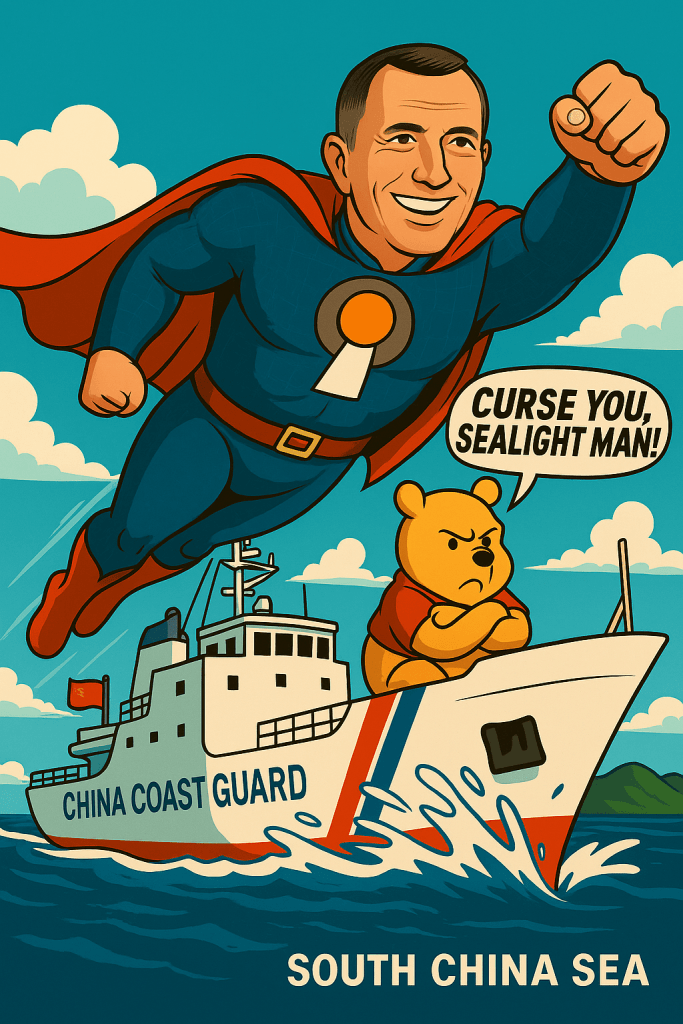
In the comic-strip cosmology of Ray Powell’s SeaLight project, transparency wears a cape. Clad in heroic postures and backed by satellite imagery, Powell casts himself as the guardian of maritime morality—unarmed, except with satellite feeds, theatrical flair, and strategic messaging. 

Yet beneath the cartoon and Pentagon-funded optics lies a familiar archetype: the white savior, rebranded for the South China Sea.

China Is Imperialist? Says Who?

Calling China a “maritime occupier,” Powell positions himself as a bulwark against aggression. But that moral pose collapses under scrutiny. He speaks for a country with over 800 foreign military installations and a documented history of over 250 military interventions since 1991—wars in Iraq, Afghanistan, Libya, Syria, Somalia, and dozens more, all under the banner of peace, freedom, or preemption.

By comparison, China’s post–Cold War footprint includes no sustained foreign occupations and only scattered border conflicts and peacekeeping missions. The imbalance is staggering. And Powell’s framing doesn’t just ignore it—it performs around it.

As David Vine argues in The United States of War, this vast base empire is not a passive network—it’s an architecture of perpetual war. These outposts make military engagement not an exception but a structural habit, cloaked in strategic necessity and sold as global stewardship.

Powell’s cartoon rhetoric—calling China an occupier—obscures the scale of U.S. militarism. The term “occupation” is deployed not to analyze, but to project. When adversaries hold territory, it’s a crisis; when the U.S. spans the globe with armed installations, it’s policy.

Framing Conflict: The Optics of Consent

This isn’t irony. It’s performance. Powell’s language manufactures a moral frame for confrontation—costumed in transparency, but driven by escalation. The cape is literal. The conditioning is deliberate. And the stage is set for war.

SeaLight’s mission is not just visual documentation—it’s narrative warfare. As the Japan Times openly notes, its “chief weapon is photography, applied purposefully, generously and consistently over time.” These images—enhanced, curated, and distributed across media—are not neutral. They’re constructed to shape public perception, sway international opinion, and ultimately manufacture consent for confrontation.

Assertive transparency becomes a kind of ideological scaffolding—a stage on which geopolitical tension is dramatized, simplified, and morally polarized. The goal isn’t simply to reveal conflict; it’s to condition audiences for escalation.

And when the messenger dons a superhero’s cape, the spectacle transforms into something deeper: a story of rescue, of virtue, of intervention. This is not analysis—it’s soft propaganda dressed in heroic metaphor.

Consent for war doesn’t begin with missiles. It begins with mythmaking.

US Ukraine Mineral Deal- Shades of Iraqi reconstruction scandal- US to provide security & the Trump admin connection to Iraq’s post-war reconstruction scandal

US Ukraine Mineral Deal- Shades of Iraqi reconstruction scandal- US to provide security

Elbridge Colby and Keith Kellogg both served in the Coalition Provisional Authority (CPA) in Iraq in 2003 under Paul Bremer and are now part of the Trump administration. The CPA, which acted as the transitional government overseeing post-war reconstruction in Iraq, faced significant criticism for its mishandling of reconstruction funds. Over $8 billion allocated for Iraq’s rebuilding remains unaccounted for, including more than $1.6 billion in cash that was discovered in a basement in Lebanon.

Meanwhile, in Iraq, Chinese companies are actively engaged in constructing a wide range of infrastructure projects, including housing units, universities, commercial centers, schools, health facilities, and power stations. They have also played a key role in developing the Nasiriya airport.

Sources:

Read More »

What’s Really Going On In the South China Sea Between the Philippines and China

What’s Really Going On In the South China Sea Between the Philippines and China

by Tina Antonis

Maritime clashes between the Philippines and China had been mostly over the Philippines’ military outpost, BRP (BRP—Barko ng Republika ng Pilipinas, which translates to “Ship of the Republic of the Philippines”—the ship prefix for the Philippines) Sierra Madre, in the Spratly Islands, which is disputed by Brunei, China, Malaysia, the Philippines, Taiwan (a province of China, as recognized by the United Nations’ Resolution No. 2758), and Vietnam. The BRP Sierra Madre was intentionally run aground on a reef near the Second Thomas Shoal in the disputed Spratly Islands, in 1997, so that the Philippines could stake their territorial claim.

Read More »

China exposes Philippines’ reneging on South China Sea commitment

Source

Related:

China exposes Philippines’ reneging on South China Sea commitment

Wang pointed out that the Philippines has made a solemn promise to tow away the military vessel illegally grounded at Ren’ai Jiao, noting that 25 years have passed, and the Philippines has still not towed away the warship.

Noting that the Philippines has violated the understanding reached between the two sides on the proper management of the situation on Ren’ai jiao, the spokesperson said despite the Philippines’ commitment not to reinforce the grounded warship and to notify China in advance of any plans to resupply it, China, out of humanitarian considerations, has made temporary special arrangements for Philippine vessels transporting necessary supplies to the warship multiple times.

“However, the Philippines continues to send government vessels and warships to forcibly enter Ren’ai Jiao, attempting to transport construction materials for large-scale repairs and reinforcement of the warship in order to achieve permanent occupation of Ren’ai Jiao,” Wang said.

PH did promise to remove BRP Sierra Madre from Ayungin

Philippines Budgets for a Permanent Base at Second Thomas Shoal

It’s Time to Build Combined Forward Operating Base Sierra Madre

Philippines Gunning For Fast And Massive Military Build-Up + More

Full video.

MANILA –“We are not satisfied with minimum [deterrence capability alone]…movement is life, stagnation is death,” Colonel Micheal Logico, a top strategist at the Armed Forces of the Philippines (AFP), recently told this reporter when asked about the country’s evolving defense strategy.“We [need] to elevate ourselves into a world-class armed forces,” he added.

Philippines Gunning For Fast And Massive Military Build-Up

Related:

De Facto American Military Forward Operating Base?

Hungry Pinoys highest so far under Marcos government

Philippines Conducts Joint Exercises With U.S. In S. China Sea

Batanes eyed for Balikatan military drills

Report: US Military Advisors Deployed to Taiwan-Controlled Islands on China’s Coast

Beijing has ‘a lot of legal weapons’ to challenge Manila’s claims in South China Sea, international law expert says

Beijing still has plenty of countermeasures it could use against Manila if tensions between the two countries continue to escalate in the South China Sea, according to a seasoned legal expert who specialises in the region.

Beijing has ‘a lot of legal weapons’ to challenge Manila’s claims in South China Sea, international law expert says

If US can clear way for ‘cease-fire in Gaza’, Red Sea problem would be solved

If US can clear way for humanitarian aid to Gaza, ‘joint patrol would not be necessary’

If US can clear way for ‘cease-fire in Gaza’, Red Sea problem would be solved

Related:

The cost of US fighting Houthis in the Red Sea just went up

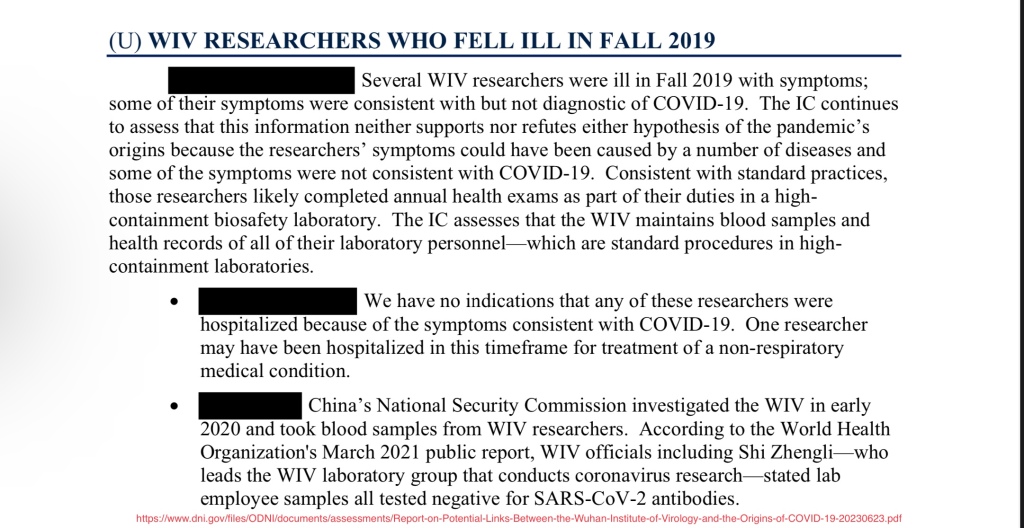
US Intel Report Reveals No Incident Occurred at Wuhan Lab That Could Have Caused Pandemic, along with some observations and sarcasm

*But anonymous sources, at the State Department, told me that ‘patient zero’ had COVID-19! 🙄

Cleared by Congress, legislation later signed by US President Joe Biden in March ordered the Director of National Intelligence (DNI) to declassify information regarding the potential origins of SARS-CoV-2, the virus that causes COVID-19. The measure forced the DNI to declassify its report within 90 days.

US Intel Report Reveals No Incident Occurred at Wuhan Lab That Could Have Caused Pandemic

H/T: Unorthodox Truth

*Some observations: WCWP does not seem to prove that Ben Hu was ‘patient zero’. They link to a Daily Caller article, whose source is David Asher, who served in Trump’s State Department. He also happens to be a former Adjunct Senior Fellow at the ‘liberal’ hawkish think tank, Center for a New American Security. He’s currently a senior fellow at Hudson Institute and on the board of advisors of FDD’s Center on Economic and Financial Power (more neocon/hawkish think tanks). They also quote former FDA Commissioner, Dr. Scott Gottlieb, whom happens to be a Senior Fellow at the American Enterprise Institute (neocon think tank) and on the boards of directors for Illumina, Inc and Pfizer (Big Pharma). See a pattern, here?!

Related:

Ridiculous,’ says Chinese scientist accused of being pandemic’s patient zero (archived)

Hu and two of his WIV colleagues were thrown into the furious COVID-19 origin debate on 13 June when an online newsletter called Public said the three scientists developed COVID-19 in November 2019. That was prior to the outbreak becoming public when a cluster of cases at the end of December 2019 surfaced in people linked to a Wuhan marketplace. Public’s report was quickly embraced by a camp that argues COVID-19 came from a virus stored, and possibly manipulated, at WIV, rather than from infected animal hosts, perhaps being sold at the Wuhan market. A Wall Street Journal (WSJ) article on 20 June that said it had “confirmed” the allegations against the three, without referring to any public evidence or named sources with direct knowledge, fueled the flames even more. Social media and other publications spread the charges—and the scientists’ names.

Blinken’s Visit to China Confirmed After Call With Chinese FM

The State Department confirmed on Wednesday that Secretary of State Antony Blinken will be visiting China, making him the highest-level Biden administration official to make the trip.

Blinken’s Visit to China Confirmed After Call With Chinese FM

Global Times:

Blinken visit still ‘opportunity’ amid mutual low expectations

Shortly before Blinken’s visit was confirmed by China, Chinese State Councilor and Foreign Minister Qin Gang had a phone call with Blinken at the latter’s request. During the phone call, Qin expounded on China’s firm stance on core concerns such as the Taiwan question.