
Tag: War against the Islamic State
The Postwar Vision That Sees Gaza Sliced Into Concentration Camps
The Postwar Vision That Sees Gaza Sliced Into Security Zones
A plan that is gaining currency in the government and military envisions creating geographical “islands” or “bubbles” where Palestinians who are unconnected to Hamas can live in temporary shelter while the Israeli military mops up remaining insurgents.
Other members of Prime Minister Benjamin Netanyahu’s Likud party are backing another, security-focused plan that seeks to slice up Gaza with two corridors running across its width and a fortified perimeter that would allow Israel’s military to mount raids when it deems them necessary.
The ideas come from informal groups of retired army and intelligence officers, think tanks, academics and politicians, as well as internal discussions inside the military. While Israel’s political leadership has said almost nothing about how the Gaza Strip will look and be governed after the heaviest fighting ends, these groups have been working on detailed plans that offer a glimpse of how Israel is thinking about what it calls the Day After.
The plans—whether or not they get adopted in full—reveal hard realities about the aftermath that rarely get voiced. Among them, that Palestinian civilians could be confined indefinitely to smaller areas of the Gaza Strip while fighting continues outside, and that Israel’s army could be forced to remain deeply involved in the enclave for years until Hamas is marginalized.
…
According to people familiar with the effort, it aims to work with local Palestinians who are unaffiliated with Hamas to set up isolated zones in northern Gaza. Palestinians in areas where Israel believes Hamas no longer holds sway would distribute aid and take on civic duties. Eventually, a coalition of U.S. and Arab states would manage the process, these people said.
Ziv, who oversaw Israel’s exit from Gaza in 2005, proposes that Palestinians who are ready to denounce Hamas could register to live in fenced-off geographic islands located next to their neighborhoods and guarded by the Israeli military. This would entitle them to reconstruction of their homes.
The process would be gradual, and in the longer term, Ziv envisages bringing the West Bank-based Palestinian Authority back to Gaza as a political solution, with the whole process taking roughly five years as the military fights Hamas insurgents. Under his plan, Hamas could be part of Gaza’s administration, if it frees all the hostages held there and disarms, becoming purely a political movement.
…
Northern Gaza, under the plan, would remain without reconstruction, and Palestinians there wouldn’t be allowed back to their homes until Hamas’s miles-long tunnel network was destroyed. Like the bubbles plan, it promotes the notion of de-escalation zones where aid can be delivered by the Israeli military or by international forces, but stops short of articulating an idea for governance.
…
Another plan published by the Washington-based Wilson Center* also advocates a coalition-style approach to the conflict but refrains from calling for Israel to consider the adoption of a Palestinian state. It says the U.S. should establish an international police force to manage security in Gaza and over time hand the job to a yet-to-be-defined Palestinian administration.
Robert Silverman**, a former U.S. diplomat in Iraq who is a co-author, said his team discussed the plan with Israeli officials for months, even changing parts of the proposal to make it more agreeable to Israel’s war objectives and political dynamics, but it stalled with the prime minister’s office.
“He believes we finish the war first and then plan the postwar,” Silverman said of Netanyahu. “All the people who have done this before say that’s a huge mistake.”
…
Another document, drafted by Israeli academics, that has made its way to the prime minister’s desk draws on historical precedents in rebuilding the war zones in Germany and Japan after World War II, and more recently in Iraq and Afghanistan. It considers how to tackle Hamas’s Islamist doctrine by learning from the defeat of ideologies such as Nazism and that of Islamic State.
Related:
The Strategic Hamlet Program (SHP; Vietnamese: Ấp Chiến lược) was a plan by the government of South Vietnam in conjunction with the US government and ARPA during the Vietnam War to combat the communist insurgency by pacifying the countryside and reducing the influence of the communists among the rural population through the creation of concentration camps.
…
The Strategic Hamlet Program was unsuccessful, failing to stop the insurgency or gain support for the government from rural Vietnamese, it alienated many and helped contribute to the growth in influence of the Viet Cong. After President Ngo Dinh Diem was overthrown in a coup in November 1963, the program was cancelled. Peasants moved back into their old homes or sought refuge from the war in the cities. The failure of the Strategic Hamlet and other counterinsurgency and pacification programs were causes that led the United States to decide to intervene in South Vietnam with air strikes and ground troops.
The *Wilson Center plan isn’t much better. 👇🏻
Related:
Read More »Defying Niger exit order leaves U.S. troops vulnerable, whistleblower says
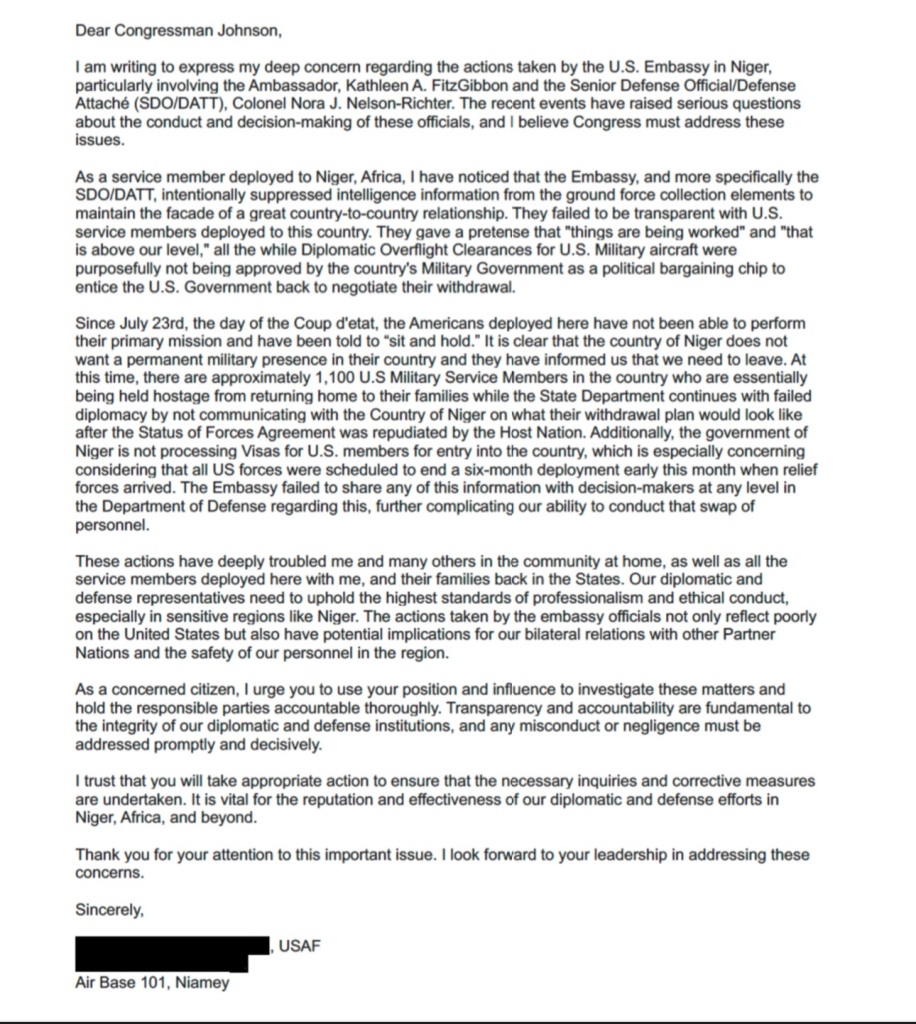
Defying Niger exit order leaves U.S. troops vulnerable, whistleblower says
“We have Army soldiers right now in Niger who aren’t getting their troop rotations, who aren’t getting their medicine, who aren’t getting their supplies, who aren’t getting their mail and the two senior people in the United States Army are sitting before me and it’s like ‘hear no evil, see no evil, speak no evil,’” said Gaetz.
Previously:
BBC: Niger’s Junta Revokes Military Agreement With US
He [Col Amadou Abdramane] also alleged that the US delegation had accused Niger of making a secret deal to supply uranium to Iran. Col Abdramane described the accusation as “cynical” and “reminiscent of the second Iraq war”.
Why Is Arab Media Silent About the Uyghur Separatists Supporting “Israel”?
We no longer hear much about the Uyghur issue, which Arab and international media outlets often promoted as a narrative to tarnish the reputation of the Chinese government and pressure it. This issue has always been framed through the lens of “generality” implying that “China is persecuting Muslims within its borders,” which is certainly not true, since the Uyghurs are not the only Muslim ethnic group in China; there are ten Muslim ethnicities in China.
Why Is Arab Media Silent About the Uyghur Separatists Supporting “Israel”?
What ISIS threat? Washington says there is none.
A new report insists the militant group now lacks the ‘intent and capability to direct attacks against the US homeland’
What ISIS threat? Washington says there is none.
US Troops Injured in Heavy Missile and Rocket Attack on US Base in Iraq
CENTCOM says a ‘number’ of US personnel are being examined for traumatic brain injuries, and one Iraqi soldier was wounded
…
According to the Pentagon, US bases in Iraq and Syria have come under attack 140 times since mid-October. The US has launched several rounds of airstrikes in both countries in response, including a drone strike in Baghdad that killed a deputy commander of the Popular Mobilization Forces (PMF), a coalition of Iraqi militias that’s part of Iraq’s security forces.
US Troops Injured in Heavy Missile and Rocket Attack on US Base in Iraq
Reviving ISIS: A US weapon against the Resistance Axis, by The Cradle’s Iraq Correspondent

The U.S. has never hesitated to use those it calls terrorists as a means for its own ends. From The Cradle’s Iraq Correspondent at thecradle.co:
Is it a coincidence that the world’s foremost terror organization is being revived just as the US struggles under a multi-front assault on its hegemony in West Asia? More curiously, both ISIS and Washington’s targets are exactly the same.
Reviving ISIS: A US weapon against the Resistance Axis, by The Cradle’s Iraq Correspondent
H/T: Der Friedensstifter
US eyes new military base in Iraq’s oil-rich region and in northern Syria
The media suggest that the US chose Al-Jazira area to construct its military bases due to its large oil and gas fields.
US eyes new military base in Iraq’s oil-rich region
Related:
US-led coalition against Islamic State building new base in northern Syria
US-led Terrorism in Central and Northern Syria the Past 48 Hours
US-sponsored terrorism in Syria continues and the past 48 hours were not an exception especially as the evil empire continues to be weakened and its hegemony continues to diminish across the globe, if you believe that the USA combats terrorism anywhere in the world, notably in Syria, please stop reading this post and go back to your comfort zone.
US-led Terrorism in Central and Northern Syria the Past 48 Hours
Video via Arabi S.
Related:
Did the U.S. really lift sanctions off Syria temporarily?
The “humanitarian exemptions”, on Syrian sanctions, are conditional!
The U.S. Treasury announced a decision on February 9 claiming to allow an easing of sanctions imposed on Syria for the ensuing six months until August 8, as part of “earthquake relief efforts.”
Did the U.S. really lift sanctions off Syria temporarily?
The decision allows for “third parties” to transfer aid to Syria without fear of U.S. sanctions, but should only be intended for aid to earthquake-effected areas. Nonetheless, the sanctions programs applied to Syria for many years, the most severe of which are the Caesar Act (2019) and Captagon Act (2022), provide for “humanitarian exceptions,” but are conditional on U.S. approval.
Related:
Did the U.S. lift sanctions on Syria?
So any earthquake relief effort must take place away from the Syrian state. In other words, it must contribute to undermining the sovereignty of the Syrian state, or it will not take place.
 Ms. Cat’s Chronicles
You must be logged in to post a comment.