WATCH: A China Coast Guard vessel (CCG 21559) fired a water cannon and rammed the BRP Datu Pagbuaya near Pag-asa Island this Sunday morning while the ship was assisting Filipino fishermen under the “Kadiwa para sa Bagong Bayaning Mangingisda” program, the PCG reports.
The incident occurred after CCG and Chinese militia vessels made dangerous maneuvers around anchored BFAR ships. CCG 21559 fired at 9:15 AM and rammed the BRP Datu Pagbuaya at 9:18 AM, causing minor damage but no injuries. (Video courtesy of PCG) | via Christine Boton
Philippine President Ferdinand Marcos Jr. said his nation won’t deploy Navy warships to the South China Sea in response to recent clashes with Beijing in disputed waters.
A Chinese navy missile craft shadowed a Philippine civilian ship on Friday in an unprecedented encounter that one analyst described as “alarming.”
The Fisheries and Aquatic Resources (BFAR) vessel the BRP Datu Romapenet was en route to a South China Sea feature known as Half Moon Shoal to deliver supplies to fishermen.
Half Moon Shoal is situated at the eastern edge of the Spratly Islands and about 60 miles from the Philippine province of Palawan, well within the Southeast Asian country’s recognized exclusive economic zone (EEZ).
According to the Philippines’ ABS-CBN News, which was onboard, the ship picked up a tail in the form of a Houbei-class (Type 22) guided-missile craft, easily identifiable by its wide camouflaged catamaran hull.
…
Chester Cabalza, founder of Manila-based think tank the International Development and Security Cooperation, told the news agency it was the first time a Type 22 had been spotted in the EEZ.
“This incident is alarming because a missile ship shadowed our BFAR ship,” Cabalza said, adding that it was a show of power intended to intimidate the Philippines.
According to the article, Philippine aircraft also frequently operate with their Automatic Dependent Surveillance-Broadcast (ADS-B) transponders deactivated, significantly increasing safety risks.
Deactivating such transponders means real-time positioning of the aircraft is not shared with air traffic controllers and other aircraft, making it more difficult to maintain situational awareness and avoid potential conflicts or collisions.
Since August 2024, the Philippines has repeatedly dispatched military aircraft to trespass into the airspace of the Spratly Islands and Macclesfield Bank, escalating tensions in the region. On August 7 and 8, the Philippines sent an NC-212i aircraft to intrude into the airspace near Scarborough Shoal for two consecutive days, disrupting China’s regular training activities. On August 19, a Cessna 208B Grand Caravan plane (C-208B) was dispatched to illegally enter the airspace of Scarborough Shoal. On August 22, the Bureau of Fisheries and Aquatic Resources of the Philippines again sent a C-208B to illegally intrude into the vicinity of Subi Reef.
…
On the other hand, the Philippine aircraft in use are primarily single-engine turboprop light utility aircraft, which are less equipped to handle complex maritime environments, increasing the likelihood of accidents during frequent operations. Moreover, Philippine military aircraft usually operate with ADS-B transponders turned off throughout their missions, posing potential safety risks. In the event of an accident, whatever the reasons, based on past behavior, the Philippines would likely blame China, leading to another cycle of victim-playing and diplomatic posturing.
The Philippines released the video of CCG ‘stealing’ supplies after China released the footage of the gunmen on the BRP Sierra Madre. This, after BBM said that any Filipino death would trigger the US-PH Mutual Defense Treaty.
WikiSpooks: Rappler (Sponsored by Facebook, Friedrich Naumann Foundation, Google, Internews, National Endowment for Democracy, Open Society Foundations, Omidyar Network)
The heightening tension between the Philippines and China over the disputed West Philippine Sea (WPS) could impede the entry of foreign investors into the country.
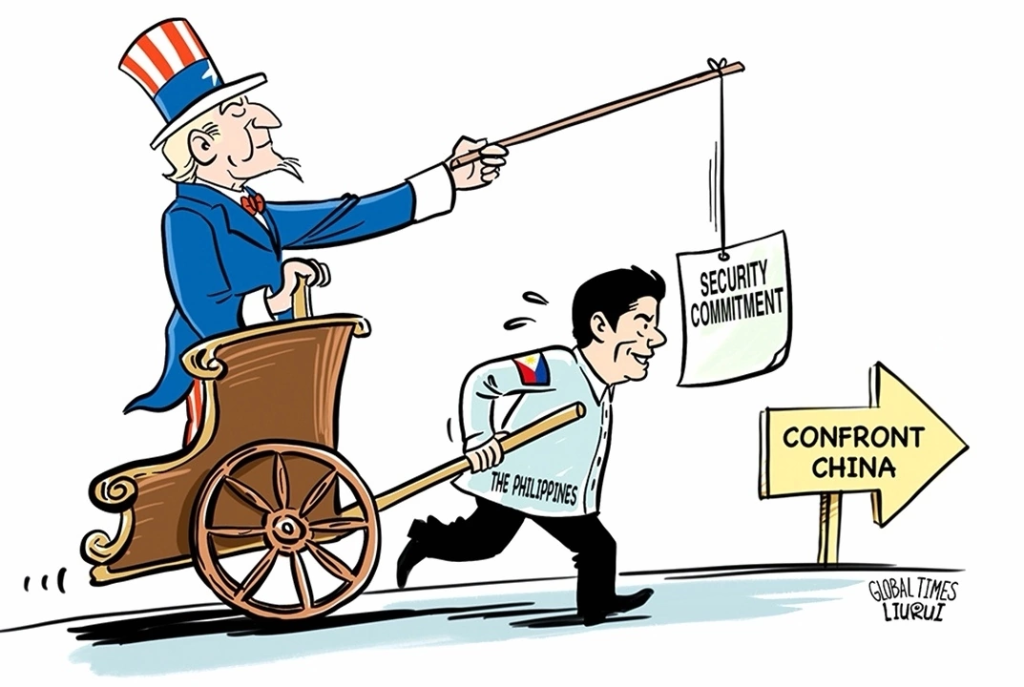
According to experts, Marcos’ tough words serve domestic political purposes when he needs to shift Filipinos’ discontent over his administration’s performance on livelihood and the economy, and are also a response to the “support” from countries outside the region, including the US.
…
“The US is the biggest external disturbance to peace and stability in the South China Sea,” Ding said, “without instigation from US, it is more likely that China and the Philippines would manage their differences through negotiation and consultation.”
Renewed talks on a bill that would reinstate a mandatory Reserve Officers Training Corps (ROTC) programme in colleges and universities in the Philippines has sparked debate on whether it would be effective in strengthening the country’s military amid growing tensions in the South China Sea.

 Ms. Cat’s Chronicles
You must be logged in to post a comment.