How Reform Rebrands Power Without Redistributing It
Notice: This is not an endorsement of Mr. Reagan. What strikes me is how long it’s taken some folks to catch on—Alexandria Ocasio-Cortez was never the political outsider she was marketed to be. I remember watching thesevideos years ago. Even then, it was clear her role was never to disrupt the machinery, but to redirect dissent—to shepherd disillusioned voters back into the Democratic fold. The Justice Democrats weren’t a rupture; they were a renovation.
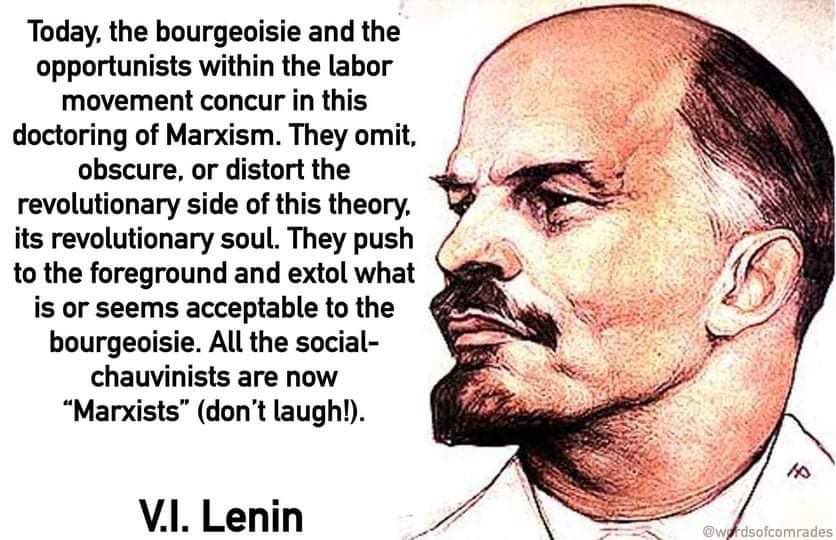
What is now happening to Marx’s theory has, in the course of history, happened repeatedly to the theories of revolutionary thinkers and leaders of oppressed classes fighting for emancipation. During the lifetime of great revolutionaries, the oppressing classes constantly hounded them, received their theories with the most savage malice, the most furious hatred and the most unscrupulous campaigns of lies and slander. After their death, attempts are made to convert them into harmless icons, to canonize them, so to say, and to hallow their names to a certain extent for the “consolation” of the oppressed classes and with the object of duping the latter, while at the same time robbing the revolutionary theory of its substance, blunting its revolutionary edge and vulgarizing it. Today, the bourgeoisie and the opportunists within the labor movement concur in this doctoring of Marxism. They omit, obscure, or distort the revolutionary side of this theory, its revolutionary soul. They push to the foreground and extol what is or seems acceptable to the bourgeoisie. All the social-chauvinists are now “Marxists” (don’t laugh!). And more and more frequently German bourgeois scholars, only yesterday specialists in the annihilation of Marxism, are speaking of the “national-German” Marx, who, they claim, educated the labor unions which are so splendidly organized for the purpose of waging a predatory war!
Bourgeois democracy, although a great historical advance in comparison with medievalism, always remains, and under capitalism is bound to remain, restricted, truncated, false and hypocritical, a paradise for the rich and a snare and deception for the exploited, for the poor. It is this truth, which forms a most essential part of Marx’s teaching, that Kautsky the “Marxist” has failed to understand. On this—the fundamental issue—Kautsky offers “delights” for the bourgeoisie instead of a scientific criticism of those conditions which make every bourgeois democracy a democracy for the rich.
In 1924 a famous manifesto was adopted at the Kuomintang’s First National Congress, which Sun Yat-sen himself led and in which Communists participated. The manifesto stated:
The so-called democratic system in modern states is usually monopolized by the bourgeoisie and has become simply an instrument for oppressing the common people. On the other hand, the Kuomintang’s Principle of Democracy means a democratic system shared by all the common people and not privately owned by the few.
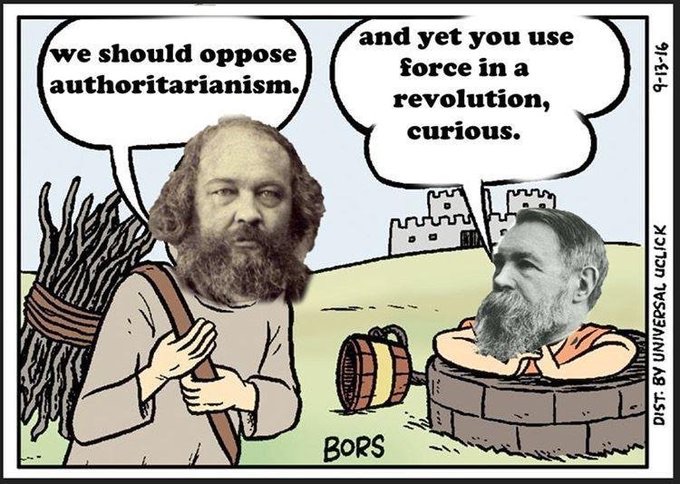
A number of Socialists have latterly launched a regular crusade against what they call the principle of authority. It suffices to tell them that this or that act is authoritarian for it to be condemned. This summary mode of procedure is being abused to such an extent that it has become necessary to look into the matter somewhat more closely.
Authority, in the sense in which the word is used here, means: the imposition of the will of another upon ours; on the other hand, authority presupposes subordination. Now, since these two words sound bad, and the relationship which they represent is disagreeable to the subordinated party, the question is to ascertain whether there is any way of dispensing with it, whether — given the conditions of present-day society — we could not create another social system, in which this authority would be given no scope any longer, and would consequently have to disappear.


 Ms. Cat’s Chronicles
You must be logged in to post a comment.