
This isn’t collapse. It’s choreography. The drowning is designed.

This isn’t collapse. It’s choreography. The drowning is designed.
There can be no emancipation of humanity without the social independence and equality of the sexes.
August Bebel: Introduction to Women Under Socialism
“Woman under Socialism” by August Bebel is a scientific publication written in the late 19th century. The work presents a critical examination of the social conditions and oppression faced by women, particularly within a capitalist framework, arguing for their liberation as a vital step towards social equality for all. Bebel’s discourse is set against the backdrop of a growing socialist movement and offers a thorough analysis of gender dynamics, class struggles, and the need for a transformational social structure. At the start of the text, Bebel introduces the central theme of the “Woman Question,” emphasizing the urgent need for women to achieve equal rights and dignity in society. He asserts that women’s subjugation is not a natural condition but a product of social structures that have evolved over time. Through a historical lens, he examines the roles and statuses of women across various stages of civilization, from the matriarchal societies of the past to the patriarchal systems of his own time. Bebel argues that just as the working class must seek to overthrow capitalism, women must unite with this struggle to break free from their bondage and achieve genuine equality.
How the son of a CIA deputy director set out to backpack around the world and to save the planet — but ended up in the Russian army and died in the war in Ukraine
“He Was Forging His Own Hero’s Journey When He Was Tragically Killed in Eastern Europe” (archived)
The revolution cannot triumph without the emancipation of women
The specific character of women’s oppression
Woman’s fate is bound up with that of the exploited male. This is a fact. However, this solidarity, arising from the exploitation that both men and women suffer and that binds them together historically, must not cause us to lose sight of the specific reality of the woman’s situation. The conditions of her life are determined by more than economic factors, and they show that she is a victim of a specific oppression. The specific character of this oppression cannot be explained away by setting up an equal sign or by falling into easy and childish simplifications.
Read More »

Frontier of global anti-imperialist struggle: China’s perceptions of the Palestinian struggle from 1955 to 1976
China is probably one of few states which flipped its diplomatic stance on the “Palestinian-Israeli conflict” in the most dramatic manner from the 1950s to 1970s. In only 20 years, the People’s Republic of China (PRC)’s official foreign policy dramatically changed from almost establishing diplomatic relations with Israel in 1950 to denying any legitimacy of the Israeli state in the 1960s to 1970s. As I aim to demonstrate in this article, the Maoist era, especially from 1955 to 1976, established the foundation of China’s diplomatic support for the Palestinian liberation movement, and this legacy is still one of the main factors guiding China’s official stance on Palestine today.
Related:
THE CHINESE PEOPLE FIRMLY SUPPORT THE ARAB PEOPLE’S STRUGGLE AGAINST AGGRESSION
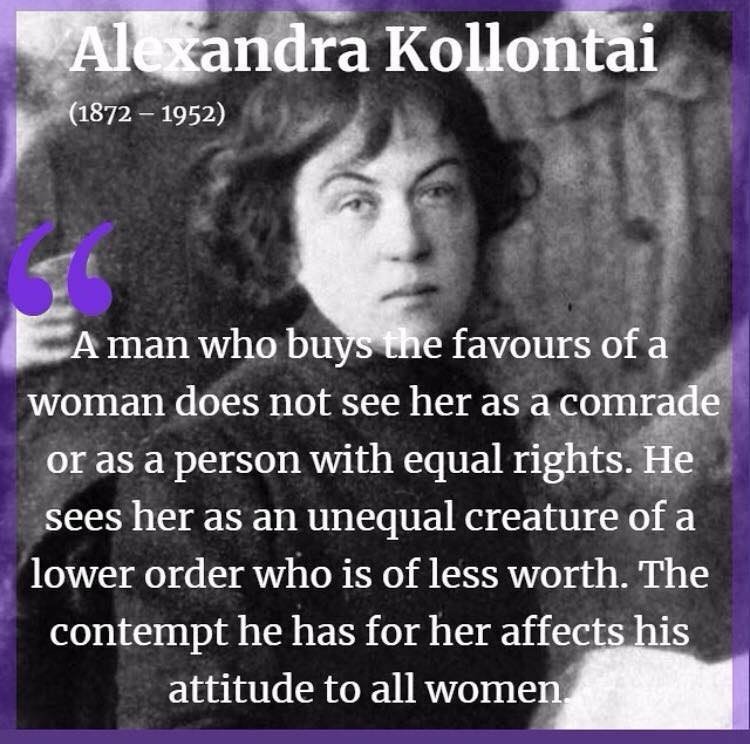
Alexandra Kollontai: Prostitution and ways of fighting it
What is the fundamental quality of the working class? What is its strongest moral weapon in the struggle? Solidarity and comradeship is the basis of communism. Unless this sense is strongly developed amongst working people, the building of a truly communist society is inconceivable. Politically conscious communists should therefore logically be encouraging the development of solidarity in every way and fighting against all that hinders its development – Prostitution destroys the equality, solidarity and comradeship of the two halves of the working class. A man who buys the favours of a woman does not see her as a comrade or as a person with equal rights. He sees the woman as dependent upon himself and as an unequal creature of a lower order who is of less worth to the workers’ state. The contempt he has for the prostitute, whose favours he has bought, affects his attitude to all women. The further development of prostitution, instead of allowing for the growth of comradely feeling and solidarity, strengthens the inequality of the relationships between the sexes.

 Ms. Cat’s Chronicles
You must be logged in to post a comment.