
The background to the article reprinted here is the “long boom” of western capitalism during the 1950s and 1960s. It first appeared in International Socialism journal in Spring 1967. On the surface it appeared that the capitalist system had stabilised itself, had broken out of the boom-slump cycle and was now able to offer the workers of Western Europe and North America a steady increase in living standards.
This was a frustrating world for Marxists, who found themselves subject to two temptations. One was to surrender to the claims poured out by the system’s apologists that capitalism had solved its problems and that the path of gradual reform offered a sure road to socialism. The other was to deny the obvious signs of stability and prosperity and assert that capitalism was on the verge of imminent, catastrophic collapse. If these temptations were to be avoided, and Marx’s analysis of capitalism’s contradictions was to hold, then the long boom must be explained.
Tag: Working Class
Lenin: Answers To An American Journalist’s Questions
Answers To An American Journalist’s Questions
1. The governmental programme of the Soviet Government was not a reformist, but a revolutionary one. Reforms are concessions obtained from a ruling class that retains its rule. Revolution is the overthrow of the ruling class. Reformist programmes, therefore, usually consist of many items of partial significance. Our revolutionary programme consisted properly of one general item—removal of the yoke of the landowners arid capitalists, the overthrow of their power and the emancipation of the working people from those exploiters. This programme we have never changed. Some partial measures aimed at the realisation of the programme have often been subjected to change; their enumeration would require a whole volume. I will only mention that there is one other general point in our governmental programme which has, perhaps, given rise to the greatest number of changes of partial measures. That point is—the suppression of the exploiters’ resistance. After the Revolution of October 25 (November 7), 1917 we did not close down even the bourgeois newspapers and there was no mention of terror at all. We released not only many of Kerensky’s ministers, but even Krasnov who had made war onus. It was only after the exploiters, i.e., the capitalists, had begun developing their resistance that we began to crush that resistance systematically, applying even terror. This was the proletariat’s response to such actions of the bourgeoisie as the conspiracy with the capitalists of Germany, Britain, Japan, America and France to restore the rule of the exploiters in Russia, the bribery of the Czechoslovaks with Anglo-French money, the bribery of Mannerheirn, Denikin and others with German and French money, etc. One of the latest conspiracies leading to “a change”—to put it precisely, leading to increased terror against the bourgeoisie in Petrograd—was that of the bourgeoisie, acting jointly with the Mensheviks and Socialist-Revolutionaries; their conspiracy concerned the surrender of Petrograd, the seizure of Krasnaya Gorka by officer-conspirators, the bribing by British and French capitalists of employees of the Swiss Embassy and of many Russian employees, etc.
Read More »
[03-08-1987] Thomas Sankara: The revolution cannot triumph without the emancipation of women
The revolution cannot triumph without the emancipation of women
The specific character of women’s oppression
Woman’s fate is bound up with that of the exploited male. This is a fact. However, this solidarity, arising from the exploitation that both men and women suffer and that binds them together historically, must not cause us to lose sight of the specific reality of the woman’s situation. The conditions of her life are determined by more than economic factors, and they show that she is a victim of a specific oppression. The specific character of this oppression cannot be explained away by setting up an equal sign or by falling into easy and childish simplifications.
Read More »
[10-02-1983] Thomas Sankara: The Political Orientation Speech
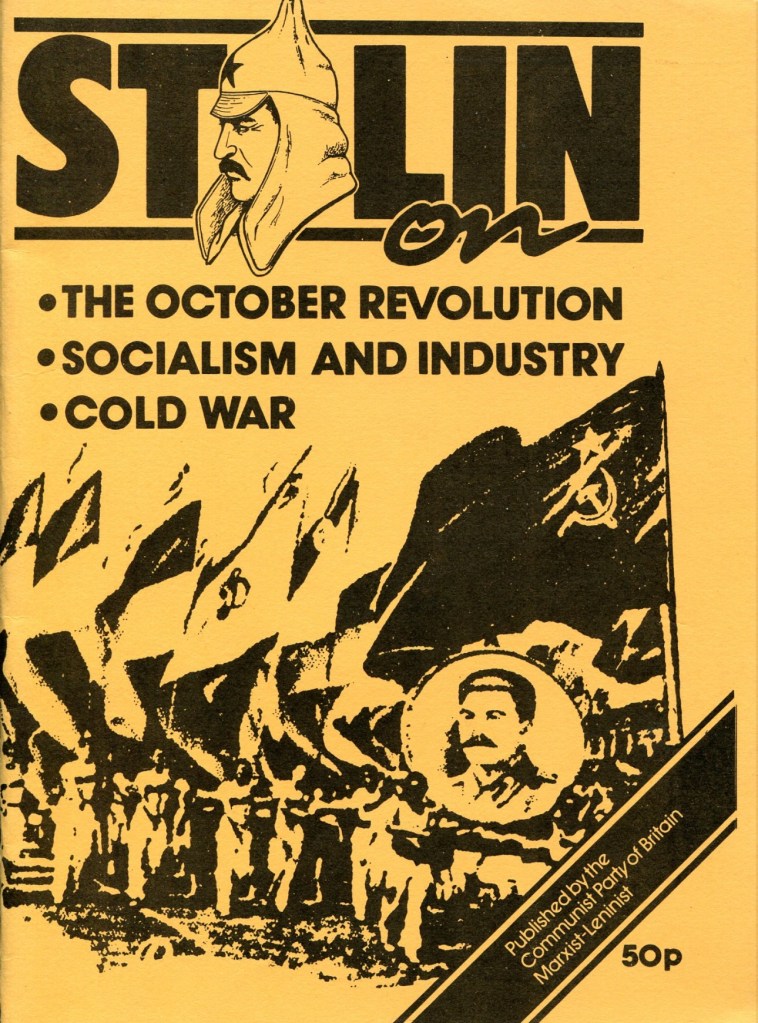
Stalin on: The October Revolution, Socialism and Industry, Cold War
Vladimir Lenin on Economic Disparity, Private Property, and the Need for Systemic Change
The Second Congress of the Communist International
In the United States of America food prices have risen, on the average, by 120 per cent, whereas wages have increased only by 100 per cent. In Britain, food prices have gone up by 170 per cent, and wages 130 per cent; in France, food prices—300 per cent,. and wages 200 per cent; in Japan—food prices 130 per cent, and wages 60 per cent (I have analysed Comrade Braun’s figures in his pamphlet and those of the Supreme Economic Council as published in The Times of March 10, 1920).
In such circumstances, the workers’ mounting resentment, the growth of a revolutionary temper and ideas, and the increase in spontaneous mass strikes are obviously inevitable, since the position of the workers is becoming intolerable. The workers’ own experience is convincing them that the capitalists have become prodigiously enriched by the war and are placing the burden of war costs and debts upon the workers’ shoulders. We recently learnt by cable that America wants to deport another 500 Communists to Russia so as to get rid of “dangerous agitators”.
Even if America deports to our country, not 500 but 500,000 Russian, American, Japanese and French “agitators” that will make no difference, because there will still be the disparity between prices and wages, which they can do nothing about. The reason why they can do nothing about it is because private property is most strictly safeguarded, is “sacred” there. That should not be forgotten, because it is only in Russia that the exploiters’ private property has been abolished. The capitalists can do nothing about the gap between prices and wages, and the workers cannot live on their previous wages. The old methods are useless against this calamity. Nothing can be achieved by isolated strikes, the parliamentary struggle, or the vote, because “private property is sacred”, and the capitalists have accumulated such debts that the whole world is in bondage to a handful of men. Meanwhile the workers’ living conditions are becoming more and more unbearable. There is no other way out but to abolish the exploiters’ “private property”.
Vladimir Lenin: “It is, of course, much easier to shout, abuse, and howl than to attempt to relate, to explain.”
Vladimir Lenin once remarked, “It is, of course, much easier to shout, abuse, and howl than to attempt to relate, to explain,” highlighting the value of constructive dialogue and education over emotional outbursts or hostile rhetoric. As a revolutionary thinker and leader, Lenin stressed the importance of articulating ideas and strategies clearly to foster understanding and rally support for the socialist movement.
He criticized those who relied on anger, insults, or simplistic slogans, arguing that such tactics undermined the more challenging but essential work of educating and persuading others. For Lenin, successful revolutionary efforts depended on thoughtful explanation, open dialogue, and the ability to engage with people on a rational level. This method was crucial for building a disciplined and informed movement capable of achieving lasting goals, rather than succumbing to fleeting emotional appeals or divisive strategies.
Ultimately, Lenin advocated for a deliberate and strategic approach to political struggle—one rooted in clarity, reason, and the empowerment of the working class through education and mutual understanding.
Musk Undercuts Trump’s Promise Not to Cut Social Security
Has he looked at TSLA recently? Or is he too busy “dismantling government bureaucracy“?
Musk Undercuts Trump’s Promise Not to Cut Social Security
Read More »Clara Zetkin: Only in Conjunction With the Proletarian Woman Will Socialism Be Victorious

The State: A Product of the Irreconcilability of Class Antagonisms
The State: A Product of the Irreconcilability of Class Antagonisms
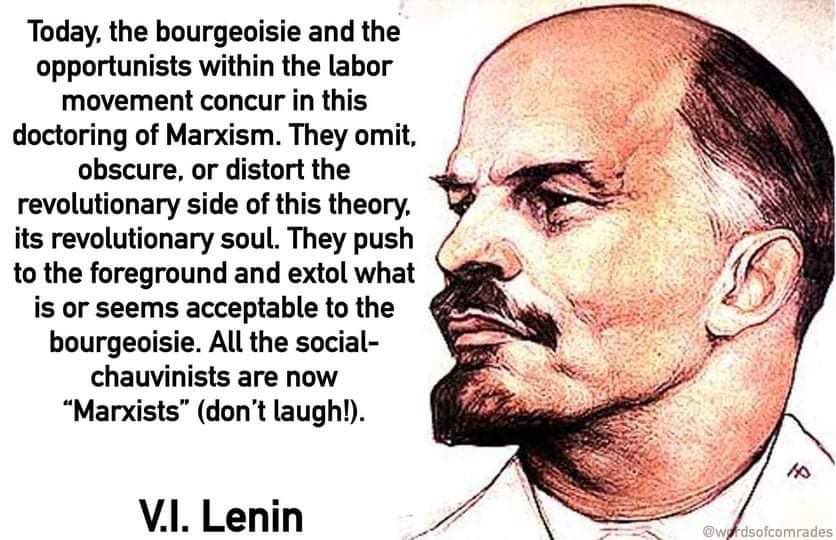
What is now happening to Marx’s theory has, in the course of history, happened repeatedly to the theories of revolutionary thinkers and leaders of oppressed classes fighting for emancipation. During the lifetime of great revolutionaries, the oppressing classes constantly hounded them, received their theories with the most savage malice, the most furious hatred and the most unscrupulous campaigns of lies and slander. After their death, attempts are made to convert them into harmless icons, to canonize them, so to say, and to hallow their names to a certain extent for the “consolation” of the oppressed classes and with the object of duping the latter, while at the same time robbing the revolutionary theory of its substance, blunting its revolutionary edge and vulgarizing it. Today, the bourgeoisie and the opportunists within the labor movement concur in this doctoring of Marxism. They omit, obscure, or distort the revolutionary side of this theory, its revolutionary soul. They push to the foreground and extol what is or seems acceptable to the bourgeoisie. All the social-chauvinists are now “Marxists” (don’t laugh!). And more and more frequently German bourgeois scholars, only yesterday specialists in the annihilation of Marxism, are speaking of the “national-German” Marx, who, they claim, educated the labor unions which are so splendidly organized for the purpose of waging a predatory war!
 Ms. Cat’s Chronicles
You must be logged in to post a comment.